One Designer Made the Same Deadly Car Twice. For Two Different Companies.
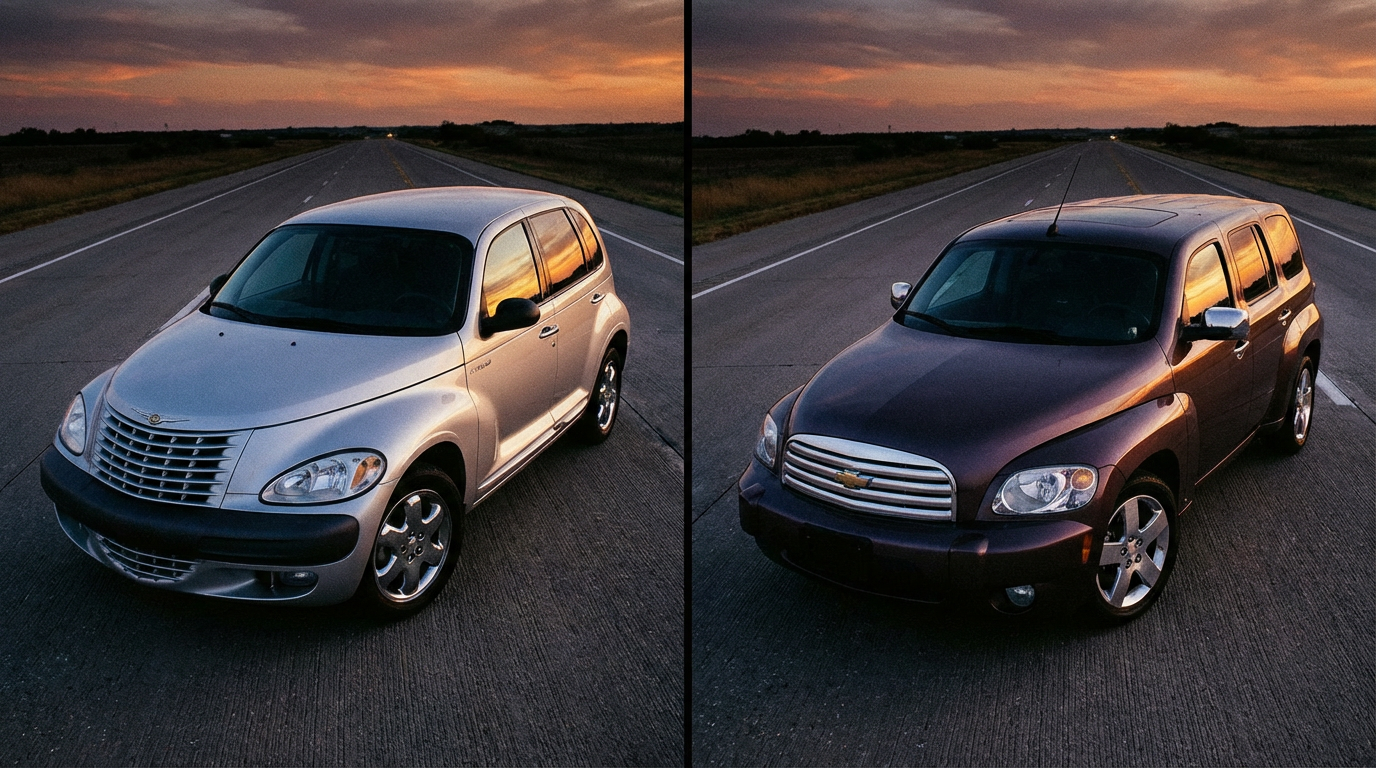
Let’s talk about what happens in the first 150 milliseconds — and what happens when the same person gets to make the same mistake twice. Bryan Nesbitt designed the Chrysler PT Cruiser as a young star at DaimlerChrysler. Then he left for General Motors and designed the Chevrolet HHR. Same retro-wagon concept. Same tall greenhouse, short hood, bulging fenders pulled from a 1940s delivery truck. Combined body count: 1,187 dead.
The PT Cruiser launched in 2000 and briefly became Chrysler’s bestseller — a postmodern hot rod for people who thought retro styling counted as a personality trait. It accumulated 653 fatalities from a fleet of 437,500 at a rate of 1.30 deaths per 100 million vehicle miles traveled. Not great, but survivable by early-2000s compact standards. Then Nesbitt took the same visual playbook to GM, and the 2006 HHR arrived looking like a PT Cruiser that had been fed nothing but protein shakes.
The HHR killed 534 people from a fleet of just 218,750 — half the cars on the road, producing a rate of 2.12 per 100M VMT. That’s 63% deadlier per mile than the PT Cruiser it was designed to compete with. Model year 2006 alone — the first year of production — claimed 55 lives. It never got meaningfully better: 2008 through 2011 averaged 42 deaths per model year from a rapidly shrinking fleet.
The impairment data adds insult to injury. The HHR’s combined impairment rate is 20.2% — right at the national average. The PT Cruiser’s is 18.8%, slightly below. Neither car has a particularly drunk or drugged-up driver pool. These are sober people dying in cars that simply couldn’t protect them. The HHR’s alcohol rate of 14.8% is higher than the PT Cruiser’s 12.9%, but the difference doesn’t come close to explaining a 63% gap in fatality rates.
The structural explanation is depressingly simple. The PT Cruiser was built on Chrysler’s PL platform, itself derived from the Dodge Neon — not a safety paragon, but at least a purpose-built automobile platform. The HHR was bolted onto GM’s Delta platform, shared with the Cobalt — a car so dangerous its ignition switch killed at least 124 people and triggered one of the largest recalls in automotive history. The HHR inherited the Cobalt’s crash structure and wrapped it in sheet metal shaped for aesthetics, not safety.
There’s something genuinely remarkable about the career arc here. Nesbitt designed a mediocre-safety retro car at Chrysler. Then he jumped to GM, got handed a worse platform, and designed an even deadlier version of the same concept. The Autopian profiled him when he became GM’s design chief in 2022, calling the PT Cruiser his “most famous work, for better or worse.” The HHR didn’t even get a mention. It rarely does. Chrysler discontinued the PT Cruiser in 2010. GM killed the HHR in 2011. Between them, they left 1,187 families with empty chairs at dinner.