The Chevy Cobalt Was a Death Trap Before GM Even Admitted It
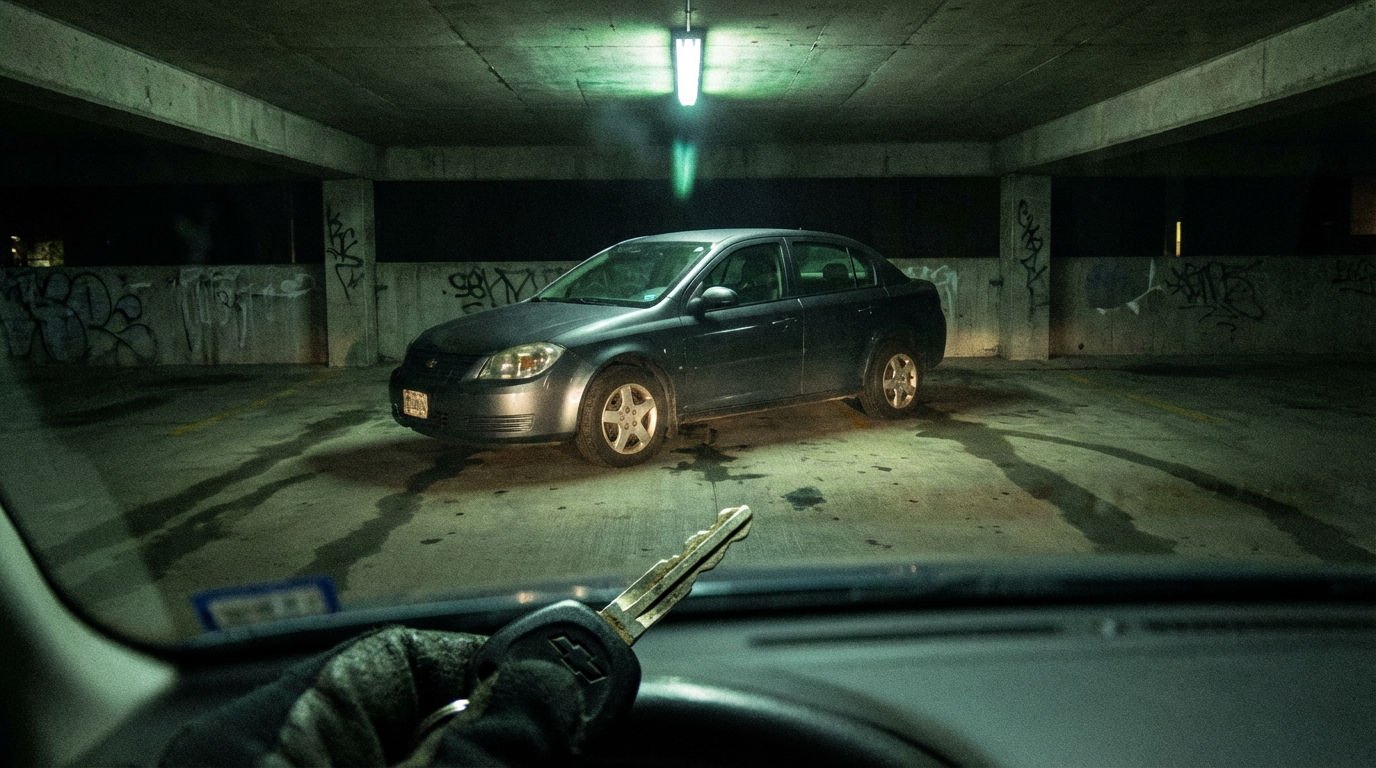
Let’s talk about what happens in the first 150 milliseconds — except when the car decides those milliseconds don’t matter.
The Chevrolet Cobalt has a fatality rate of 5.10 deaths per 100 million vehicle miles traveled. That makes it the deadliest compact sedan in the FARS database — worse than the Ford Focus (2.52), worse than the Nissan Sentra (2.13), worse than the Honda Civic (2.25). It’s not even close.
You probably remember why. In 2014, GM finally acknowledged what it had known since at least 2004: the Cobalt’s ignition switch could slip from “run” to “accessory” while driving, cutting engine power and — critically — disabling the airbags.[1] A heavy keychain, a bumpy road, a knee brushing the key. That’s all it took.
GM recalled 2.6 million vehicles. The company paid $900 million in criminal fines[2] and established a $625 million victim compensation fund. At least 124 deaths were directly linked to the defect.[1] But the FARS data tells a darker story: 1,540 total occupant fatalities[3] across just six model years of production (2005–2010).
The Model Year Breakdown
The 2006 model year alone accounts for 328 deaths — the most of any Cobalt year. The 2008 follows at 306, and the 2007 at 292. Even the final 2010 model year, after GM theoretically knew about the defect, saw 225 fatalities in the observation window.
The Replacement Test
Here’s where it gets damning. GM replaced the Cobalt with the Chevrolet Cruze in 2011. The Cruze has a fatality rate of 0.63 per 100M VMT. That’s an 8× improvement. Same manufacturer, same segment, same price point. The Cobalt wasn’t just a bad car — it was a generational failure of engineering ethics.
For comparison, the compact sedan class average sits around 2.0–2.5. The Cobalt is more than double the worst of its peers. The Civic (2.25), Corolla (1.85), and Elantra (1.50) all prove that building a safe small car was entirely possible in the same era.
The Uncomfortable Math
GM’s victim fund compensated 124 deaths linked to the ignition switch defect.[1] The FARS database records 1,540 total fatalities.[3] Even accounting for the fact that not every Cobalt death was caused by the defect, the gap between 124 and 1,540 raises a question that should make every safety engineer uncomfortable: how many of those other deaths happened because airbags that should have deployed didn’t?
We’ll never know. And that might be the most damning number in this entire database.
Sources & References
- Wikipedia, General Motors ignition switch recalls — timeline, death toll, recall scope, and victim compensation details. en.wikipedia.org
- U.S. Department of Justice, General Motors Agrees to Deferred Prosecution Agreement and $900 Million Financial Penalty, Sept. 17, 2015. justice.gov
- NHTSA, Fatality Analysis Reporting System (FARS), 2014–2023. All fatality counts, rates, and model-year breakdowns derived from FARS data. nhtsa.gov
- NHTSA, FARS Query System — custom queries for vehicle-level fatality data. cdan.dot.gov
- National Household Travel Survey (NHTS) — average annual VMT per vehicle used for rate estimation. nhts.ornl.gov
- IIHS, 2010 Chevrolet Cobalt Crash Test Ratings — "Good" frontal offset, "Acceptable" side impact. iihs.org
- Kenneth Feinberg, GM Ignition Switch Compensation Fund — 124 deaths, 275 injuries confirmed; $625 million in victim payouts. motortrend.com
- NHTSA, Recall Campaign 14V-047 (Feb. 2014) — Chevrolet Cobalt, Pontiac G5, Saturn Ion ignition switch defect; 2.6 million vehicles. nhtsa.gov/recalls