Your Car Was Designed to Save You in a Rollover. Not to See the Person in the Crosswalk.
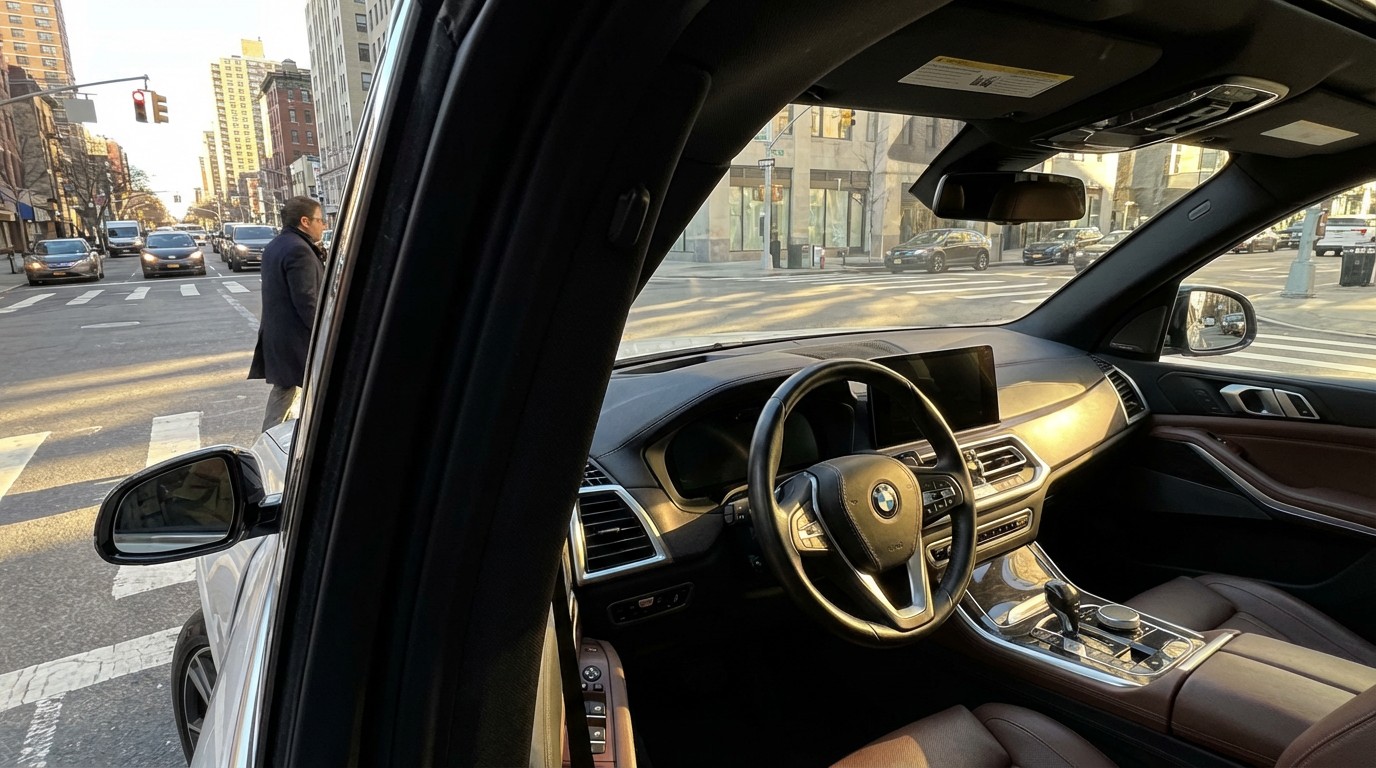
Every vehicle sold in America must survive being dropped on its roof. Federal Motor Vehicle Safety Standard 216 requires that the roof hold at least three times the vehicle’s weight without collapsing into the cabin. Automakers achieve this by making the A-pillars thick. Thick enough to channel crash forces around the passenger compartment. Thick enough to keep you alive when two tons of metal roll over at highway speed.
Also thick enough to hide the person standing in the crosswalk you’re turning into.
An IIHS study published in November 2025 measured the driver-side blind zones on 168 passenger vehicles and cross-referenced those measurements against approximately 4,500 police-reported pedestrian crashes across seven states. The finding: when the A-pillar blocks more than 30% of the driver’s leftward view, left-turn pedestrian crash risk rises 70% (statistically significant at p<0.05 after adjusting for vehicle type and driver demographics).[1]
Not a small effect. Not a marginal correlation buried in a regression table. Seventy percent.
What You Can’t See at the Intersection
When you turn left, your eyes scan through a narrow window between the A-pillar and the edge of the windshield. A pedestrian approaching from the left occupies that field of view for a fraction of a second before disappearing behind the pillar. If they’re walking fast enough, or if the pillar is wide enough, they might never appear in your visual field at all. You complete the turn. You hit someone you literally could not see.
IIHS researchers used a camera-based measurement technique on each of the 168 vehicles, calculating the angular width of the blind zone for two driver heights: 5’9” (the 50th-percentile American male) and 4’11” (the 5th-percentile American female). They measured three visibility factors:[2]
- Driver-side blind zone width: How many degrees of the leftward view the A-pillar blocks
- Forward field of view: The total windshield angle, temple to temple
- Nearest visible point: How far ahead you can see over the hood and dashboard
Every metric told the same story. Narrow the field of view below 85 degrees and left-turn crash risk rises 51%. Push the nearest visible ground point beyond 30 feet and crash risk rises 37%. Make the blind zone big enough and you get the full 70%.[1]
Interestingly, passenger-side blind zones showed no significant impact on right-turn pedestrian crashes. The geometry is different: right turns are slower, tighter, and the driver naturally looks into the turn. Left turns require scanning across oncoming traffic while simultaneously checking a crosswalk that sits in the A-pillar’s shadow.
The Engineering Paradox
Here is the problem nobody at NHTSA wants to say out loud: the features that save occupants are the features that kill pedestrians.
Thick A-pillars protect you in a rollover. Long hoods give you a larger crumple zone in a frontal crash. High beltlines improve side-impact protection. Every one of these design choices earned its spot through real crash data. They save lives. Specifically, they save the lives of people inside the vehicle.
They do not save the lives of people outside the vehicle. They make those lives harder to see.
IIHS President David Harkey acknowledged the bind directly: “The challenge for automakers will be to find ways to address them that don’t diminish the protection vehicles provide to their occupants in a crash.”[2] That sentence captures the regulatory dilemma. FMVSS 216 mandates roof strength. No federal standard mandates forward visibility. One standard has force of law. One has good wishes.
What a Five-Foot Woman Sees From an SUV
This is where the data takes an uncomfortable turn.
For the 5’9” driver, the average blind zone blocked 27% of the leftward view. Bad, but below the 30% threshold that triggers the 70% crash risk increase. For the 4’11” driver, the average blind zone blocked 33%. Above the threshold. Across all 168 vehicles measured.[1]
And the gap was worst in the vehicles most popular with American buyers.
For the taller driver, cars actually had the largest average A-pillar blind zones, while pickups had the smallest. Surprising, until you consider that truck cabs position the driver higher relative to the windshield base. But for the shorter driver, the hierarchy flipped: SUVs and pickups had the largest blind zones, the narrowest forward field of view, and the greatest distance to the nearest visible point.[1]
Put this together. American vehicle sales have shifted dramatically toward SUVs and trucks over the past fifteen years. Women represent a growing share of new vehicle purchases. A 5’1” woman driving a midsize SUV faces a meaningfully worse blind zone than a 5’10” man in the same vehicle. The market trend toward larger vehicles is simultaneously the trend toward worse visibility for shorter drivers. Nobody cross-referenced these two curves, but they’re both in the data.
7,314 Dead Pedestrians and Counting
Pedestrian deaths in America reached 7,314 in 2023, according to IIHS Fatality Facts. That is a 78% increase from the 2009 low of 4,109, though population grew only about 10% over the same period — meaning the per-capita pedestrian death rate has also risen sharply.[3]
We have covered pieces of this crisis before: the hood height epidemic, the hit-and-run crisis, the stroad speed convergence. Each investigation found a structural factor that contributes to the count. Hood height changes impact geometry. Hit-and-run involves driver behavior. Stroad design creates speed mismatches.
A-pillar blind zones add another layer: the vehicle itself prevents the driver from seeing the person they’re about to hit. Unlike distraction or impairment, this isn’t a failure of attention. It’s a failure of geometry. A driver can be sober, alert, looking in the correct direction, and still not see the pedestrian. The car is in the way.
What Works (and What Doesn’t)
Pedestrian automatic emergency braking works. IIHS data from 2022 shows that vehicles equipped with pedestrian AEB had a 27% lower rate of pedestrian crashes.[5] But most current AEB systems are calibrated for straight-ahead driving. They detect a pedestrian in front of the vehicle, moving laterally across its path. During a left turn, the vehicle’s trajectory changes mid-maneuver. Many AEB systems aren’t designed to handle that geometry.
Side-view cameras can compensate for A-pillar blind zones by showing the driver what the pillar hides. Some newer vehicles project camera feeds into the instrument cluster during turns. Effective, but not mandated. Not standard on most models.
Leading pedestrian intervals at traffic signals give pedestrians a 3-7 second head start before vehicles get the green. By the time a driver begins their left turn, the pedestrian is already in the crosswalk and visible, past the A-pillar’s shadow. Simple. Cheap. Effective. Deployed in some cities, ignored in most.
What doesn’t work: telling drivers to “look twice.” If the pedestrian is behind a structural pillar, looking twice shows you the same thing as looking once. Nothing.
A Standard That Doesn’t Exist
FMVSS 216 sets a measurable, enforceable roof-strength standard. Every vehicle must meet it. Engineers design around it. The standard has saved thousands of lives in rollovers.
No equivalent federal standard exists for driver visibility. No minimum forward field of view. No maximum A-pillar width. No requirement that the driver be able to see a 5-foot-tall object at a specific distance during a turn. IIHS has now provided the data showing that blind zones above 30% correlate with a 70% increase in pedestrian crash risk during left turns. The data exists. The standard does not.
Automakers will say that FMVSS 216 compliance requires thick A-pillars, and that any visibility standard would conflict with rollover protection. That’s probably true for current construction methods. It is not true as a permanent engineering constraint. Transparent A-pillar concepts, camera-based pillar overlays, and structural alternatives using advanced materials have all been demonstrated. None have been mandated.
So we have a system that protects occupants through engineering standards and protects pedestrians through suggestions. FMVSS 216 saved occupants by making pillars thick. The thick pillars hide pedestrians. 7,314 pedestrians died last year. The tradeoff is not hidden. It is structural. And the person in the crosswalk was never part of the calculation.
Methodology note: Blind zone measurements and crash risk analysis from Wen Hu et al., “Effects of driver direct visibility in passenger vehicles on the risk of turning crashes with pedestrians,” IIHS, November 2025. The study measured 168 vehicles using camera-based technique and analyzed ~4,500 police-reported pedestrian crashes across 7 states (crashes involving turning vehicles at intersections with speed limits ≤35 mph). Straight-moving crashes were used as controls to isolate the effect of blind zones from general vehicle characteristics. The 70% risk increase applies specifically to left-turn crashes where the driver-side blind zone exceeds 30% of the leftward view. Pedestrian fatality counts from IIHS Fatality Facts: Pedestrians, 2023. The height-gender observation regarding blind zone disparities is the author’s cross-referencing of the IIHS two-height measurement data with vehicle market share trends; the IIHS study measured visibility differences by height but did not frame them in terms of demographic purchasing trends. Pedestrian AEB effectiveness (27% reduction) from Cicchino 2022; most AEB systems studied were not specifically designed for turning scenarios. All crash statistics reflect reported incidents; actual crash totals may be higher due to underreporting, particularly in non-fatal pedestrian-vehicle conflicts.