The 40-Inch Line: Above It, Your Truck’s Front End Becomes a Pedestrian Death Machine
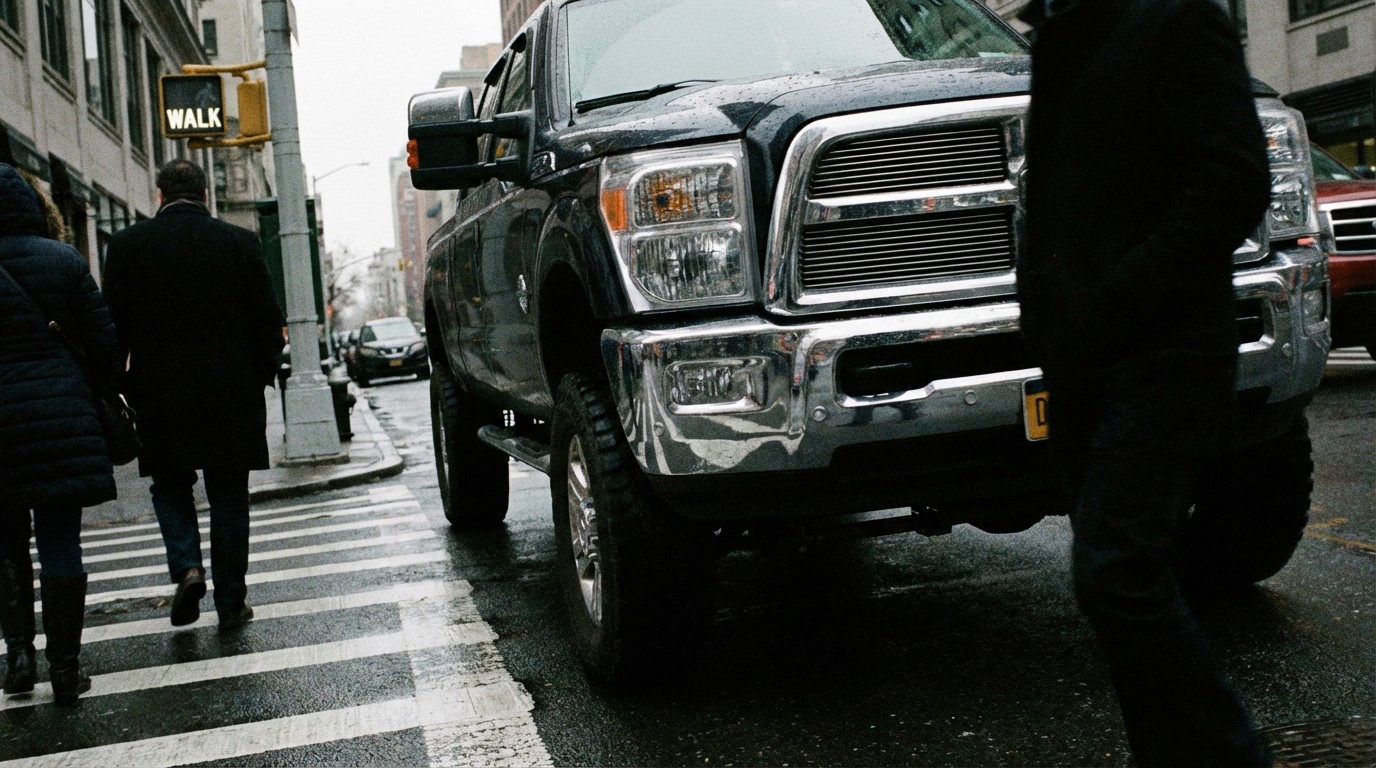
Stand in front of a 2024 Ford F-250 Super Duty. Look straight ahead. You are staring at the grille. The hood’s leading edge is 55 inches off the pavement. That’s taller than the roof of a Honda Civic. If you’re average height, the hood is at your sternum.[3]
Now imagine that truck is doing 35 in a school zone.
IIHS studied 17,897 single-vehicle-single-pedestrian crashes across 2,958 vehicle models and found a line in the data that automakers keep crossing: 40 inches. Above that hood height, with a blunt vertical front end, the pedestrian fatality risk jumps 45% compared to vehicles with hoods 30 inches or shorter and sloped profiles.[1]
Not 45% more injuries. Forty-five percent more deaths.
How a truck kills a pedestrian (it’s the geometry, not the mass)
When a sedan hits a pedestrian, the bumper catches the legs, the hood scoops the torso, and the person rolls up onto the windshield. Ugly. Survivable more often than you’d think. The body decelerates across two or three impact surfaces over a fraction of a second.
When a tall truck with a flat front end hits a pedestrian, the grille catches the torso directly. No scoop. No roll. The pedestrian gets launched forward or thrown under the vehicle. All that kinetic energy transfers into the chest and abdomen instead of distributing across the legs-to-hood-to-windshield sequence.[1]
IIHS broke it down further. Between 30 and 40 inches, shape still matters: blunt front ends at that height carry a 26% increased fatality risk. Sloped front ends in the same height range? No statistically significant increase at all. Below 30 inches, geometry barely matters. Above 40, the blunt-front combination is where pedestrians go to die.
And flat hoods (angle of 15 degrees or less from horizontal) add another 25% fatality bump regardless of height. Stack a tall hood, a blunt grille, and a flat hood angle and you’ve built a pedestrian-killing machine that just happens to also be a truck.
Light trucks now kill more pedestrians than cars do
GHSA’s 2025 report on 2024 pedestrian fatality data lays out the fleet-level consequences. Of the pedestrian fatalities where striking vehicle type was known, 54.1% involved light trucks (SUVs, pickups, and vans). Passenger cars accounted for 37.3%. Large trucks, 7.3%.[2]
That ratio didn’t exist twenty years ago. Light trucks overtook passenger cars as the primary pedestrian killer sometime around 2015, roughly tracking the moment the average new truck hood crept past 40 inches.
| Striking Vehicle Type | Share of Pedestrian Fatalities (2023) |
|---|---|
| Light trucks (SUVs, pickups, vans) | 54.1% |
| Passenger cars | 37.3% |
| Large trucks | 7.3% |
| Other/unknown | 1.3% |
Meanwhile, pedestrian deaths themselves have gone berserk. The U.S. hit 7,148 pedestrian fatalities in 2024. Down 4.3% from 2023’s record but still nearly 20% above 2016 levels and 80% above the 2009 low.[2] The overall vehicle fatality rate has been declining for decades thanks to airbags, crumple zones, and ESC. Pedestrian deaths went the other direction.
The trucks didn’t have to get this tall
Consumer Reports measured it: passenger truck hoods have grown an average of 11% taller since 2000. New pickups got 24% heavier in the same period. Front blind spots on some trucks now stretch 11 feet longer than a sedan’s.[3]
Ford’s own designers told Consumer Reports they shifted from softer lines because “customers prefer more purposeful looks.” GM said bigger grilles were needed for engine cooling when towing. Both of those are real engineering and market factors. Neither requires a 55-inch hood leading edge.
The F-250’s hood is taller than a five-year-old child is tall. A driver sitting behind that hood cannot see a pedestrian standing directly in front of the vehicle at distances under 15 feet. This isn’t a crash scenario. It’s a parking lot.
AEB is coming. It won’t fix this fast enough.
There’s a technology story running parallel to the geometry story, and it’s both encouraging and insufficient.
AAA tested pedestrian automatic emergency braking (AEB) systems in 2019 and got a 0% success rate at night. Zero. The systems couldn’t see pedestrians in the dark at all.[4]
By 2025, the retest showed 60% effectiveness at night. Toyota’s Camry hit 100%. Honda’s Accord managed only 40%. That’s a massive improvement in six years, but it leaves a 40% failure rate on the best-case average for a crash type where 75% of fatalities happen after dark.[2]
NHTSA has mandated pedestrian AEB for all new passenger cars and light trucks by September 2029, including nighttime detection up to 62 mph.[5] That’s good policy. It also means the current fleet will be accumulating pedestrian kills for another decade-plus of turnover. We wrote about fleet turnover lag before: the average vehicle on American roads is 12.6 years old. A mandate for 2029 new vehicles won’t reach fleet saturation until the early 2040s.
And AEB doesn’t change hood height. A system that brakes from 35 mph to 20 mph before impact is less deadly than 35-to-35. But a 45-inch blunt grille hitting a pedestrian at 20 mph is still significantly worse than a 28-inch sloped sedan hood at the same speed. The geometry problem survives the technology fix.
The counterargument (and why it doesn’t hold up)
The obvious pushback: light trucks make up a larger share of the fleet than ever. Of course they’re involved in more pedestrian deaths. It’s exposure, not design.
Fleet composition does matter. Trucks and SUVs went from about half of new sales in the early 2010s to 78% in 2023. More trucks on the road means more truck-pedestrian collisions. But the IIHS study controlled for this. Their 45% figure comes from a regression that isolates front-end geometry as an independent variable, holding speed, pedestrian age and sex, and other factors constant across 17,897 crashes.[1]
There’s also the smartphone-and-infrastructure argument: people walk more, stare at phones, cross mid-block, and American road design treats pedestrians as obstacles rather than users. All true. None of it explains why a tall truck kills at a 45% higher rate per crash than a short car. Behavior and infrastructure affect collision frequency. Hood geometry affects collision lethality.
Nobody regulates hood height
NHTSA regulates bumper height (sort of, for passenger cars only, and the standard is from 1979). It regulates lighting height. It just mandated AEB. It does not regulate hood height, front-end angle, or pedestrian-impact geometry for light trucks.
The European Union does. Euro NCAP has tested pedestrian head and leg impact protection since 1997. The EU’s General Safety Regulation requires “direct vision” standards for trucks that effectively cap hood height. When the same Ford F-150 crosses the Atlantic, it has to meet standards that constrain the very geometry IIHS identified as lethal.
In the U.S., the F-150’s hood can be as tall as Ford wants. The market rewards it. Buyers keep choosing trucks that look “purposeful,” and pedestrians keep absorbing the cost.
7,148 and counting
Here’s where this gets personal. Seventy-five percent of pedestrian fatalities happen after dark.[2] Twenty-five percent are hit-and-runs. The typical victim is crossing a road without a crosswalk, at night, in a place where sidewalks probably don’t exist. American road infrastructure was built for cars, not people, and when a person tries to exist near a road that wasn’t designed for them, the truck that arrives is taller, blunter, and heavier than anything the road was built for either.
We ran the aggressor-vehicle numbers last week and found that pickups kill more people outside the truck than inside it. This is the mechanism. It’s not just mass transfer in two-vehicle crashes. It’s a 55-inch wall of steel hitting an unprotected human at sternum height because the market decided hoods should look tough.
The 40-inch line exists in the data. IIHS drew it. Automakers keep building above it. And 7,148 pedestrians a year keep finding out what that means.
Methodology note
FARS captures only crashes involving at least one fatality. It does not capture pedestrian injuries, which outnumber fatalities roughly 10:1. The pedestrian fatality share by striking vehicle type (54.1% light trucks) comes from GHSA’s analysis of state-reported data for 2023 where vehicle type was identified; not all fatal crashes have complete vehicle records. The IIHS front-end geometry study used police-reported crash data (not limited to fatalities) across multiple states, giving it a broader severity range than FARS alone. Their 45% relative risk figure comes from a multivariate logistic regression controlling for impact speed, pedestrian age, pedestrian sex, and crash location. GHSA pedestrian fatality figures use state-reported early estimates and may be revised. Fleet composition percentages come from registration data cross-referenced with GHSA reporting. Hood height measurements are from Consumer Reports and manufacturer specifications, not standardized test protocols. The approximate 2015 crossover date for light trucks surpassing passenger cars in pedestrian fatality share is inferred from the trend in GHSA annual reports and is not a precise determination.