Zoox Recalled Every Car It Has. All 105 of Them.
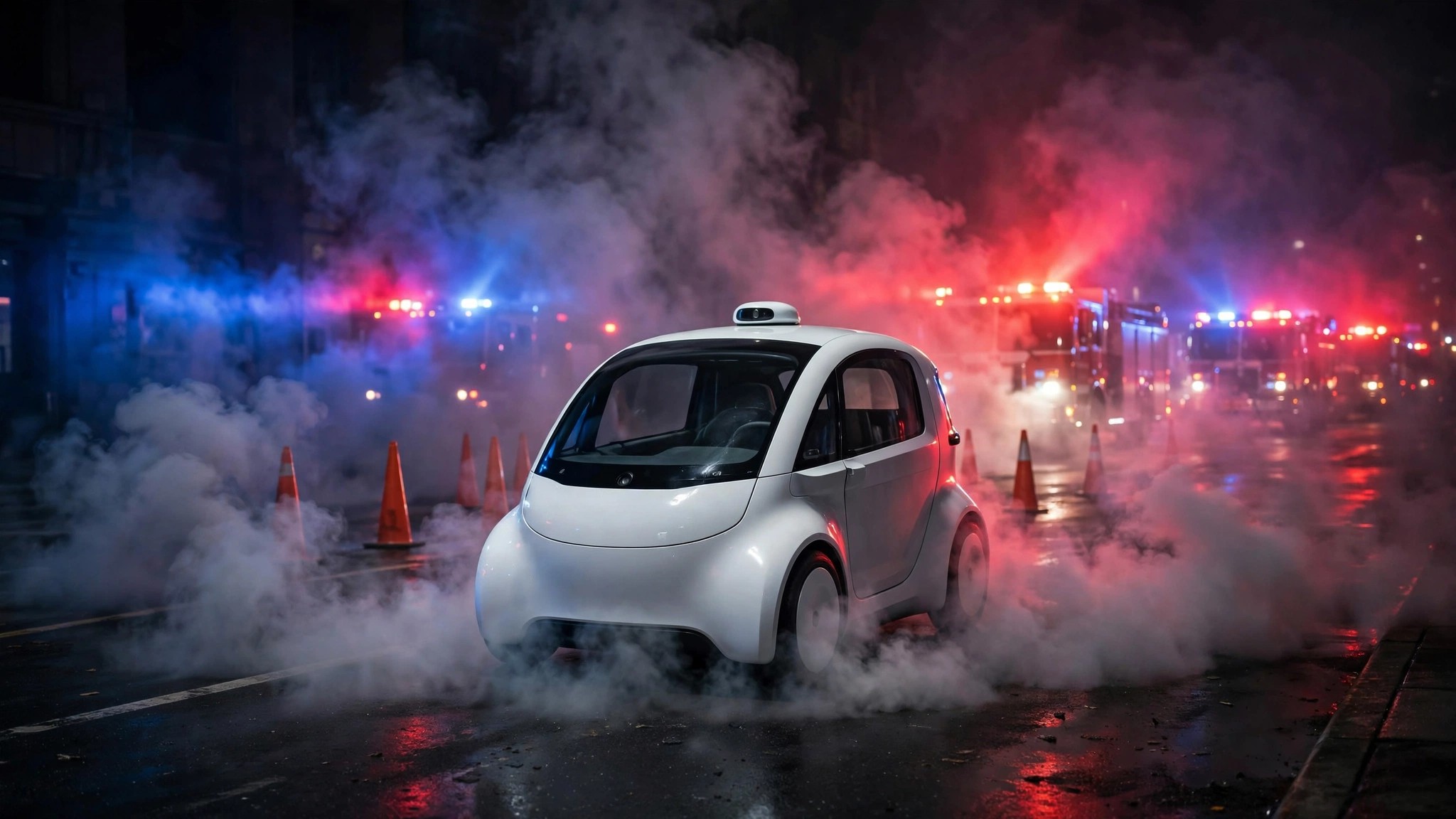
On June 20, an unmanned Zoox robotaxi rolled into a wall of smoke from an active fire and kept going. It hard-braked inside the scene, tried to steer out, and froze. A remote human operator reversed it. Firefighters dropped traffic cones behind it like tombstones. Nobody was hurt. And on July 17, Amazon's self-driving unit did the only thing it could: it recalled every vehicle it owns.
Not 105,000. Not 1.05 million. A hundred and five autonomous vehicles, every Zoox currently operating on American roads. That recall covers the company's complete inventory because the software deficiency that let one car blunder into a fire scene exists in all of them.[1]
The timing was pointed. Nine days earlier, NHTSA Administrator Jonathan Morrison had published a letter to the entire autonomous vehicle industry documenting what he called "a clear pattern" of driverless cars interfering with first responders. AVs driving directly into active emergency scenes. Blocking the paths of ambulances and firefighters. Failing to recognize flashing lights, flares, smoke, fire, and traffic cones.[2] Morrison gave the industry until the end of July to present solutions. Zoox responded in nine days with the most honest possible answer: we have a problem, here is a recall, and the fix is a software update.
Credit where it's earned. Proactive recall, no injuries, no crashes, fast turnaround. That is how the system is supposed to work.
But step back. Zoox could recall every car overnight precisely because of how its fleet works. These are software-defined vehicles on a software-defined fleet. The smoke-detection failure wasn't a broken sensor or a corroded wire. It was a gap in the perception stack. The car's AI literally did not understand that dense smoke meant "do not enter." Morrison's letter was blunt about this: "Emergency scenes are not rare or extreme 'edge cases.'"[3] Smoke, flares, a firetruck with its lights on. These are the most visually obvious situations on a road.
A broader pattern makes the Zoox incident look less like a one-off and more like a species-level blind spot. Waymo vehicles have reportedly blocked fire stations in San Francisco. San Francisco Fire Chief Patrick Rabbitt said the problem has gotten worse, not better. In Austin, Waymo cars froze at emergency scenes and ignored first responders' hand signals. In Texas, both NHTSA and the NTSB are investigating Waymo vehicles that passed stopped school buses with their lights activated.[4] Morrison's language was unusually direct for a regulator: "An AV that cannot safely interact with first responders is a danger to the general public."[2]
What none of the recall documents capture is the indirect toll. When a robotaxi blocks a fire lane for ninety seconds, that delay doesn't appear in any crash database. FARS tracks fatal crashes. It does not track the minutes added to a response time because an autonomous vehicle sat in the path of an ambulance while its remote operator figured out what to do. Those minutes are invisible in the data. They are not invisible to the person waiting inside a burning car.
The scale question nobody wants to answer
Zoox has 105 vehicles and generated one emergency-scene incident. Waymo has roughly 700 vehicles and has accumulated a documented pattern of them. Scale these fleets to the tens of thousands that full commercial deployment requires, and the math gets uncomfortable. A single-digit percentage incident rate at 105 vehicles is a manageable embarrassment. That same rate at 50,000 vehicles is a systemic hazard.
The industry's counterargument is valid and should be stated at full strength: human drivers impede emergency vehicles too. They rubberneck. They freeze. They fail to yield. The difference is regulatory. Morrison noted that human drivers who impede emergency operations face fines and jail time. An AV that does the same thing gets a software update and a recall number.[3]
What this means for you
If you live in a city with autonomous vehicles operating, the practical takeaway is straightforward: these vehicles are not yet reliable around emergency scenes. If you see a robotaxi near an active fire, accident, or police scene, give it a wider berth than you would a human driver. It may stop unpredictably, reverse without warning, or simply sit in a lane while its remote operator takes control.
Morrison's letter gave the industry until the end of July. That deadline is twelve days away. Zoox's recall was one answer. What the rest of the industry does will determine whether autonomous vehicles earn back the assumption of competence that NHTSA just publicly revoked.
Sources & References
- Reuters, “Zoox recalls self-driving cars because they may not detect smoke,” July 17, 2026. reuters.com
- NHTSA, “Trump’s Transportation Department to AV Developers: ‘An Automated Vehicle That Cannot Safely Interact With First Responders is a Danger to the General Public,’” July 8, 2026. nhtsa.gov
- TechCrunch, “Feds demand autonomous vehicle companies stop interfering with first responders,” July 8, 2026. techcrunch.com
- Engadget, “NHTSA Calls Out Autonomous Cars For Interfering With First Responders,” July 9, 2026. engadget.com
Limitations: Only one confirmed Zoox incident precipitated this recall; the broader pattern documented by NHTSA covers multiple AV operators. FARS does not track AV-specific crashes or emergency scene interference. A fleet of 105 vehicles is too small for meaningful statistical analysis of incident rates. Delayed emergency response times caused by AV interference are not captured in any federal crash database.