A $120,000 Camera Catches 82% of Wrong-Way Drivers Before They Kill Anyone. Most States Don't Have One.
I ran the numbers on wrong-way crashes. A 17-year FARS analysis found 302 wrong-way fatal crashes per year on divided highways, killing an average of 409 people annually across 6,953 total fatalities from 2004 to 2020.[1] Ohio DOT quantified the asymmetry: wrong-way incidents are 0.3 percent of all crashes and 40 times more likely to end in death.[2] Two vehicles closing at a combined 140 mph produce the kind of collision where the coroner, not the paramedic, makes the first call.
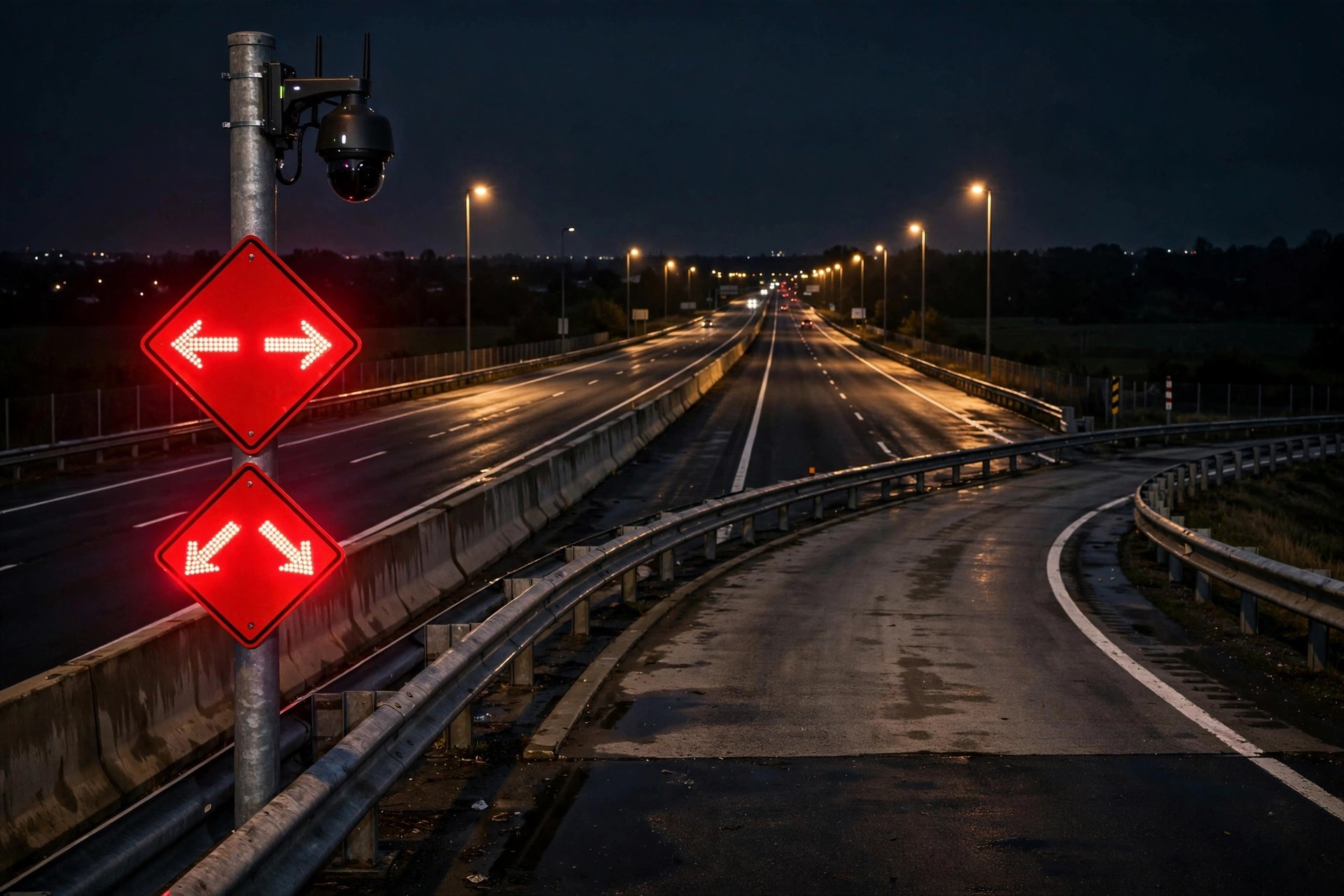
Connecticut decided to stop counting bodies and start counting cameras. After State Representative Quentin Williams was killed by a wrong-way driver in January 2023, the legislature required the DOT to install detection systems on 120 high-risk exit ramps, and the agency built 211 at approximately $120,000 per unit with $4,500 annual maintenance. Since August 2023, those cameras have detected 680 wrong-way drivers, and 82.5 percent self-corrected when triggered flashing signs lit up. The remaining 17.5 percent generated instant alerts with live video to the Highway Operations Center and State Police.[3] Connecticut's wrong-way fatalities went from 23 in 2022 to thirteen last year to one so far in 2026.
Rhode Island ran the same experiment cheaper: $600,000 across 24 high-risk locations, 47 wrong-way incidents detected, and zero crashes at equipped sites.[4] Not low. Zero. Columbus, Ohio, is installing 30 cameras at $3.4 million total, using a three-box visual trigger that catches wrong-direction movement and alerts the always-staffed traffic management center within seconds, down from what Ohio DOT described as "miles and minutes."[2]
There are roughly 65,000 interstate ramps in the United States.[5] Fewer than 300 have detection cameras. Even targeting the riskiest 10 percent would cost approximately $780 million at Connecticut pricing. That is 10.4 percent of the $7.5 billion the Infrastructure Investment and Jobs Act allocated for highway safety improvements.[6] NHTSA values a statistical life at $13.2 million. Preventing 60 wrong-way fatalities per year pays back the entire targeted deployment in one year. The cost-per-life-saved lands around $37,000, which is less than the average new-car transaction price in 2025.
Sixty percent of wrong-way drivers test positive for alcohol.[7] Peak window: midnight to 4 a.m. Last week in Cleveland, England, a wrong-way driver killed seven people including two police officers on a dual carriageway.[8] In May, a Ford F-150 carrying Modelo tall boys entered I-40 the wrong direction near Yukon, Oklahoma, and hit a Ford Fiesta head-on. Four teenagers died. The F-150 driver survived.[9] Reflective signs did not save anyone in either crash.
If you drive between midnight and 4 a.m. on a divided highway, stay in the leftmost lane of your direction of travel. A wrong-way driver traveling in what they believe is the left lane occupies your right lane. Maximizing that buffer is the single most effective personal action available. It is not in any state driver's manual. It should be.
Counterargument: Detection cameras do not prevent wrong-way entry; they compress response time. If a head-on collision happens within 30 seconds of ramp entry, no camera system intervenes fast enough. The structural fix is median barriers on every divided highway, roundabouts replacing diamond interchanges, and physical channelization that makes wrong-way entry geometrically impossible. Connecticut's 82.5 percent self-correction rate may also reflect selection bias: drivers who notice flashing signs may not have been dangerously impaired.
Limitations: FARS does not specifically tag wrong-way crashes; the 302-per-year figure relies on coded manner-of-collision and road-type fields from a 2024 Journal of Safety Research analysis covering 2004 to 2020. The $120,000 figure is Connecticut-specific and excludes fiber backhaul costs in rural states. Camera effectiveness data comes from pilot deployments, not randomized controlled trials. Connecticut's fatality decline could partially reflect regression to the mean after a high-fatality 2022. Not all wrong-way entries occur at instrumented ramps.
Sources & References
- “Comprehensive analysis of trends, distribution, and odds of wrong-way driving fatal crashes on divided highways in the United States (2004–2020),” Journal of Safety Research, 2024. doi.org
- Ohio DOT, wrong-way detection camera deployment, Columbus, June 2026. Via The Columbus Dispatch. dispatch.com
- Connecticut DOT, wrong-way detection system results, via GovTech, November 2024 (John Tarr presentation). govtech.com
- Rhode Island DOT, wrong-way detection deployment results, via Traffic Technology Today, 2018. traffictechnologytoday.com
- Federal Highway Administration, Interstate System highway statistics. fhwa.dot.gov
- Infrastructure Investment and Jobs Act, Public Law 117-58, Highway Safety Improvement Program. fhwa.dot.gov
- NTSB Special Investigation Report, “Wrong-Way Driving,” December 2012; AAA Foundation for Traffic Safety, March 2021. ntsb.gov
- Reuters, “Seven dead including two police officers in wrong-way crash in Cleveland, England,” August 22, 2026. reuters.com
- The Oklahoman, “Mississippi man charged with four counts of murder in Oklahoma wrong-way collision,” May 29, 2026. oklahoman.com