850 People Died in Work Zones Last Year. Four Out of Five Weren't Wearing Orange.
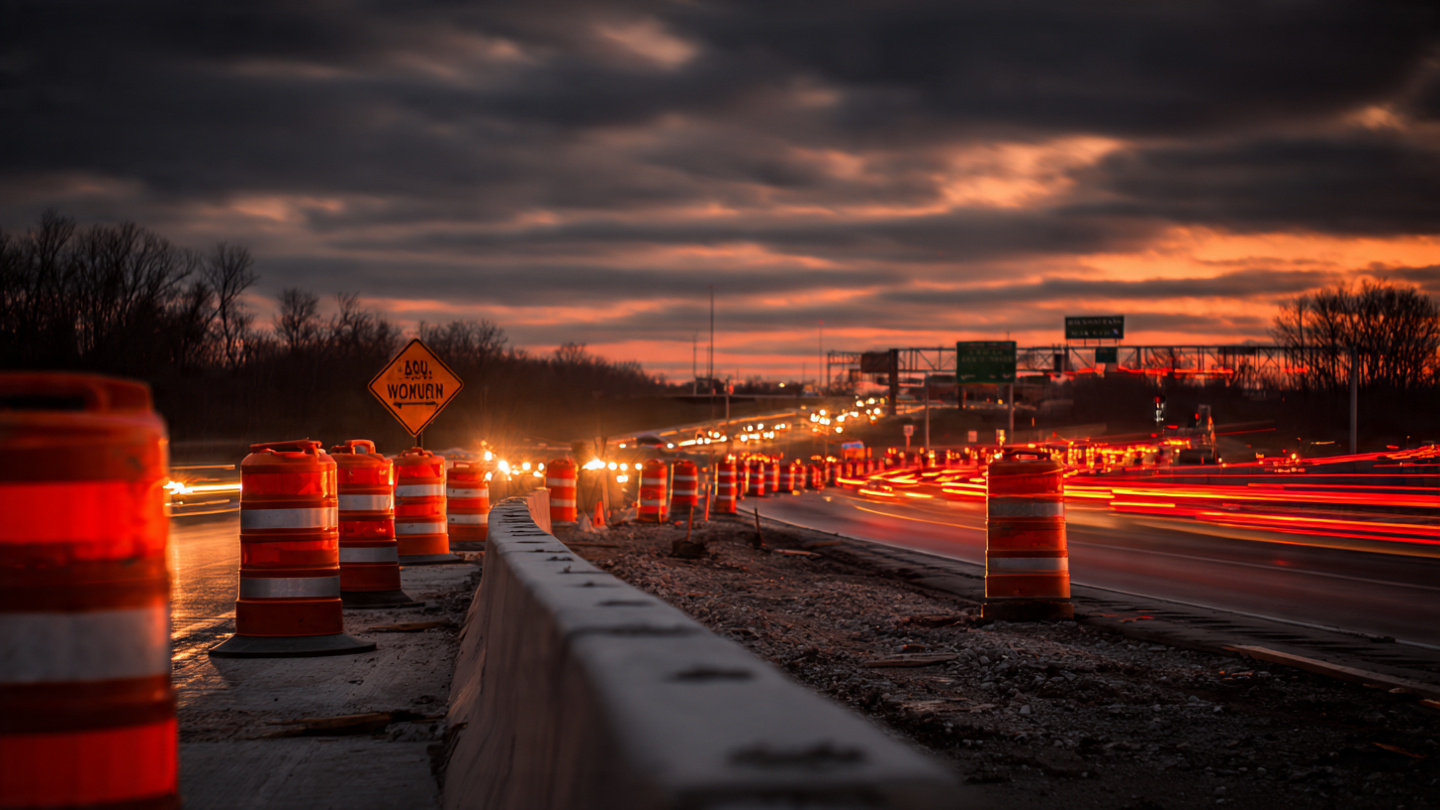
On Friday afternoon, a charter bus plowed into stopped traffic on I-81 in Virginia, killing five people and injuring forty-four more in a crash that, according to the NTSB, showed little evidence of braking.[1] It happened in a work zone. And the people who died weren't construction workers standing behind orange barrels, because that is almost never who dies in work zones.
The Federal Highway Administration published the number in April: 850 people were killed in work zone crashes across the United States in 2024.[2] FHWA noted that "nearly 20%" of those victims were pedestrians, construction workers, maintenance crews, or utility workers. Run the arithmetic on that and you land somewhere around 680 dead motorists and passengers who were just trying to get through the cones. The CDC's five-year breakdown of work zone fatalities from 2016 through 2020 confirms the ratio is durable: 62% drivers, 19% passengers, 16% pedestrians.[3] Workers on foot are a minority of their own safety statistic.
Nobody builds a memorial for the motorists. The entire policy apparatus around work zone safety, from National Work Zone Awareness Week to the $500,000 FHWA training initiative announced this spring, frames the problem as protecting the crews inside the barrels.[2] That framing is understandable because a construction worker standing on asphalt has zero protection if something goes wrong at 70 miles per hour, and 126 workers per year die at road construction sites because of exactly that physics problem.[3] But it obscures the uncomfortable math: for every worker killed, roughly four motorists die in the same zones, hitting the same barrels, slamming into the same stopped queues that nobody upstream was monitoring.
The I-81 crash is textbook for this pattern. E&P Travel Inc., a North Carolina charter company with four buses and 11 drivers, had been incorporated for barely two years when its bus rear-ended traffic that had backed up in a construction zone.[4] The company carried a "satisfactory" FMCSA safety rating despite a prior English language proficiency violation logged against one of its drivers in September 2025.[5] NTSB board member Tom Chapman told reporters investigators were looking at "speed limit signs and work zone design" and whether the growing backup was being monitored at all.[1] That last question cuts deeper than driver error: the Associated General Contractors of America surveyed its members this spring and found 55% of highway contractors say work zone crashes pose a greater risk now than a year ago, while only 4% say risk has declined.[6] More than half of those who experienced crashes said projects were delayed for multiple days, and forty percent want more severe penalties while thirty-nine percent say the penalties already exist but nobody enforces them.
The five-year CDC data reveals what kinds of drivers die in these zones. Speeding was a factor in 31% of fatal work zone crashes, alcohol in 28%, distraction in 13%.[3] Thirty percent of all fatal work zone crashes involved a large truck. Nearly half of all work zone deaths clustered in five states: Texas, Florida, California, Georgia, and Illinois. Michigan alone logged 6,000 work zone crashes in 2025, killing 22 motorists and 3 workers, injuring over 1,000 people.[7] Two more MDOT workers were killed on U.S. 127 near Holt on May 27, three days before the I-81 crash that made national headlines.
The problem has a geometry no training program can fix: highway work zones create abrupt speed differentials between moving traffic and stopped queues, funneled into narrowed lanes with reduced sight distances, and they rely on the same distracted, impaired, or simply inattentive driving population that kills 40,000 people annually on open road to suddenly exercise discipline behind the cones. Work zone fatalities have hovered between 800 and 900 per year for a decade while the national mileage death rate has dropped 23% since its 2021 peak.[8] The zones are getting left behind.
What you should actually do
Check your route before you leave, because Google Maps and Waze both flag active work zones. If you see brake lights stacking ahead of orange signs at highway speed, that is the single most dangerous moment in a work zone, not the narrow lane, not the barrier two feet from your mirror, but the transition from 65 to zero that happens faster than most drivers process it. Maintain the gap ahead of you so that when the queue materializes, you have distance to work with instead of a physics problem with no solution. And if you drive a commercial vehicle through construction zones: your stopping distance at 70 mph is roughly twice what you think it is, and the NTSB file on I-81 will eventually confirm that.
Sources & References
- CNN, “Bus driver in crash that killed 5 people, injured 44 on Virginia interstate charged with involuntary manslaughter,” May 31, 2026. cnn.com
- FHWA, “Trump’s Transportation Department Highlights Importance of Safe Driving during National Work Zone Awareness Week,” April 22, 2026. highways.dot.gov
- CDC/NIOSH, “Behind the Wheel at Work, Vol. 7, No. 1: Motor vehicle crash deaths in work zones 2016–2020.” cdc.gov
- Associated Press via WVLT, “Bus hits cars in Virginia, killing 5 people and injuring 34, state police say.” May 30, 2026.
- New York Post, “Virginia bus crash that killed 5 involved non-English speaking driver who got license in NY, says Sean Duffy,” May 31, 2026. nypost.com
- Associated General Contractors of America, “Highway Contractors Report Growing Dangers In Work Zones,” May 2026. agc.org
- Lansing State Journal / Michigan DOT, “Two MDOT workers killed in US 127 crash near Holt,” May 27, 2026.
- NSC, “February 2026 Preliminary Crash Fatality Estimates,” 2026. injuryfacts.nsc.org; Wikipedia, “Motor vehicle fatality rate in U.S. by year.” wikipedia.org