For Every Person a Ram 2500 Kills, 4 of Them Are in the Other Car
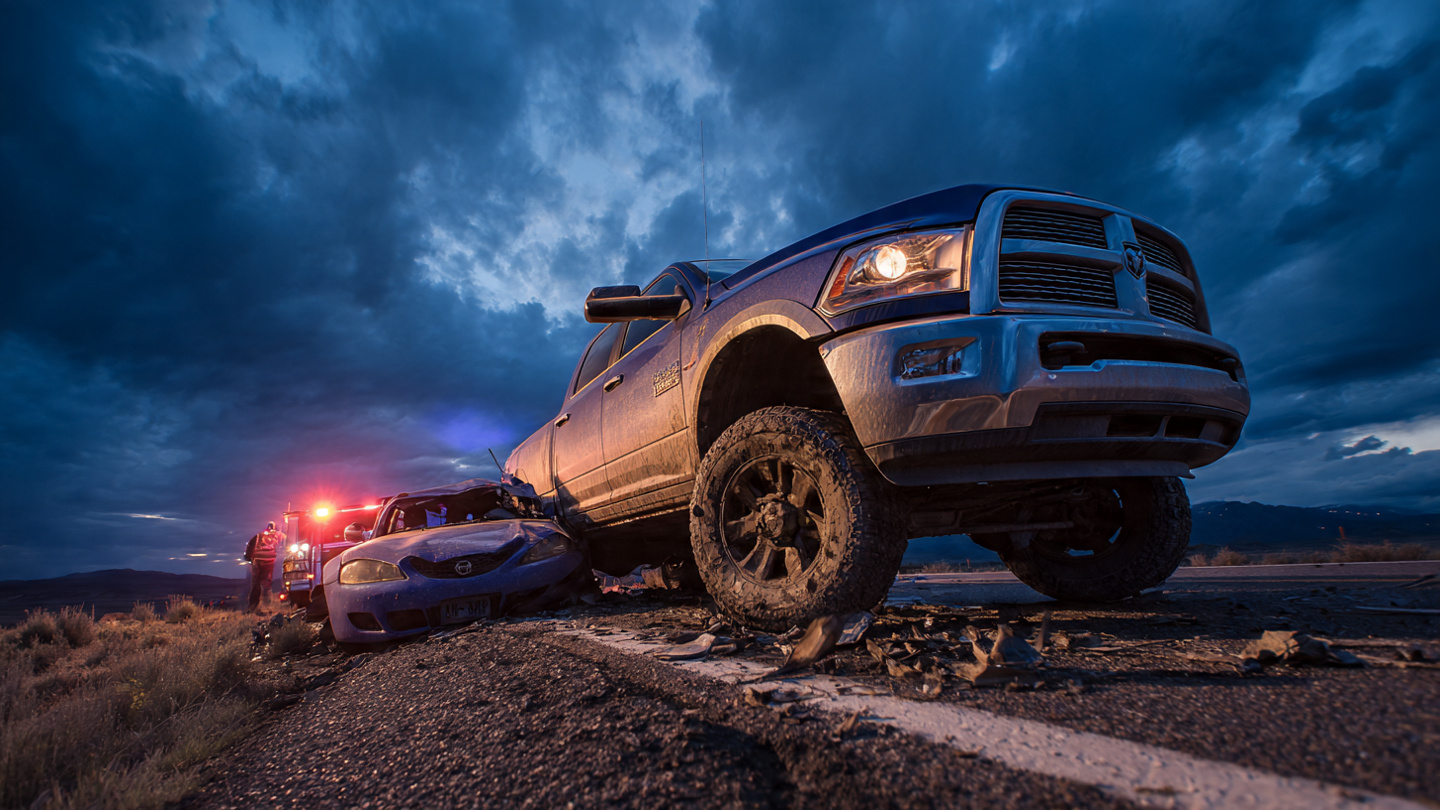
FARS tracks every fatality in every fatal crash on American roads and which vehicles were involved in each one. Divide one by the other and you get a number nobody publishes: the occupant death ratio, or how often a vehicle's own occupants die when that vehicle is present at a fatal crash. For the Ram 2500, that number is 0.205.[1] In roughly 80% of fatal crashes involving a Ram 2500, the person who dies is not inside the Ram.
At the opposite end sits the Chevrolet Cavalier at 0.857. In 86% of its fatal crashes, the Cavalier's own occupant is the one who dies. The Dodge Neon is right behind it at 0.856, then the Buick LeSabre at 0.823 and the Chevrolet Cobalt at 0.808. Every vehicle near the top of this list is a small, light sedan that absorbs the physics its crash partner dishes out. Every vehicle near the bottom is a truck that weighs two to three times as much.
None of this is complicated, and Newton's second law does not require a peer reviewer. When a 6,400-pound Ram 2500 collides with a 2,600-pound Cavalier, the deceleration forces distribute according to the mass ratio, and the lighter vehicle absorbs roughly 2.5 times the energy per pound of structure. The Ram's crumple zones barely engage while the Cavalier's passenger compartment becomes the crumple zone.
Roll this up by vehicle class across 82,290 fatal crashes involving pickups between 2014 and 2023, and the aggregate numbers are damning. Pickup occupants died in those crashes 39,897 times. The remaining fatalities, roughly 42,400 over the decade and approximately 4,200 per year, were pedestrians, cyclists, or occupants of the other vehicle.[1] The class-level occupant death ratio for pickups is 0.485, which means that for every pickup occupant who dies in a fatal crash, slightly more than one person in something else dies too. Sedans come in at 0.644, sports cars at 0.672.
A February 2025 IIHS study quantified the mechanism behind these numbers with unusual precision.[2] Below the fleet-average curb weight of 4,000 pounds, every additional 500 pounds of vehicle mass reduces the driver's own death rate by 17 per million registered vehicle years while increasing the crash partner's death rate by just 1, a tradeoff that clearly favors the buyer. Above 4,000 pounds, the math inverts catastrophically: every additional 500 pounds reduces the driver's death rate by only 1 but increases the crash partner's death rate by 7. IIHS senior statistician Sam Monfort summarized it in a sentence that should be printed on every truck window sticker: "Choosing an extra-heavy vehicle doesn't make you any safer, but it makes you a bigger danger to other people."[2]
So here is the moral architecture of the American road, rendered in federal data: a Ram 2500 driver who buys that vehicle for its perceived safety is purchasing protection that comes almost entirely at the expense of everyone around them, and the physics of the purchase produces barely any marginal benefit to the buyer once the vehicle exceeds 4,000 pounds. NBER researchers estimated the externalized cost of vehicle weight at $93 billion annually, roughly 27 cents on every gallon of gasoline in damage inflicted on other road users.[3] That cost is invisible at the dealership. The Cavalier driver whose front end collapses into the footwell pays it in full on the highway.
Meanwhile 97% of late-model pickups now weigh more than 4,000 pounds, up from 91% a decade earlier.[2] The fleet is getting heavier in the exact weight range where additional mass provides the least benefit to the buyer and the greatest danger to everyone else. IIHS found that pickups are still nearly twice as likely as cars to kill the other driver in a two-vehicle crash, even after a decade of voluntary front-end redesigns that improved structural compatibility.[2]
What to do with this
If you drive a sedan or compact, the data says one thing clearly: avoid the vehicles at the bottom of the occupant death ratio list. The Cavalier, Neon, Cobalt, and LeSabre absorb the most punishment in multi-vehicle crashes. Check IIHS ratings at iihs.org/ratings before buying, and prioritize vehicles with Good structural ratings in the updated side and front overlap tests. If you currently drive one of these high-ratio sedans, it will not protect you in a collision with anything larger. That is not fixable with aftermarket parts or careful driving.
If you are shopping for a pickup, the 4,000-pound threshold is the number that matters. Every pound above it buys you almost nothing in crash survival while making you measurably more dangerous to every other vehicle on the road. The midsize segment (Tacoma, Ranger, Colorado) sits closer to that threshold than the full-size and heavy-duty classes. If you do not tow regularly, the physics case for a Ram 2500 over a Tacoma is nonexistent.
Limitations
The occupant death ratio computed here uses total FARS fatalities associated with a given vehicle model divided by the number of fatal crashes involving that model. FARS does not break out which fatalities belong to which vehicle in a multi-vehicle crash, so the ratio is a proxy, not a direct measurement of whose occupant died. Single-vehicle crashes, where the only possible fatality is the vehicle's own occupant or an unrestrained passenger, pull the ratio toward 1.0 for all vehicles. The signal is strongest in the gap between classes, not in individual model-to-model comparisons within a class. We also cannot separate pedestrian and cyclist fatalities from crash-partner vehicle occupant fatalities in this dataset.
Strongest counterargument
Pickups serve functional purposes that require size and weight: towing, payload, work-site durability. A 6,400-pound truck pulling a 10,000-pound trailer needs the mass for stability and braking authority. Penalizing vehicle weight would punish the contractor, the rancher, the family hauling a boat on vacation. This is a legitimate argument for the subset of pickup owners who actually tow. NHTS survey data suggests that subset is roughly 25% of pickup owners in any given year. The other 75% bought a physics advantage they do not functionally need, and someone in a Cavalier might die for it.
Sources & References
- NHTSA, Fatality Analysis Reporting System (FARS), 2014–2023. Occupant death ratios computed from per-model deaths and fatal crash involvement counts. nhtsa.gov
- IIHS, “Supersizing vehicles offers minimal safety benefits — but substantial dangers,” February 2025. iihs.org
- Anderson, M.L. and Auffhammer, M., “Pounds That Kill: The External Costs of Vehicle Weight,” NBER Working Paper No. 17170. nber.org
- IIHS, Vehicle Size and Weight topic page. iihs.org
Source: NHTSA FARS 2014–2023. Occupant death ratios are computed from model-level deaths and crash-involvement counts in our FARS dataset; they do not isolate single- vs. multi-vehicle crashes. See methodology for caveats.