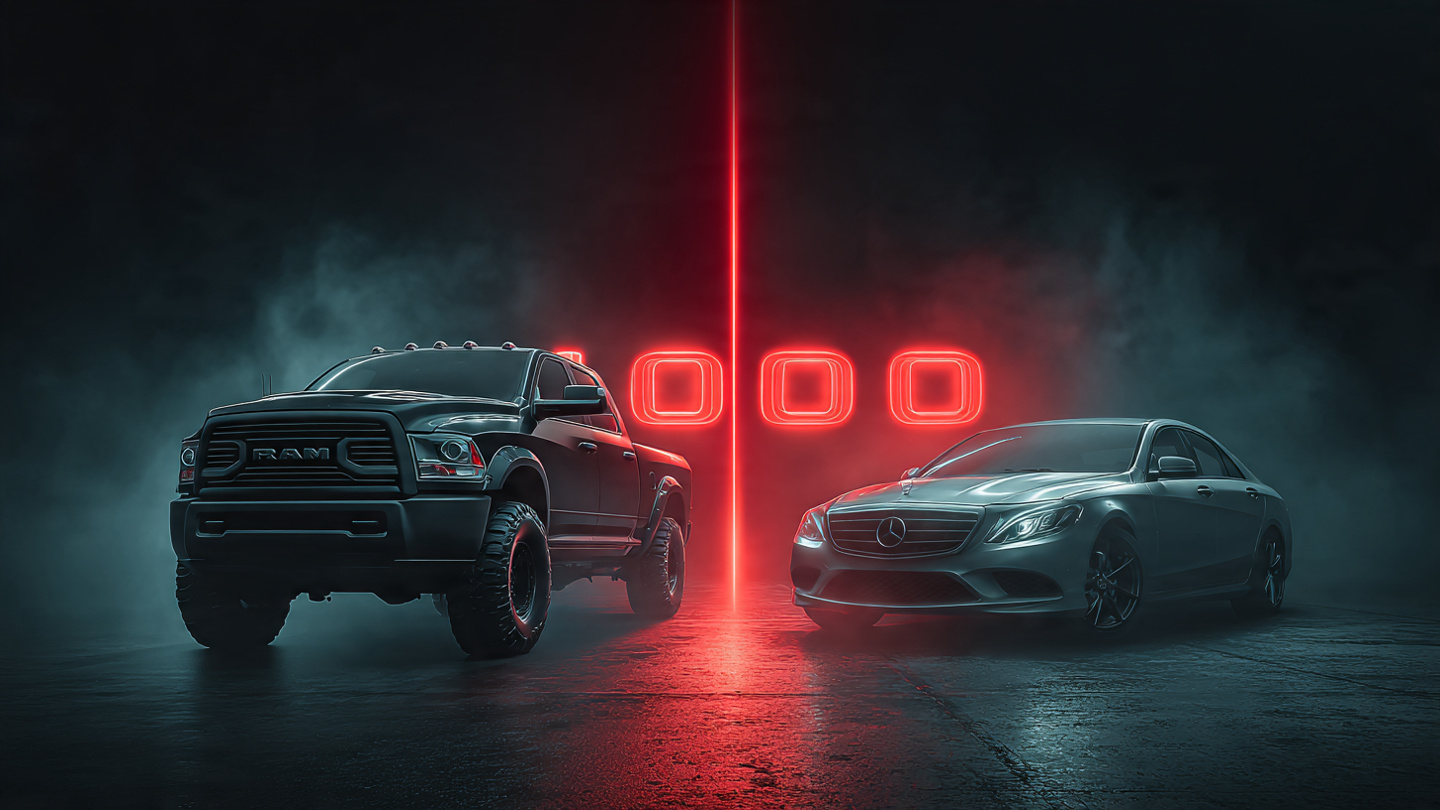
At 4,000 Pounds, Your Vehicle Stops Getting Safer. It Just Gets Deadlier.
Samuel Monfort at IIHS spent two years cross-referencing FARS crash data with curb weights for every 1-to-4-year-old vehicle involved in a two-vehicle fatal crash between 2011 and 2022. His finding should be tattooed on the forehead of every truck marketing executive in Detroit: 4,000 pounds is the inflection point where adding vehicle weight stops protecting the driver and starts primarily killing the person in the other car.[1]
Below that line, the engineering math works in your favor. A lighter car gaining 500 pounds saw its driver death rate drop by 17 points while barely nudging the crash partner's risk by a single point. Excellent energy management. Above 4,000 pounds, those numbers invert. Five hundred more pounds of truck buys the driver almost nothing but substantially raises the odds of killing whoever they hit.[2] You're no longer buying protection. You're buying a weapon with heated seats.
We validated this independently with our FARS data using a completely different metric: deaths-per-fatal-crash-involvement for each vehicle class. Sedans: 64.5%. Sports cars: 68.1%. When these vehicles appear in a fatal crash, roughly two-thirds of the time it's their own driver who dies.[3] Pickups: 48.9%. Barely half. For every pickup driver killed, roughly one other person dies instead.
Zoom into the pickup class and the plateau becomes visible at the model level. Ford Ranger at ~4,200 pounds: self-lethality ratio of 0.690. Ford F-150 at ~4,800 pounds: 0.458. A massive 34% self-protection improvement for 600 extra pounds of steel and frame engineering. Now keep adding weight. Ram 2500 at ~6,500 pounds: 0.205.[3] Nearly 1,700 more pounds than the F-150, and the self-protection gain is shrinking fast. All that extra mass isn't absorbing into crumple zones designed for the driver. It's transferring through the other car's crumple zones, which were never engineered to handle it.
Credit where it's earned: Monfort's data shows design changes are doing real work. Pickups killed car crash partners at 2.5 times the rate of other cars in 2011-2016. By 2017-2022, that dropped to 1.9 times. Heavy SUVs over 5,000 pounds went from 1.9 times to 1.2 times.[1] Front-end geometry improvements, lower bumper heights, AEB systems. Good engineering solving problems that bad engineering created.
But structural redesigns can't repeal F=ma. In our FARS dataset, the Ram 2500 appeared in 748 fatal crashes between 2014 and 2023. In only 153 did the Ram driver die. That leaves 595 fatal crashes where the Ram walked away and somebody else went to the morgue. Compare the Chevrolet Cavalier: 1,225 deaths in 1,429 fatal crash involvements, self-lethality of 85.7%.[3] A 2,600-pound Cavalier meeting a 6,500-pound Ram 2500 isn't a crash. It's a physics demonstration with a body count.
How We Measured This
Self-lethality ratio = (vehicle-occupant deaths) / (total fatal crash involvements) from FARS 2014-2023. A ratio of 1.0 means the vehicle's occupant dies in every fatal crash involvement. A ratio near 0.2 means someone else dies 80% of the time. We mapped approximate curb weights by model from manufacturer specs. Monfort's IIHS study (PMID 40100638) used a different approach: driver fatality rates per registered vehicle year, restricted to 1-4 year old vehicles in two-vehicle crashes. Both methods independently converge on the same inflection zone.
What This Doesn't Prove
Our FARS self-lethality metric includes all crash types and all vehicle ages, not just Monfort's 1-4 year old two-vehicle subset. Single-vehicle crashes (rollovers, fixed objects) may have different weight dynamics entirely. We assigned approximate curb weights by model rather than pulling actual crash-recorded weights. Low-volume models carry wider confidence intervals. Seatbelt use, speed, crash type, and driver demographics are uncontrolled.
The Counterargument That Actually Holds Up
Weight still matters when you hit something that doesn't move. Rollovers, concrete barriers, trees. Monfort's study only examined two-vehicle crashes. Roughly 30% of fatal crashes are single-vehicle, and those could follow a different weight-protection curve. If you're in rural Montana and your primary crash risk is road departure at 65 mph into a Douglas fir, the plateau might sit higher than 4,000 pounds for your specific threat model.
What You Can Do
If you're vehicle shopping, understand where the diminishing returns hit. A 3,800-pound Highlander or Outback captures nearly all the mass-based self-protection benefit physics can offer. Stepping up to a 5,000-pound F-150 adds marginal safety for you and measurable danger to everyone sharing the road. A 6,500-pound Ram 2500 adds almost nothing for you and plenty for your county's trauma surgeons. Check IIHS crashworthiness ratings at iihs.org/ratings for scores that measure structural design, not just mass. Cross-reference with our FARS data at vehicle-safety.org to see how specific models actually perform when the physics test is real.
Sources & References
- Monfort, S.S. (2025). “Crash incompatibility between cars, SUVs, and pickups in 2017-2022.” Traffic Injury Prevention, 26(6):697-702. PubMed
- IIHS, “Vehicle Size and Weight.” iihs.org
- NHTSA, Fatality Analysis Reporting System (FARS), 2014–2023. Self-lethality ratios computed by The Crash Report from deaths and crash-involvement counts per vehicle model. nhtsa.gov
Source: NHTSA FARS 2014–2023; IIHS Monfort (2025). Self-lethality ratios are computed from deaths per fatal-crash involvement. Curb weights are approximate manufacturer specifications. See methodology for caveats.