170 Million Miles of Proof That Robots Drive Better. Then Someone Moved a Cone.
Waymo has now driven 170.7 million fully autonomous miles without a human behind the wheel, and in March it published the most comprehensive autonomous vehicle safety dataset ever assembled: 92% fewer serious-injury-or-worse crashes than human drivers across the same road types and geographies.[1] A peer-reviewed study in Traffic Injury Prevention validated the core finding at 56.7 million miles, showing statistically significant reductions across all three injury severity levels, with intersection crashes down 96% and single-vehicle airbag-deployment crashes eliminated entirely.[2] Four million miles a week, with one serious-injury crash prevented every eight days. Two hundred human lifetimes of driving compressed into a dataset that, by any honest reading, constitutes the strongest evidence for autonomous vehicle safety ever produced.
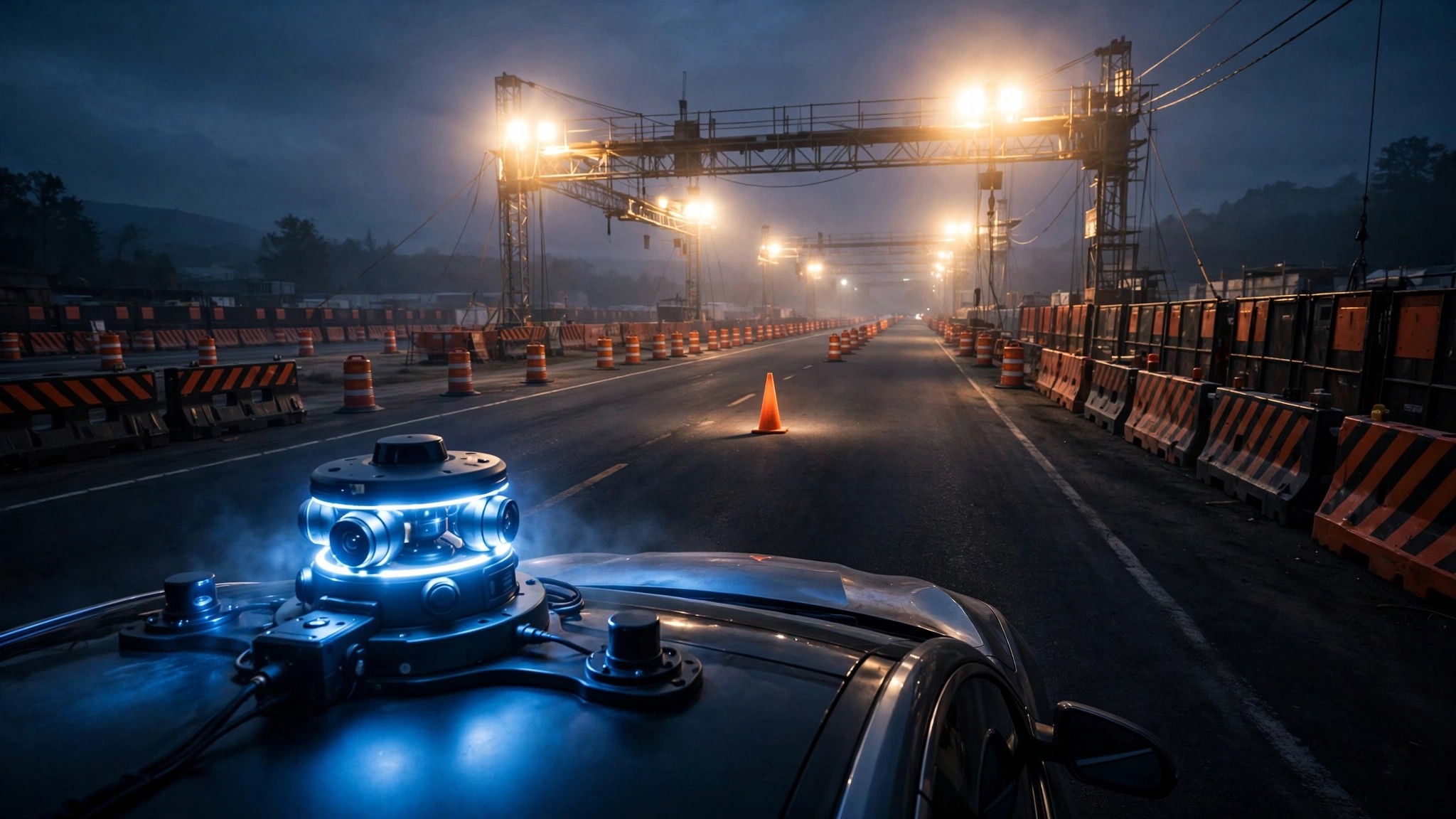
On June 8, Waymo filed its sixth safety recall with NHTSA. This time, 3,871 vehicles equipped with the fifth-generation Automated Driving System were pulled off every freeway in the country because the cars kept driving into active construction zones at highway speed.[3] Twelve incidents triggered the recall. Five in Phoenix, where Waymo cars blew past ramp closure signs and entered pre-planned freeway work zones. Seven in the Bay Area, where vehicles threaded between orange cones marking closed lanes as if the cones were suggestions rather than boundaries.
Read that juxtaposition again. Slowly.
The machine that is statistically, demonstrably, peer-review-confirmedly better than you at driving cannot tell whether a road is closed when there are cones on it. Not occasionally. Not in edge cases at the margins of perception. In twelve documented incidents across two metropolitan areas, the system that reduces intersection crashes by 96% looked at a wall of orange barrels and decided the lane was open.
NHTSA's recall report describes the failure mechanism with a specificity that makes it worse: the ADS "may enter and drive at speed in freeway construction zones due to inappropriately prioritizing the avoidance of other freeway hazards and/or failing to recognize the construction zone."[3] Translation: the car saw the cones, identified them as objects to avoid, and then drove around them into the work zone rather than stopping before them. It solved the wrong problem perfectly.
Work zones are not a footnote in American traffic safety. FHWA data shows 850 people died in work zone crashes in 2024, and four out of five victims were drivers and passengers, not construction workers wearing high-visibility vests.[4] These zones represent exactly the kind of chaotic, high-consequence driving environment where a superhuman autonomous system should, in theory, provide the greatest benefit. Lane markings vanish and speeds drop without warning. Barriers materialize where medians used to be, and temporary signs sometimes contradict the permanent ones they replaced. Human drivers kill each other in these zones at alarming rates precisely because the cognitive load spikes and the physical environment becomes unpredictable.
Waymo's 92% figure does not cover this environment. At all. The company's own safety dashboard specifies that its analysis covers surface-street driving in its operating cities. When Waymo released Atlanta-specific data in June showing 94% fewer airbag-deployment crashes over 5.4 million miles, it noted that Waymo vehicles are prohibited on most of Atlanta's major highways.[5] The denominator of the safety claim excludes the roads where the hardest driving happens. That is neither fraud nor deception, but it is a structural limitation that nobody seems eager to headline.
I want to be precise about what this means, because the lazy read is "robots bad, humans good," and the lazy read is wrong. Waymo's surface-street record is extraordinary, and nobody else in the industry publishes data this transparent, subjects it to peer review, or voluntarily recalls vehicles before a regulator forces them to. The six recalls are not evidence of failure; they are evidence of a company that reports failures rather than burying them in firmware updates and blaming the driver. Tesla, by comparison, dropped the word "Autopilot" in January 2026 after a California court ruled the name misled consumers, is currently under two separate federal investigations for a June crash in Katy, Texas that killed a 76-year-old woman, and settled a separate FSD-involved fatality lawsuit this month without disclosing terms.[6][7] Waymo's transparency is genuinely admirable by industry standards.
But admirable transparency does not resolve the architectural problem. An autonomous vehicle is, at its core, a system that compares sensor input against a pre-built model of the world and then acts on the delta. On a surface street where the curbs, lanes, signs, and signals match the high-definition map, that comparison is easy. Construction zones are the precise inverse: environments defined by the fact that the map no longer matches the road. The cones are the message that everything behind them has changed. Waymo's system saw the cones, classified them as obstacles, and maintained its model of the road that existed before the cones were placed. It treated the territory as if the map were still correct. Twelve times.
Waymo says a software fix is coming and that it has restricted freeway operations in the interim. Fair enough. Construction zone detection is a solvable engineering problem, and I expect Waymo will solve it more reliably than most human drivers eventually do. But the episode reveals something deeper: the environments where autonomous driving is easiest are also the environments where humans already drive the most safely, and the environments where autonomous driving is hardest are where humans die at the highest rates. The 92% improvement is real, and it is also concentrated in the conditions that needed it least.
If you ride with Waymo today, know that the vehicle is restricted to surface streets, which is where the safety data applies and where the machine genuinely outperforms you. If you drive your own car through a construction zone on a freeway tonight, understand that you are operating in an environment that the most advanced autonomous driving system in the world just admitted it cannot handle. Adjust your speed, put the phone down, and pay attention to the cones. Right now, in that specific moment, you are the only safety system available, and the data says 850 people a year prove that you are not very good at it either.
Sources & References
- Waymo, “From the Road” safety update, March 19, 2026. 170.7 million autonomous miles, 92% fewer serious-injury-or-worse crashes. waymo.com
- Victor, T. et al., “Comparison of Waymo Rider-Only crash rates by crash type to human benchmarks at 56.7 million miles,” Traffic Injury Prevention, 2025. PMID 40378124. pubmed.ncbi.nlm.nih.gov
- NHTSA, Waymo recall filing, June 2026. 3,871 vehicles, 5th Gen ADS, construction zone entry defect. nhtsa.gov/recalls
- FHWA, Work Zone Safety Facts and Statistics, 2024. 850 work zone fatalities; approximately 80% motorists and passengers. ops.fhwa.dot.gov
- Waymo, Atlanta safety data release, June 2026. 5.4 million autonomous miles, 94% fewer airbag-deployment crashes. waymo.com/safety
- Reuters, “US opens probe of fatal Tesla crash into Texas home,” June 23, 2026. NHTSA special crash investigation, Katy, TX. reuters.com
- TechCrunch, “Tesla settles FSD crash lawsuit as federal investigations continue,” June 26, 2026. techcrunch.com