The Average Car on the Road Is 12.8 Years Old. So Is the Average Car in a Fatal Crash.
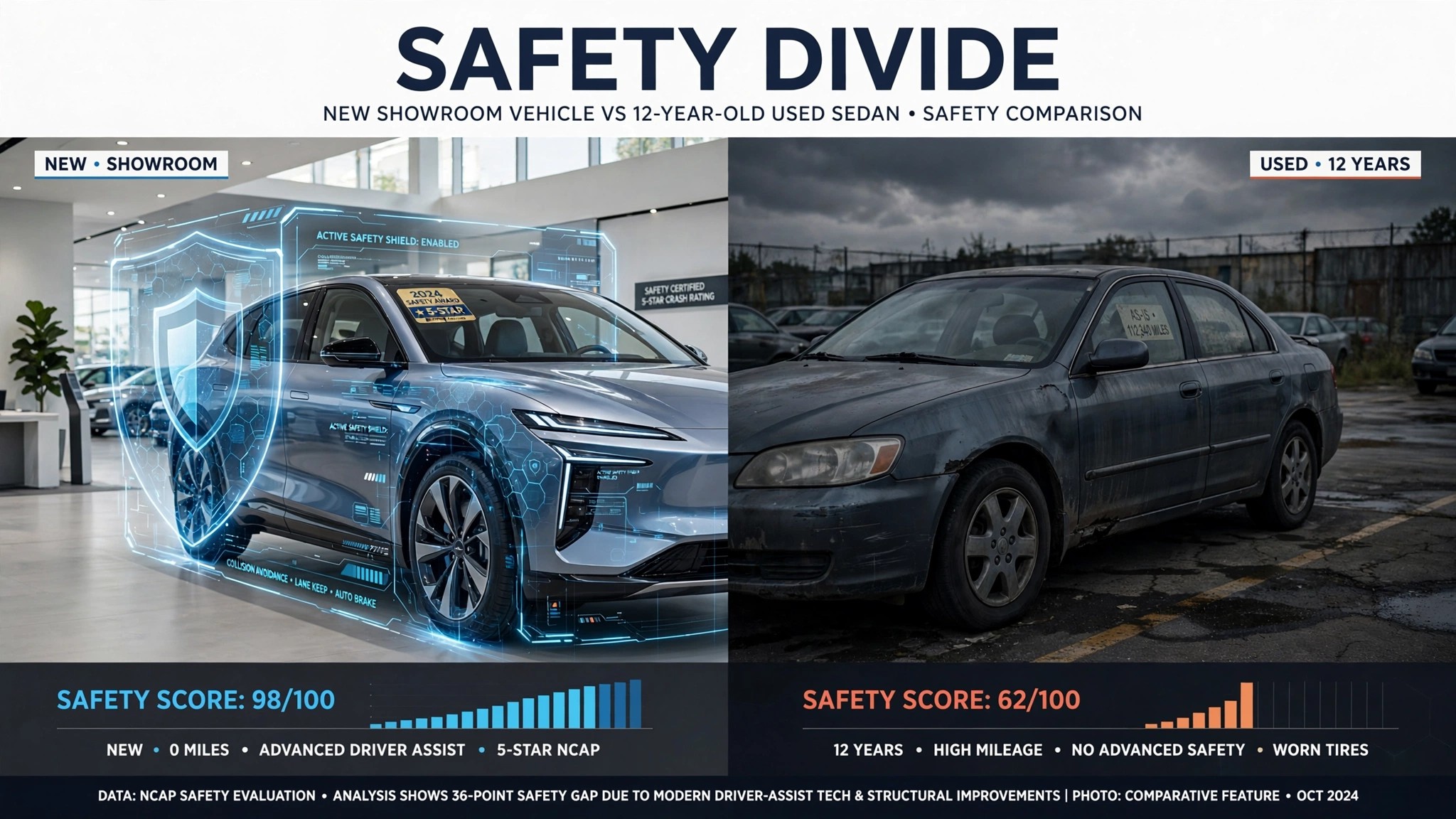
S&P Global Mobility put out a number this year that should bother everyone and will bother almost nobody. The average light vehicle on American roads is now 12.8 years old, a record. Passenger cars specifically average 14.5 years. A record too. The 289 million vehicles rolling across this country were, on average, built when Barack Obama was running for his second term.[1]
FARS put out a number that matches it almost exactly. Nobody in the industry has connected the two.
Run the Fatality Analysis Reporting System data across a decade of crashes (2014 through 2023, 177,284 fatal-vehicle deaths, 337 tracked models) and sort by the age of the vehicle at the time of the crash. A distribution emerges that should be projected onto the wall of every auto show keynote in the world:[2]
| Vehicle Age | Deaths | Share |
|---|---|---|
| 0–2 years | 15,998 | 9.0% |
| 3–5 years | 20,226 | 11.4% |
| 6–8 years | 18,734 | 10.6% |
| 9–11 years | 24,665 | 13.9% |
| 12–14 years | 32,925 | 18.6% |
| 15–17 years | 28,797 | 16.2% |
| 18–20 years | 19,146 | 10.8% |
| 21+ years | 16,793 | 9.5% |
Two-thirds of all traffic fatalities happen in vehicles 10 years old or older. 65.8% of deaths, to be precise. Vehicles under three years old account for 9%. Nine percent. The new-car showroom, with its Top Safety Pick stickers and its five-star crash ratings and its confident salespeople, protects less than a tenth of the fatal fleet. A person driving a 12-year-old car is dying in a vehicle that never had electronic stability control mandated for it, never had a backup camera required, never saw AEB as standard equipment, and was crash-tested to standards that have since been tightened twice.[3]
ESC alone saves an estimated 2,202 lives per year, according to IIHS research. NHTSA mandated it for model year 2012. A 2011 model is now 15 years old and sitting squarely in the second-deadliest age bracket. Vehicles built before that mandate account for 134,491 deaths in our FARS dataset. Post-mandate vehicles account for 52,567. A 2.6-to-1 ratio that understates the gap, because newer vehicles have had fewer cumulative exposure years.[4]
Which vehicles dominate the death peak? Not exotics. Not muscle cars. Not anything with a reputation for danger. The 10 vehicles with the most fatalities in the 12-to-15-year bracket are the Silverado, F-150, Accord, Impala, Civic, RAM, Camry, Altima, Trailblazer, and Corolla. Every one is a bread-and-butter nameplate that nobody warns you about. Every one was the most affordable option at its dealership a decade ago. Every one is now the backbone of the used-car market, where a 23-year-old buying their first car or a single parent stretching a tax refund picks up a 2012 Civic for $8,000 and inherits whatever safety engineering Honda considered sufficient fourteen years ago.
Automakers do not discuss this lag. They announce AEB agreements, lane-departure warnings, blind-spot monitors, rear cross-traffic alerts. All real technologies. All saving lives. All protecting, overwhelmingly, the 9% of fatal-crash-eligible vehicles that rolled off a lot in the last two years. The press release gets written, the IIHS gives a Top Safety Pick, the stock ticks up, and somewhere a 2009 Altima with no stability control and drum brakes in the rear crosses the centerline at 11 PM because its driver overcorrected and nobody mandated the $30 sensor that could have prevented it.
S&P Global's 4.5% scrappage rate means the median vehicle stays on the road for roughly 22 years before it's junked. A safety feature mandated today will not reach half the fleet for over a decade. AEB became a voluntary industry standard around model year 2023. At a 4.5% scrappage rate, half the fleet will still lack AEB in 2034. Roughly 350,000 Americans will die in traffic between now and then.[5]
If you are buying a used car, the single most important question is not the mileage, the Carfax, or whether the dealer threw in floor mats. It is the model year. A 2018 or newer vehicle has a backup camera (mandated). A 2012 or newer has ESC (mandated). A 2023 or newer likely has AEB (voluntary standard). Every year older than those thresholds subtracts a layer of protection that was proven to save lives, was available as technology, and was simply not installed in the vehicle you are considering because it was built before someone required it.
Check your VIN at nhtsa.gov/recalls. Then check your model year against the mandate timeline. If your car predates ESC (pre-2012), you are driving in the bracket that produces two out of every three traffic fatalities in America. That is not a scare statistic. It is 134,491 people in a federal database who died in vehicles that lacked a feature costing less than a set of tires.
Sources & References
- S&P Global Mobility, Average Age of Light Vehicles in the US, 2025. Record 12.8 years; passenger cars 14.5 years. 289 million vehicles in operation. spglobal.com/mobility
- NHTSA, Fatality Analysis Reporting System (FARS), 2014–2023. Model-year distributions for 337 vehicle models across 177,284 fatal-vehicle deaths. nhtsa.gov
- NHTSA, Federal Motor Vehicle Safety Standards: ESC (FMVSS 126, mandated MY 2012), rearview cameras (FMVSS 111 amendment, mandated MY 2019). nhtsa.gov
- IIHS, Life-saving benefits of ESC continue to accrue, 2011. ESC estimated to prevent 2,202 fatalities annually by 2015. iihs.org
- NHTSA, 2024 Traffic Safety Facts: Early Estimate: 36,640 fatalities in 2024. At current rates, cumulative deaths 2026–2034 ≈ 329,000–366,000. nhtsa.gov
Methodology note: Vehicle age at crash is approximated using the midpoint of the FARS data range (crash years 2014–2023, midpoint ~2018) minus model year. This produces an age distribution, not an exact per-crash age. The 65.8% figure reflects all vehicles with model years 10+ years older than the crash-year midpoint. Fleet age data (12.8 years average) is from S&P Global Mobility's January 2025 study covering 289 million registered light vehicles. ESC mandate applies to vehicles manufactured after September 1, 2011 (model year 2012+); some manufacturers installed ESC voluntarily before the mandate, so the pre/post-2012 split slightly overstates the gap. Scrappage-based AEB fleet penetration projections assume a constant 4.5% annual scrappage rate, which may vary.