The Second-Safest SUV in America Can’t Get an IIHS Award
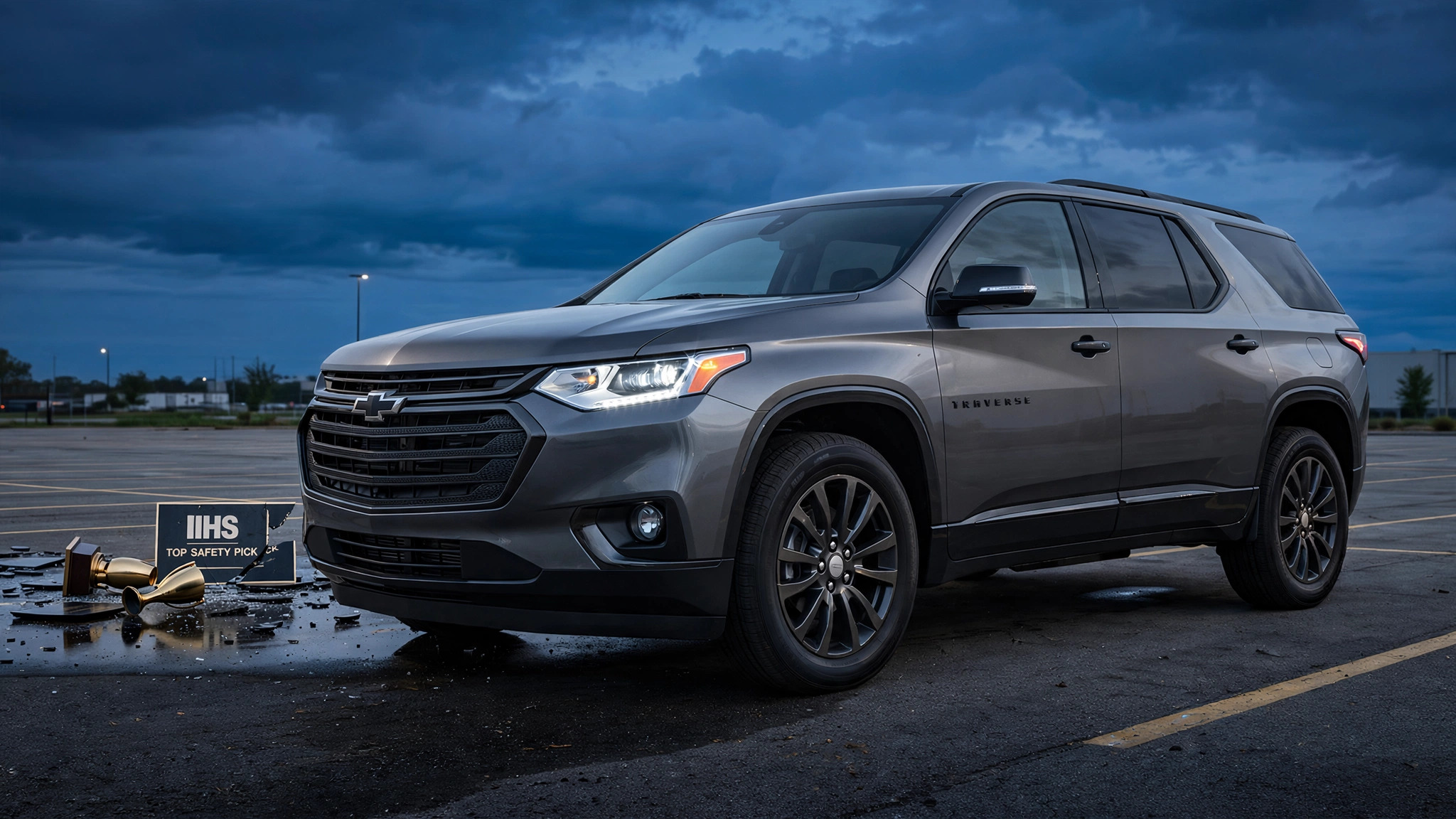
Somewhere in a Chevrolet product meeting, an engineer is staring at a spreadsheet showing the Traverse has the second-lowest fatality rate of any SUV in the FARS database, just 0.20 deaths per 100 million vehicle miles traveled across a decade of federal crash records, and wondering why nobody has noticed.[1] Consumer Reports pulled the Traverse’s “Recommended” badge over transmission and infotainment gripes.[4] IIHS denied it any 2026 safety award after tightening rear-seat crash criteria.[3] Meanwhile NHTSA hands it five stars and the road keeps proving the lab wrong.
Between 2014 and 2023, 265 people died in a Chevrolet Traverse.[1] In that same window the Pilot logged 514, the Highlander 1,106, and the Explorer 3,797. Rate-adjusted, the Traverse is 1.45 times safer than the Pilot, 2.1 times safer than the Highlander, and 7.7 times safer than the Explorer, which sells nearly twice the units yet produces fourteen times the body count. Nobody puts that comparison in a press release.
Chevrolet’s own lineup makes the paradox worse. Its safest SUV shares a badge with its deadliest: the Tracker posts a rate of 7.83, thirty-nine times the Traverse’s 0.20, the highest of any SUV in the entire FARS dataset.[1] One manufacturer, one bowtie, a 39-fold spread in the probability of dying. Impairment explains none of it: Traverse drivers test positive for alcohol or drugs in 19.1 percent of fatal crashes, matching the Explorer’s 19.5 percent and the national fleet average. Model-year death counts run flat from 12 to 30 annually since the nameplate launched in 2009, meaning the safety wasn’t a fluke generation but a sustained baseline across two full redesigns.
So why no IIHS award? Because IIHS overhauled its moderate overlap front test for 2026 to scrutinize rear-seat occupant protection, and the Traverse falls short in that simulated environment.[3] Fair enough. But a consumer checking IIHS now sees no award next to the Traverse and a Top Safety Pick+ next to the Hyundai Palisade, whose rate of 0.06 rests on just 38 total deaths, a sample that could flip with one bad weekend. FARS captures fatalities, not the crashes that merely maimed someone, and a vehicle can post a low death rate while still exposing rear passengers to elevated injury risk in the crash geometry IIHS replicates. Lab tests and body counts measure genuinely different things, and both matter, but only one counts corpses over a decade, and on that score the Traverse trails only a RAV4.
Caveats: FARS records fatal outcomes only, and VMT-based rates carry roughly ±15 percent uncertainty. Non-fatal injury data from state crash files might paint a different picture, the gap IIHS is trying to close.
If you are shopping for a three-row SUV, the Traverse’s 0.20 and the Pilot’s 0.29 are your fatality-rate benchmarks; the Explorer’s 1.54 is the cautionary tale. Cross-reference IIHS ratings at iihs.org/ratings because surviving and walking away uninjured are different outcomes, and check your current VIN at nhtsa.gov/recalls while you are at it.
Sources & References
- NHTSA, Fatality Analysis Reporting System (FARS), 2014–2023. Death rates, impairment percentages, and fleet estimates derived from FARS crash records cross-referenced with Polk registration and NHTS VMT data. nhtsa.gov
- NHTSA, 2026 Chevrolet Traverse Safety Ratings, 5-star overall rating, 17.4% rollover risk. nhtsa.gov
- GM Authority, “No IIHS Top Safety Pick Award For 2026 Chevy Traverse,” March 2026. IIHS tightened moderate overlap front test criteria for rear-seat occupant protection. gmauthority.com
- Consumer Reports pulled “Recommended” status from the 2025–2026 Traverse after subscriber surveys flagged transmission, electronics, and body hardware issues. consumerreports.org