Toyota Built 270,000 Engines That Could Seize at Highway Speed. Then It Fixed the Problem. Then the Fix Failed.
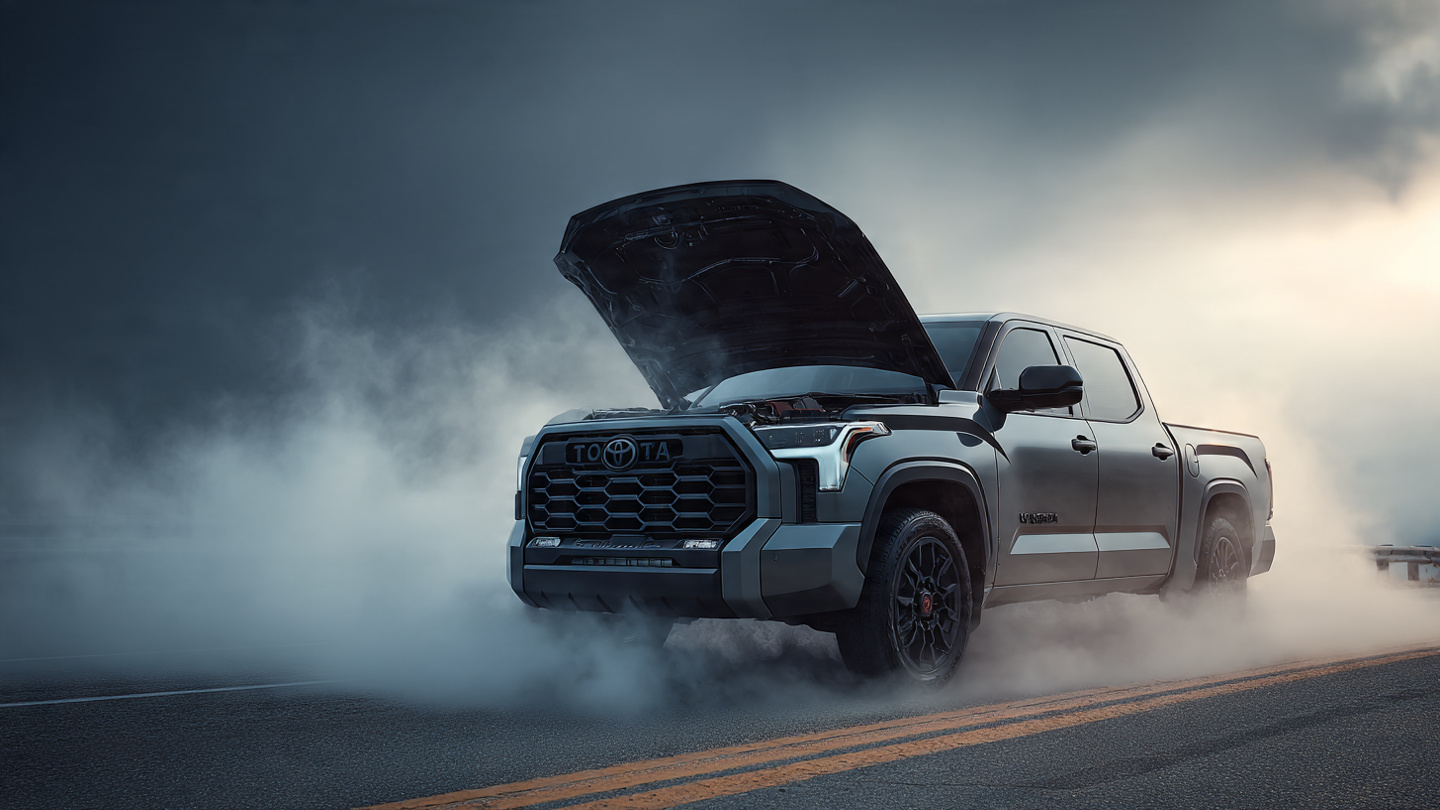
Across the 2014–2023 FARS window, the Toyota Tundra posted a fatality rate of 0.94 deaths per 100 million vehicle miles traveled. Second-safest full-size pickup in America by fatality rate, behind only the Ram 1500. Fourteen years of the 5.7-liter i-FORCE V8 grinding along without drama built that number. Then Toyota replaced it with a twin-turbo V6 called the V35A, and in less than two years the replacement had been recalled three times for the same catastrophic defect.
Wave one landed May 30, 2024: NHTSA Campaign 24V381000.[1] Toyota acknowledged that 102,092 Tundras and Lexus LX600s built between July 2021 and November 2022 contained engines where machining debris had not been cleared during assembly. Debris migrated to crankshaft main bearing number one, and under sustained load the bearing would fail, ending in complete engine seizure with no warning beyond a knock that arrives seconds before silence. Toyota did not attempt rebuilds, instead authorizing full engine replacement at roughly $10,000 per truck. Multiply that out: 102,092 engines at five figures each puts the floor somewhere north of a billion dollars, and that was before the scope grew.
Toyota also said the problem was contained. Buried in the defect information report was a reassuring sentence: V35A engines manufactured after November 2022 were built with “new or improved processes that better clear machining debris.”[2] Fix in, debris gone, new trucks clean.
Fifteen months later, the second wave hit. NHTSA Campaign 25V767000 expanded the population to 126,691 vehicles, now including 2024 Tundras, more LX600s, and the 2024 Lexus GX.[3] Tundra production dates in wave two ran through February 14, 2024, meaning trucks built more than a year after Toyota claimed the manufacturing process had been corrected were rolling off the line with the same contaminated bearings. Same defect, same bearing, same debris that was supposed to be gone. Wave two’s remedy, as of this writing, is listed as “under development.” Toyota has not yet figured out how to fix the fix.
By May 2026, a third campaign added approximately 44,000 more Tundras.[4] The cumulative tally crossed 270,000 vehicles, and the V35A had become something genuinely unusual in Toyota’s engineering history: a powertrain that kept failing in exactly the same way despite two declared corrections.
Meanwhile, the safety data from the engine this replaced tells an uncomfortable story of what was lost. FARS model-year breakdowns show the V8-era Tundra on a steady downward fatality slope: 140 deaths in the 2006 model year, 58 by 2007 (the second-generation redesign), tapering to just 8 deaths among 2021 models, fewer with every generation. Among full-size pickups in the FARS dataset, the Tundra’s rate of 0.94 per 100 million VMT sits well below the Silverado (1.25), F-150 (1.04), and Sierra (1.01).[5] That ranking was earned under the V8. What the V35A has introduced is a failure mode that no crash structure, no crumple zone, and no airbag can compensate for: sudden loss of motive power at highway speed.
An engine that seizes at 70 mph does not politely coast to a stop; power steering vanishes and power brake assist follows within seconds. FARS categorizes these crashes under loss-of-motive-power events, and while V35A-specific incidents are too recent to appear in the 2014–2023 FARS window, the risk profile is well documented. NHTSA’s own defect report notes that “a loss of motive power while driving at higher speeds can increase the risk of a crash.”[1] Independent teardowns have confirmed the failure pattern: spun main bearing number one, consistent across affected engines, visible on disassembly.[4]
Three waves. One defect. A manufacturing fix that did not fix the manufacturing. And a truck that spent fourteen years earning a safety reputation that its new engine is now systematically dismantling.
Limitations
FARS data captures the V8-era Tundra (through 2021 model years). The 2022+ V35A models are not yet reflected in sufficient volume for meaningful FARS rate calculations, so the direct fatality impact of the engine defect cannot be quantified from crash data. The estimated replacement cost of ~$10,000 per engine is derived from industry reporting and dealer documentation; Toyota has not publicly disclosed total recall costs. Wave three details are based on automotive press reporting; NHTSA documentation for the most recent campaign was not yet publicly indexed at time of writing.
Counterargument at full strength
Toyota has consistently characterized this as a manufacturing contamination issue, not a design defect, and that distinction matters. If the V35A architecture is fundamentally sound and the debris problem traces to a specific production line process, then a permanent fix is achievable once Toyota identifies every contamination vector. The company replaced entire engines rather than attempting bearing swaps, which is the most aggressive and expensive remedy available, and hybrid Tundra models retain electric drive capability even during engine failure, providing some loss-of-power mitigation. It is also possible that the expanded recall waves reflect Toyota casting a wider net out of caution rather than evidence of new failures in post-fix production. The Tundra’s strong FARS record was built over decades, and one engine generation’s recall history does not erase the structural safety of the platform.
What you should do
If you own a 2022–2024 Toyota Tundra, 2022–2024 Lexus LX600, or 2024 Lexus GX, check your VIN at nhtsa.gov/recalls or toyota.com/recall. If your vehicle falls within the recalled production dates and you hear engine knocking, experience rough running, or see warning lights, stop driving and contact your dealer. For wave one vehicles, the engine replacement remedy is available. For wave two and three, Toyota has not yet finalized a repair; you can request a loaner vehicle at $60/day while waiting. Document everything. And if you are shopping for a used Tundra, the 2021 and earlier V8 models are not affected by this recall.
Sources & References
- NHTSA, Safety Recall Campaign 24V381000, Toyota Tundra/Lexus LX600 Engine Stall, May 30, 2024. nhtsa.gov
- Toyota Motor Engineering & Manufacturing, Defect Information Report, 24V381000, May 2024. Quoted: “V35A engines of this configuration, manufactured after this production period, were manufactured with new or improved processes that better clear machining debris.”
- NHTSA, Safety Recall Campaign 25V767000, Toyota Tundra/Lexus LX/GX Engine Stall (Expansion), Nov. 2025. Consumer Reports coverage: consumerreports.org
- CarBuzz, “Why Toyota’s New V6 Is Constantly Being Recalled,” June 2, 2026; The Drive, “Toyota Built Its Reputation on Reliability. The Tundra Is Threatening to Undo It,” June 3, 2026. thedrive.com
- NHTSA, Fatality Analysis Reporting System (FARS), 2014–2023. nhtsa.gov