Your Car Needs Half a Mile of Your Attention to Change the Radio. A 2005 Volvo Needed 328 Feet.
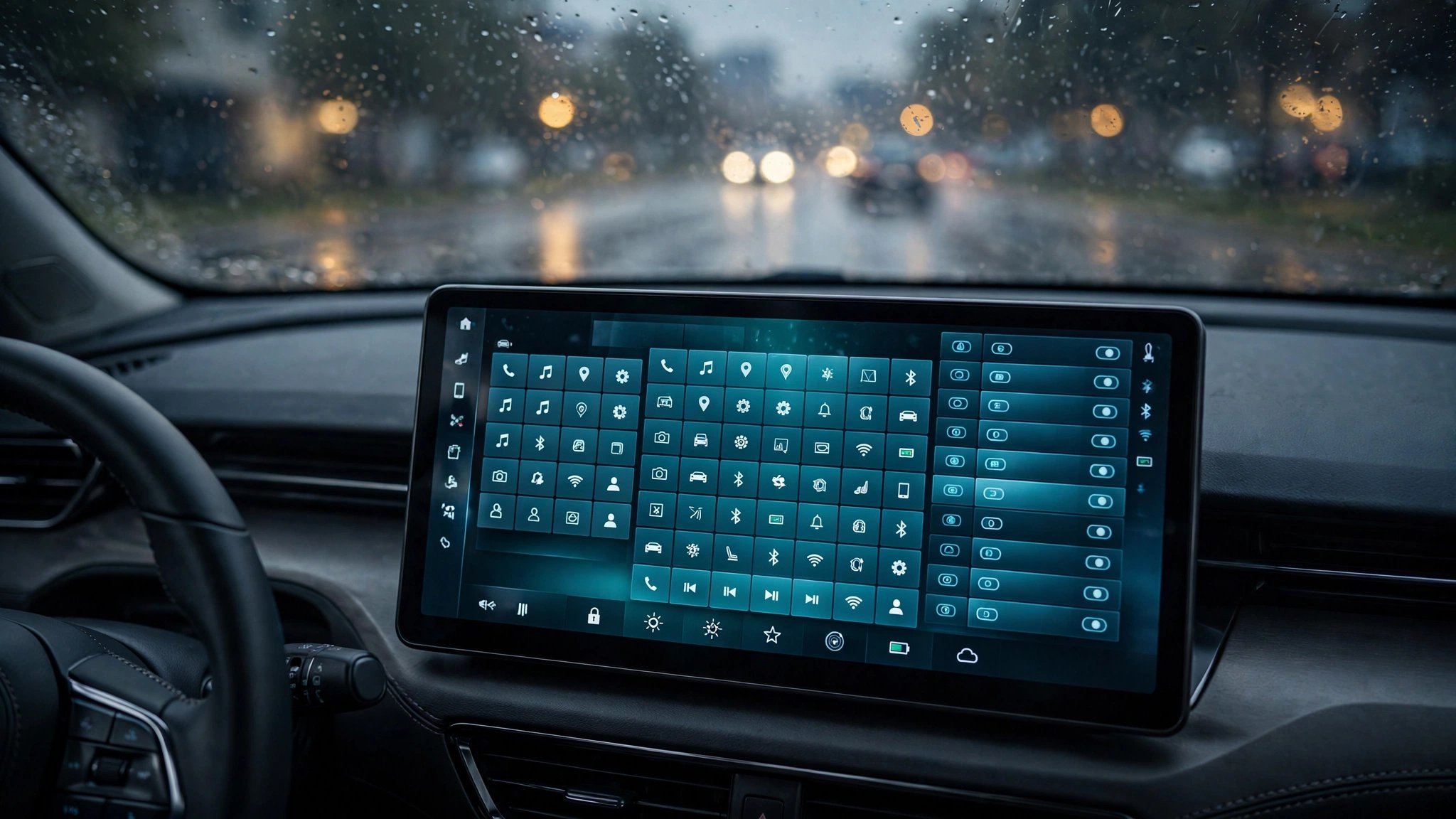
Swedish car magazine Vi Bilägare ran the same distraction test in 2022 and again this month, measuring how far drivers traveled at 68 mph while completing four basic cabin tasks: bump the temperature two degrees, switch the radio station, reset the trip meter, dim the interior lights.[1] The 2022 average across twelve vehicles was 2,480 feet. The 2026 average across ten new models was 2,667 feet. That is a 7.5% regression in four years, an extra 187 feet of highway consumed by screen-tapping, menu-diving, and hunting for a climate icon that moved since last Tuesday's software update.
The baseline vehicle in both rounds was a 2005 Volvo V70 with physical knobs, toggle switches, and zero touchscreen real estate. Same four tasks. 328 feet. Every function had a dedicated control surface that the driver's hand could locate by feel without looking down, because the knob for the temperature was always the knob for the temperature, and it didn't rearrange itself after a firmware patch.
The worst-performing 2026 models extended that distance past 3,000 feet: the Mazda CX-60, Mercedes-Benz CLA, and Toyota Corolla Cross all forced drivers to cover more than half a mile with their cognitive bandwidth split between the road and a glowing rectangle at elbow height.[1] The best new entrants performed roughly twice as well. Volvo's own XC60, Škoda's Kodiaq, and the Tesla Model Y came in at the low end of the 2026 cohort, but none broke below 1,500 feet. Not one new vehicle came within four times the V70's score.
The Math Nobody Runs
At 68 mph, a car covers about 100 feet per second. The 2,667-foot average translates to 26.7 seconds of divided attention per set of tasks. The 328-foot V70 baseline translates to 3.3 seconds. Automatic emergency braking, the safety technology IIHS and NHTSA have spent a decade mandating and testing and celebrating, intervenes in roughly 1.5 seconds to prevent a crash.[2] So the industry built a system that needs 1.5 seconds to save you, then bolted a screen to the dashboard that steals 26.7 seconds of your focus. The prevention side got faster while the causation side got slower, and the two never appear on the same scorecard.
IIHS awards Top Safety Pick+ for crashworthiness, headlights, AEB, pedestrian detection, seat belt reminders, and LATCH child-seat anchors.[2] NHTSA awards five stars for frontal crash, side crash, and rollover resistance. Between them, the two agencies test everything the car does after a collision begins and a growing slice of what the car does in the 1.5 seconds before impact. Neither agency tests what the car's own interface does to the driver during the thousands of seconds of ordinary driving between those rare emergency moments. Zero points deducted. Zero stars lost.
3,208 Deaths NHTSA Can Barely Count
NHTSA recorded 3,208 distraction-affected fatalities in 2024 and 315,167 injuries, which sounds like a lot until you learn how the number is built.[3] A crash only earns a distraction code if the responding officer documents it, the officer distinguishes "adjusting vehicle controls" from "not paying attention," and the driver or a witness admits it. NHTSA's own internal analysis, using the National Motor Vehicle Crash Causation Survey, found that distraction likely contributes to 29% of all crashes, implying roughly 10,500 fatalities per year, more than three times the official count.[4] Total distraction-affected crashes jumped 20% in a single year, from 652,049 in 2022 to 781,958 in 2023.[3]
China noticed. A regulation taking effect in 2027 will require physical controls for turn signals, gear selection, wipers, defrosters, windows, and hazard lights.[5] The United States has no equivalent rule, no proposed rulemaking, and no apparent interest in creating one.
The Strongest Case for Touchscreens
In fairness, Vi Bilägare measures total task completion distance, not pure eyes-off-road time; drivers glance between the screen and the windshield, so the 26.7-second figure overstates continuous visual distraction. Voice controls are improving and can bypass the screen entirely for some commands. Modern lane-keeping and AEB do provide a partial safety net during brief inattention. Volkswagen, stung by customer backlash, is publicly reversing course and restoring physical controls for audio and climate.[5] The trend may, eventually, self-correct through market pressure.
But "the market will fix it" is an argument that works on a timeline measured in vehicle generations, which means eight to ten years from design freeze to fleet turnover, while the distraction distance keeps growing every time the test is rerun.
What You Can Do
Set your climate, audio, and navigation before you pull out of the driveway. Use voice commands whenever your car supports them. If you are shopping, the Vi Bilägare data gives you a starting list: the Volvo XC60, Škoda Kodiaq, and Tesla Model Y distracted drivers least among 2026 models; the Mazda CX-60, Mercedes-Benz CLA, and Toyota Corolla Cross consumed over 3,000 feet each. If the only way to defog the windshield is a three-tap menu buried under “Vehicle Settings,” buy a different car. Check whether your current model has been part of a digital dashboard recall at nhtsa.gov/recalls. NHTSA accepts public comments on proposed rulemakings at regulations.gov; the agency has no open docket on interface distraction, and that absence is itself worth a letter to your representative. And if someone tells you a Top Safety Pick+ means the car is safe, ask them how many points IIHS deducted for an interface that eats half a mile of your attention.
The answer is zero.
Sources & References
- Vi Bilägare, touchscreen distraction test, 2022 and 2026. Tasks performed at 110 km/h (68 mph) on closed airfield. Reported by CarBuzz, “The Distracted Driving Epidemic Is Getting Worse. Here’s Proof Touchscreens Are To Blame,” July 9, 2026. vibilagare.se
- IIHS, 2026 Top Safety Pick award criteria; IIHS, “Automatic Emergency Braking” topic overview. iihs.org/ratings; iihs.org/topics
- NHTSA, Distracted Driving in 2024, April 2026. 3,208 fatalities, 315,167 injuries. Total distraction-affected crashes: 781,958 (2023). nhtsa.gov
- NHTSA National Motor Vehicle Crash Causation Survey; NSC analysis estimating distraction involvement in 29% of crashes. injuryfacts.nsc.org
- Sam Abuelsamid (Telemetry VP), quoted in CarBuzz, July 9, 2026, on China’s 2027 physical-controls regulation and Volkswagen’s reversal.
Limitations
Vi Bilägare tested 10 vehicles in 2026 and 12 in 2022, a small sample for cross-year comparison, and the test was conducted on a European market fleet where some models (Mazda CX-60, Škoda Kodiaq) differ from their U.S. counterparts. The 2005 V70 baseline is illustrative but not directly comparable: modern vehicles have more features requiring more controls, and the V70’s tasks were mechanically simpler. Total task distance is not identical to eyes-off-road time; drivers alternate glances, and the cognitive load varies by task. NHTSA’s 29%/10,500-fatality estimate derives from a model built on 2005–2007 crash investigation data and has not been updated for current vehicle interfaces or driving patterns. No direct causal link between touchscreen task time and specific crash outcomes has been established in peer-reviewed literature.