One Dead Toddler. Three Recalls. And Dozens of SUVs Nobody’s Checked Yet.
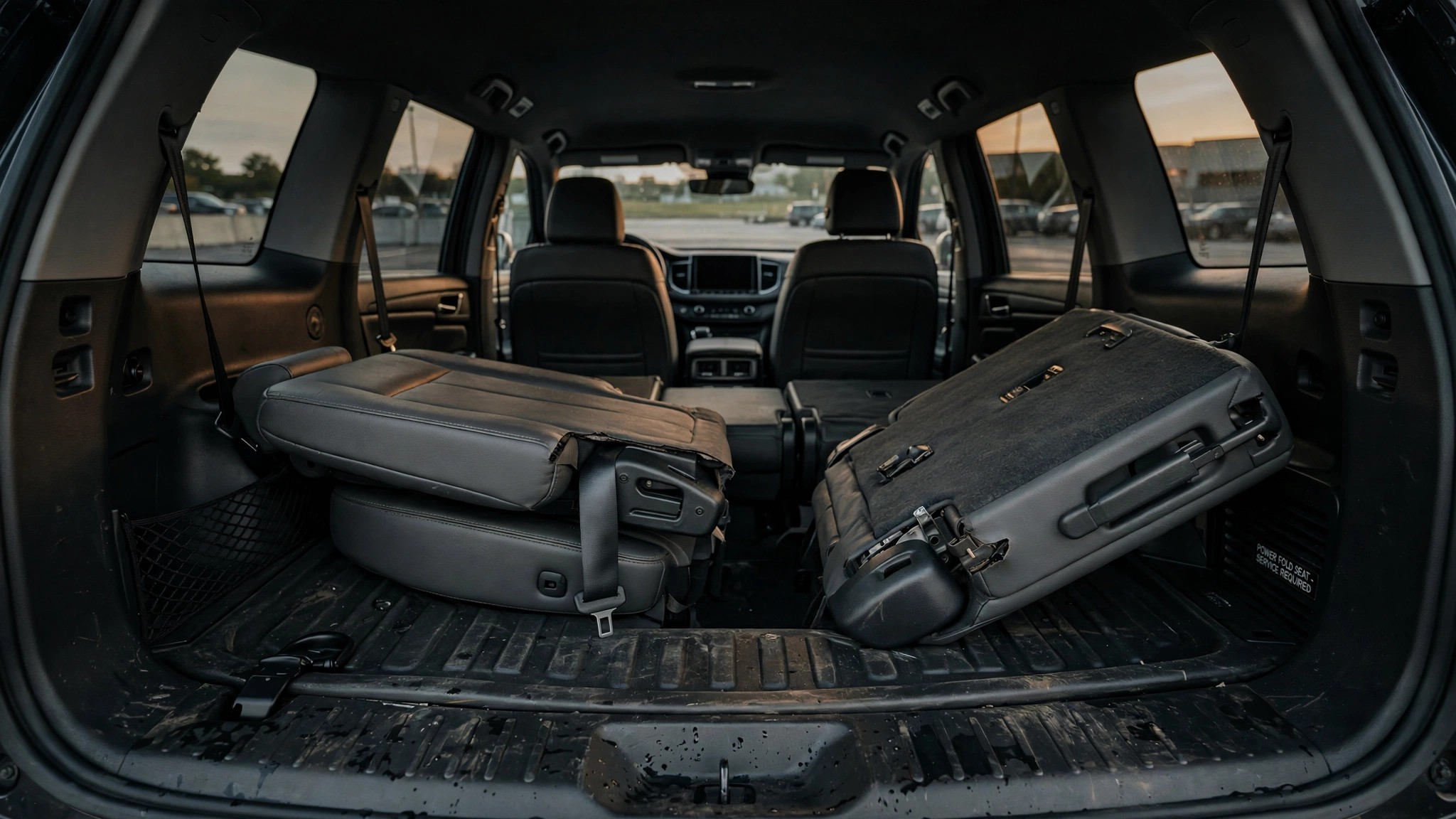
On March 7, a two-year-old named Lucia Ayala climbed into the third row of a 2026 Hyundai Palisade in an Akron, Ohio parking lot. The power-folding seatback pinned her. Bystanders pulled her free, but she’d already suffocated.[1]
Hyundai recalled 68,500 Palisades. Kia followed with 568 Telluride Hybrids sharing the same platform.[2] Then on July 1, General Motors filed paperwork recalling every Cadillac Vistiq ever sold, all 14,540 of them, after a GM engineer ran a test that, in retrospect, should have been run before the vehicle went on sale.[3]
Three automakers, three recalls, and one dead child as the catalyst for all of it. And the mechanism of discovery is almost more disturbing than the defect itself: GM didn’t find the Vistiq’s problem through internal testing, or customer complaints, or quality engineering. A single engineer saw Hyundai’s recall and thought, huh, we should probably check ours. He placed a 33-to-40-pound box on the third-row seat and pressed the button. The seatback folded down onto the box, stopped, and did not reverse, leaving the box pinned in place and impossible to remove without manually operating the seat back. He reported it through GM’s “Speak Up For Safety” program on March 31.[3]
A 33-pound box is roughly the weight of a three-year-old child.
GM had received six complaints about this between May 2025 and June 2026. Nobody ran the box test until Hyundai’s recall made the news.
Now here’s the part that should ruin your morning commute: there is no federal safety standard requiring anti-pinch protection for power-folding seats. FMVSS 207 governs seating system strength, whether your seat holds you in a crash, but it says nothing about whether an automated seat mechanism should stop crushing a child who’s sitting in it when someone presses a button from the cargo area.[4] Entirely unregulated. Automakers install the feature, market it as a convenience, and whether it includes the basic safeguard of reversing when it encounters resistance is entirely up to them.
Three models have been recalled so far. But power-folding third-row seats are available across more than twenty SUV lines currently sold in the United States: Chevrolet’s Traverse, Tahoe, and Suburban; GMC’s Yukon and Yukon XL; Buick Enclave; Ford Explorer, Expedition, and Lincoln Aviator; Toyota Highlander and Grand Highlander; Lexus TX; Honda Pilot; Nissan Pathfinder; Subaru Ascent; Mazda CX-90; Volkswagen Atlas; BMW X7; Mercedes-Benz GLS; Volvo XC90; Jeep Grand Cherokee L. Not exhaustive. Tesla just announced a third-row Model Y L.
How many of these have been tested for entrapment risk since March? Based on NHTSA’s recall database, the answer is three: Hyundai, because a child died; Kia, because they share a platform with Hyundai; and GM, because one engineer read the news and grabbed a box.
NHTSA hasn’t issued an industry-wide inquiry, and no General Order demands that every manufacturer of power-folding seats demonstrate anti-pinch compliance. It’s possible, even likely, that some manufacturers have tested their systems internally and found adequate obstruction detection without needing to file a recall, and different motor designs and force limiters may prevent the same failure mode the Palisade and Vistiq share. But we have no way to verify that, because there’s no standard requiring the test and no database recording the result. Consider: the Vistiq runs on GM’s Ultium architecture, a completely different platform than Hyundai-Kia’s N3, and had the same fundamental failure. Platform-agnostic. It’s a design philosophy: motorized seats folding with enough force to trap a child, controlled by a single button press, with no requirement to reverse.
Auto-reverse isn’t exotic technology; power windows have had it since the mid-1990s, mandated under FMVSS 118 after children were strangled by closing windows.[5] Garage doors got anti-pinch requirements in 1993 under UL 325, and elevator doors have had equivalent protections for decades. The engineering is identical in every case: detect resistance, reverse direction. For windows, the rule exists because kids died, and for garage doors, same reason. Power-folding seats somehow slipped through without a standard, despite being operated by a button that anyone in the cargo area can press while a child sits in the row ahead.
What you should do
If you own a three-row SUV with power-folding seats, never fold them while anyone is seated, and treat the fold button like a saw switch where you clear the area before pressing. Check nhtsa.gov/recalls with your VIN, and understand that the absence of a recall for your specific model does not mean the feature has been tested. It may just mean no engineer has reached for a 33-pound box yet.
Sources & References
- NY Post, “Hyundai halts sales of Palisade SUVs after death of two-year-old girl,” March 2026. Police report, Akron OH. nhtsa.gov
- Carscoops, “Kia Pulls Some Tellurides From Sale Over Defect Linked To Child Death In Palisade,” March 2026. NHTSA campaign 26V173000. nhtsa.gov
- Jalopnik, “Cadillac Recalls Every Vistiq After Internal Investigation Spurred By Deadly Hyundai Palisade Power-Folding Seat Incident,” July 2026. NHTSA recall N262555780. nhtsa.gov
- NHTSA, FMVSS 207 — “Seating Systems.” Covers structural integrity of seating. No provisions for automated folding mechanism safety or anti-pinch. ecfr.gov
- NHTSA, FMVSS 118 — “Power-Operated Window, Partition, and Roof Panel Systems.” Requires auto-reverse for power windows to prevent entrapment. ecfr.gov