Tesla Named Its Own Document ‘Radar Saves Us.’ Then It Shipped 3.2 Million Cars Without Radar.
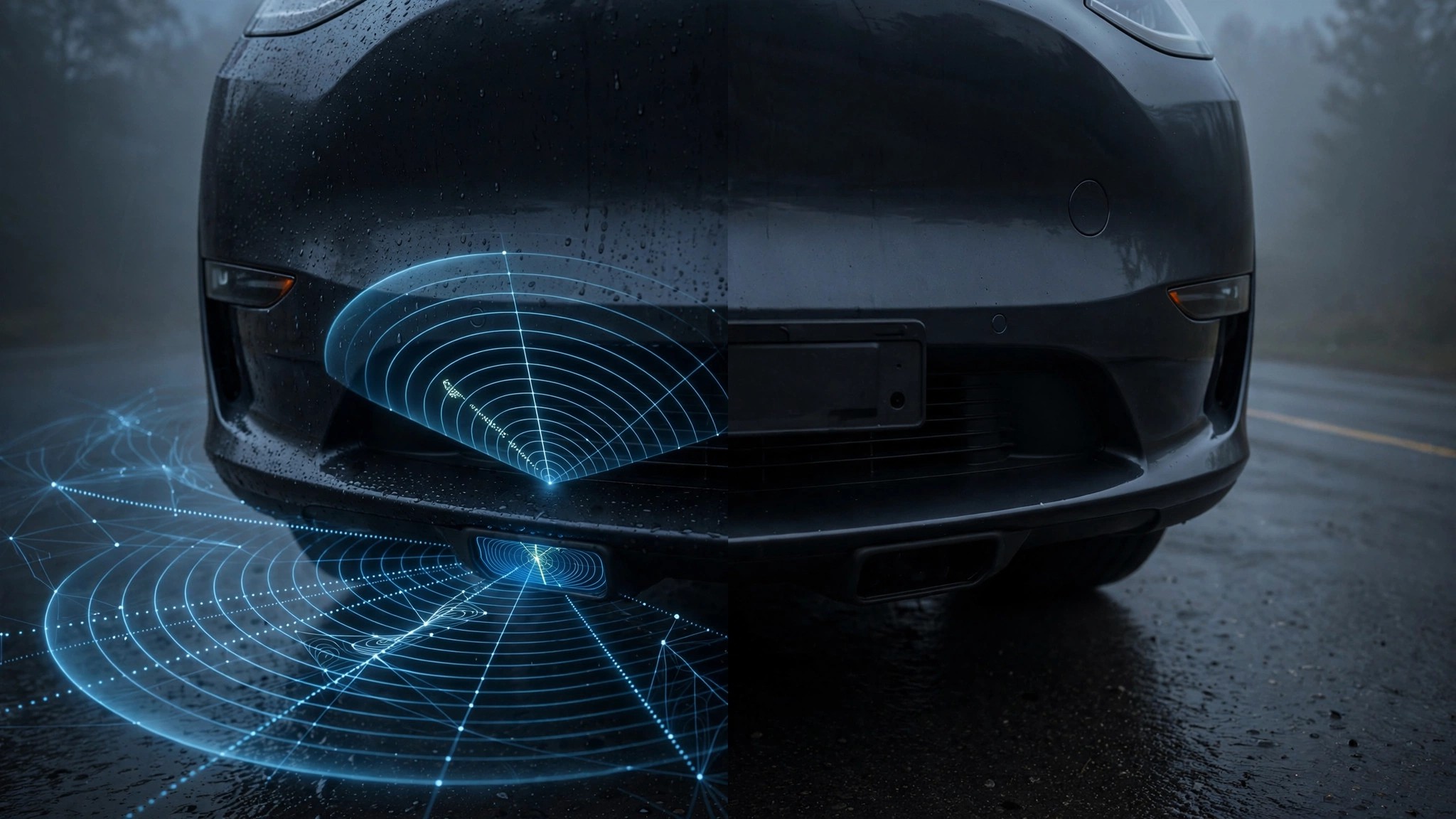
The federal government just told Tesla to hand over a document that Tesla itself created, titled, and submitted to regulators. The document is called “Radar Saves Us.”[1] Four words. An engineer’s title when they’ve done the math and the math scared them.
NHTSA’s Office of Defects Investigation issued a formal information demand on July 21, requiring Tesla to produce every internal communication, test record, and dataset behind that document.[1] The deadline is August 12. Refusal carries penalties up to $27,874 per day, capped around $139 million. The document surfaced during an earlier phase of the probe; now the agency wants the foundation it was built on.
The probe covers nine crashes where Tesla’s Full Self-Driving system failed to detect reduced visibility (sun glare, fog, airborne dust) until immediately before impact.[2] One of them killed a pedestrian in an Arizona dust storm on November 28, 2023. Tesla submitted the required crash report seven months later. The next day, it started developing a software patch. NHTSA still doesn’t know which vehicles actually received that patch.
When NHTSA asked Tesla whether the patch would have helped, Tesla’s own analysis said: maybe in three of the nine crashes.[2] A 33% coverage rate on a fix you built after a fatal crash. That’s the kind of number that turns an engineering analysis into a recall.
What FARS Says About Tesla’s Fleet
Pull the Fatality Analysis Reporting System data for 2014–2023 and Tesla’s lineup splits into two very different stories:[3]
| Model | Deaths | Est. Fleet | Rate (per 100M VMT) |
|---|---|---|---|
| Model S | 100 | 175,000 | 0.50 |
| Model X | 29 | 157,500 | 0.15 |
| Model 3 | 92 | 1,575,000 | 0.05 |
| Model Y | 57 | 1,750,000 | 0.03 |
Model S: 0.50 deaths per 100 million vehicle miles traveled. Model Y: 0.03. That’s a 16.7x gap within the same manufacturer. Model S had radar when it launched. It was the vehicle that proved Tesla could build a premium EV with best-in-class sensor fusion. Then the radar came out.
Among 278 total Tesla fatalities in FARS, Model S accounts for 100: 36% of all Tesla deaths from 4.8% of the combined fleet.[3] It’s 7.5x overrepresented in the fatality column relative to its fleet share.
The Confounds Nobody Skips
Fleet age explains part of this and maybe most of it. The Model S has been on the road since 2012. Older vehicles accumulate more exposure-years in FARS’s 2014–2023 window. Model Y production started in 2020. Its fleet is fundamentally younger, with less time to rack up fatal miles.
Performance matters too. The Model S is Tesla’s fastest production car. Speed kills independently of sensor architecture. A Ludicrous Mode launch and a foggy intersection are a lethal combination regardless of whether there’s a radar behind the bumper.
And 24% of Model S fatal crashes involved impaired drivers,[3] the highest of any Tesla model and well above the sedan class average. That’s a driver population variable, not a sensor variable.
We cannot isolate radar removal from vehicle age, performance, or driver demographics using FARS alone. This is correlation, not causation. The data doesn’t prove removing radar killed anyone.
What the Data Does Prove
The data proves Tesla created a document called “Radar Saves Us,” then removed radar from every vehicle it makes. Those two facts don’t need FARS to be damning.
In product liability law, the distinction between a design choice and a known defect hinges on the manufacturer’s internal knowledge. Did they know about the risk? Did they have a fix? Did they ship without it anyway? A document titled “Radar Saves Us” is not ambiguous. It’s the kind of exhibit that ends up on a courtroom projector screen.
Tesla’s engineers reportedly warned against removing radar.[1] Tesla’s marketing claimed the camera-only system could handle “whiteout conditions” and “all conditions.” Then it softened the on-screen warning when the cameras went blind. Nine crashes later, at minimum, NHTSA wants to know what Tesla knew, when it knew it, and why it shipped anyway.
The Counterargument, at Full Strength
Tesla’s best defense is already in the FARS data. Model Y has the lowest death rate of any Tesla at 0.03 per 100M VMT, and it was designed camera-only from the start. If vision-only were inherently lethal, Model Y should be dying at higher rates, not the lowest. The document may refer to specific edge cases (dust storms, heavy fog) where radar adds a measurable margin, not to fleet-wide mortality. Tesla could reasonably argue that improved algorithms have closed the gap in most conditions and that the nine investigated crashes represent outliers, not a systemic flaw. That’s a legitimate position. Whether it survives the document itself is another question.
What You Should Do
If you own a Tesla with FSD: NHTSA still doesn’t know which vehicles received the updated degradation detection software.[2] Tesla hasn’t told them. You almost certainly don’t know either. Check your VIN at nhtsa.gov/recalls.
In fog, glare, dust, or heavy rain: disengage FSD and drive manually. The system’s own degradation detection has failed to alert drivers in time during every one of the nine investigated crashes. If a camera can’t see, FSD can’t drive. The warning may not come until it’s too late.
And if a manufacturer names its own internal research “Radar Saves Us” and then removes radar from 3.2 million vehicles, the question isn’t whether you trust the algorithm. It’s whether the manufacturer trusted it.
Sources & References
- Fred Lambert, “NHTSA targets Tesla’s ‘Radar Saves Us’ document in FSD crash probe,” Electrek, July 21, 2026. electrek.co
- NHTSA Office of Defects Investigation, Engineering Analysis EA25001: Tesla FSD Supervised, Visibility Degradation Detection, March 2026. nhtsa.gov
- NHTSA, Fatality Analysis Reporting System (FARS), 2014–2023. nhtsa.gov
Source: NHTSA FARS 2014–2023. Fleet estimates use VMT-weighted calculations and carry ±15% uncertainty for low-volume models. Death rate comparisons across Tesla models are confounded by vehicle age, performance characteristics, and driver demographics. Correlation between radar removal and death rates is not established by this data. See methodology for caveats.