Toyota Fixed the Tacoma’s Back Seat. IIHS Says It’s Still Not Good Enough.
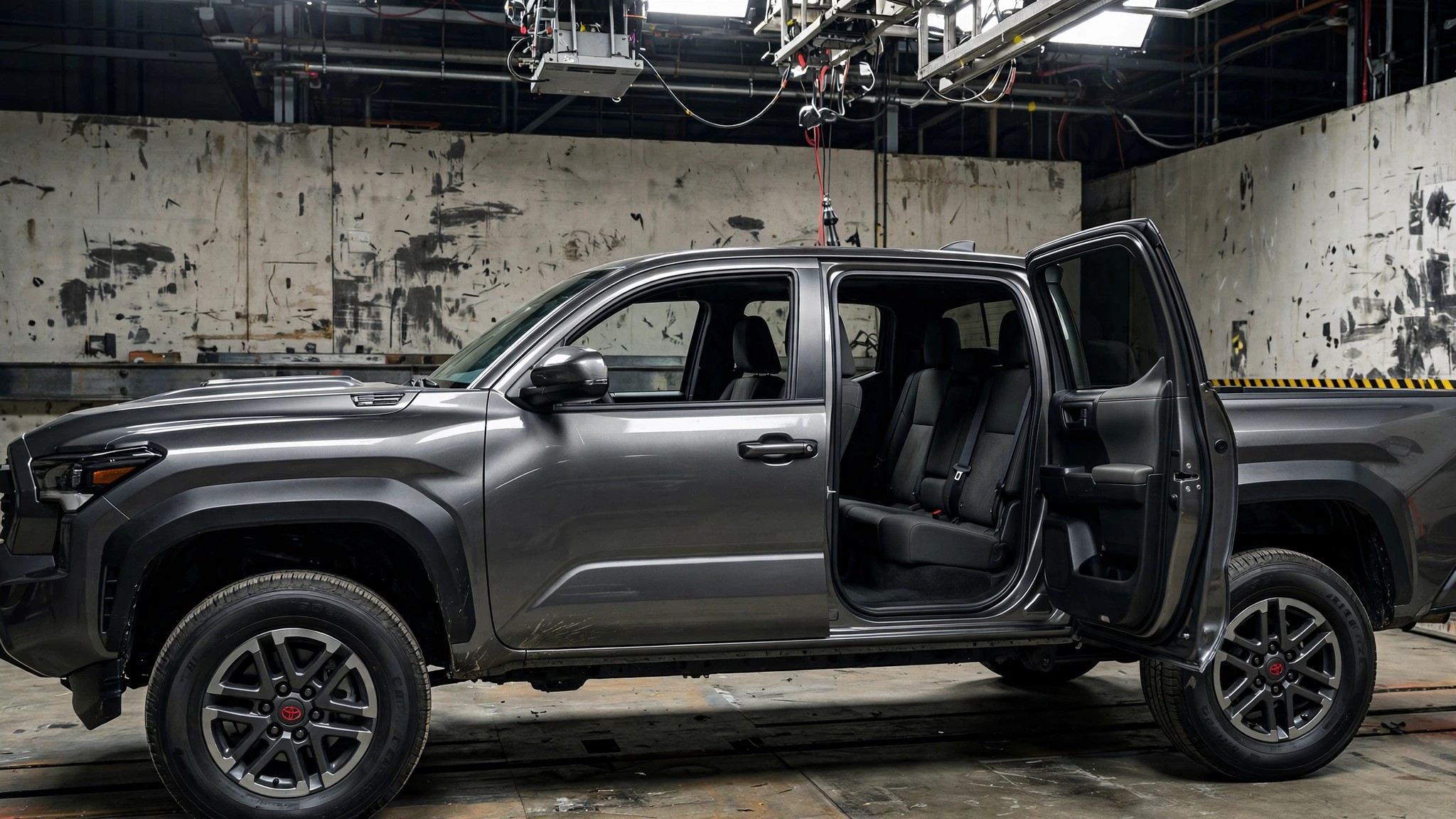
In 2025, the Insurance Institute for Highway Safety told Toyota something uncomfortable: the redesigned Tacoma crew cab earned a Poor rating in the updated moderate overlap front test, with rear-seat protection that lagged the rest of the midsize pickup segment.[1] Toyota responded. For 2026 models, the company modified the rear seat pan and upgraded the rear seat belt load limiters, specifically targeting the test that exposed the weakness.[2]
Result: overall Marginal, one grade better than Poor and two grades short of Good. Structure held up fine, and the driver walked away without issue in every measured category. All four rear passenger injury metrics scored Good individually. But the component that actually keeps a 12-year-old from slamming into the front seatback during a 40 mph offset collision, the one labeled “rear passenger restraints and dummy kinematics,” scored Poor again.[2] The dummy’s head came dangerously close to striking the seatback in front of it. That single subcomponent dragged the entire rating from what would have been Good to Marginal.
Toyota did not ignore the problem, and that matters enough to acknowledge. Toyota identified the failure, engineered a response, and implemented physical changes to the seat structure and belt system between model years. Most automakers confronted with a Poor rear-seat rating do nothing for years, content to wait for the next product cycle. Toyota acted in twelve months, but acting was not enough, which tells you something important about how difficult rear-seat occupant protection remains, even for a manufacturer that takes it seriously.
Context sharpens the frustration when you consider who sits in the back. America’s best-selling midsize truck is specifically configured to carry passengers in the second row.[3] The crew cab exists because families need four doors, because contractors haul apprentices, because the access cab’s jump seats are for gym bags, not human spines. When IIHS added a rear-seat dummy to this test in 2022, they did it because their own research showed something that should have been obvious: in newer vehicles, the risk of fatal injury is now higher for belted rear occupants than for those in front.[1] Front seats got dramatically safer over the past two decades with force-limiting belts, adaptive airbags, and pretensioners calibrated to different crash severities, while rear seats stagnated with the same basic three-point belt from 1995.
FARS fatality data reinforces what is at stake here. Across the 2014 to 2023 observation window, 2,274 people died in crashes involving Toyota Tacomas, spread across 4,348 fatal crashes.[4] The per-VMT fatality rate of 0.80 is actually moderate for a midsize pickup, well below the Ford Ranger at 2.91 and the Nissan Frontier at 1.45. But model year distribution reveals the structural problem: nearly half of Tacoma fatalities involve pre-2005 models built before electronic stability control existed. Post-2016 Tacomas are substantially safer vehicles overall, but IIHS is now asking, and Toyota’s fix partially but not fully answers, whether that safety improvement extends equally to the second row.
How did the rest of the segment fare? Among the Tacoma’s direct competitors in the updated moderate overlap front test for 2026 models, the Nissan Frontier earned a Good overall rating. Chevrolet’s Colorado and Ford’s Ranger each scored Marginal, same as the Tacoma. Honda’s Ridgeline, perennial punchline of the truck world, got Poor.[5] No midsize crew cab pickup earns a clean Good across both the updated side and updated moderate overlap front tests simultaneously. Every truck in this segment has a rear-seat problem. Toyota’s version of that problem is simply the most visible because the Tacoma sells the most units and Toyota tried the hardest to fix it.
What should you actually do if you own a 2024, 2025, or 2026 Tacoma crew cab? Models from 2026 with the seat pan and belt changes are incrementally safer for rear passengers than the 2024 and 2025 models that earned the original Poor rating. If you carry children or smaller adults in the back seat regularly, the honest answer is that no midsize pickup currently provides the level of rear-seat protection available in most midsize SUVs and crossovers. Both the Toyota RAV4 and Honda CR-V, vehicles built on car-based platforms with unibody construction, earn Good ratings in this test.[6] Trucks, by design, present a harder engineering problem: body-on-frame construction, higher ride height, and longer wheelbases change how crash energy propagates through the occupant cell. That is an engineering explanation, not an excuse for the buyer.
Toyota will try again, maybe for the 2027 model year getting the restraints and kinematics from Poor to Acceptable and the overall from Marginal to Good. Until then, the 2026 Tacoma crew cab stands as proof of two things at once: that Toyota takes rear-seat safety more seriously than most competitors, and that taking it seriously is not the same as solving it.
Sources & References
- IIHS, “Small pickups fall short when it comes to rear-seat safety.” iihs.org
- IIHS, 2026 Toyota Tacoma Crew Cab Pickup Ratings. iihs.org
- Toyota Motor Sales USA, Tacoma remains America’s best-selling midsize pickup truck. Sales data via GoodCarBadCar and Automotive News.
- NHTSA, Fatality Analysis Reporting System (FARS), 2014–2023. nhtsa.gov
- IIHS, Current Ratings for Small Pickups. iihs.org
- IIHS, Current Ratings for Small SUVs. iihs.org
What to do: If you regularly carry children or smaller passengers in the Tacoma crew cab’s second row, check your VIN against IIHS ratings to confirm your model year. Your 2026 model with its seat pan and belt improvements is incrementally safer than the 2024–2025 models, but no midsize pickup currently matches the rear-seat protection of comparable crossover SUVs. For rear-seat-heavy families, a RAV4 or CR-V provides measurably better crash protection for passengers behind the driver. If you need a truck, the Nissan Frontier currently leads the segment in the updated moderate overlap front test.