927,000 Vehicles Recalled This Week. Four Out of Five Trace to One Place.
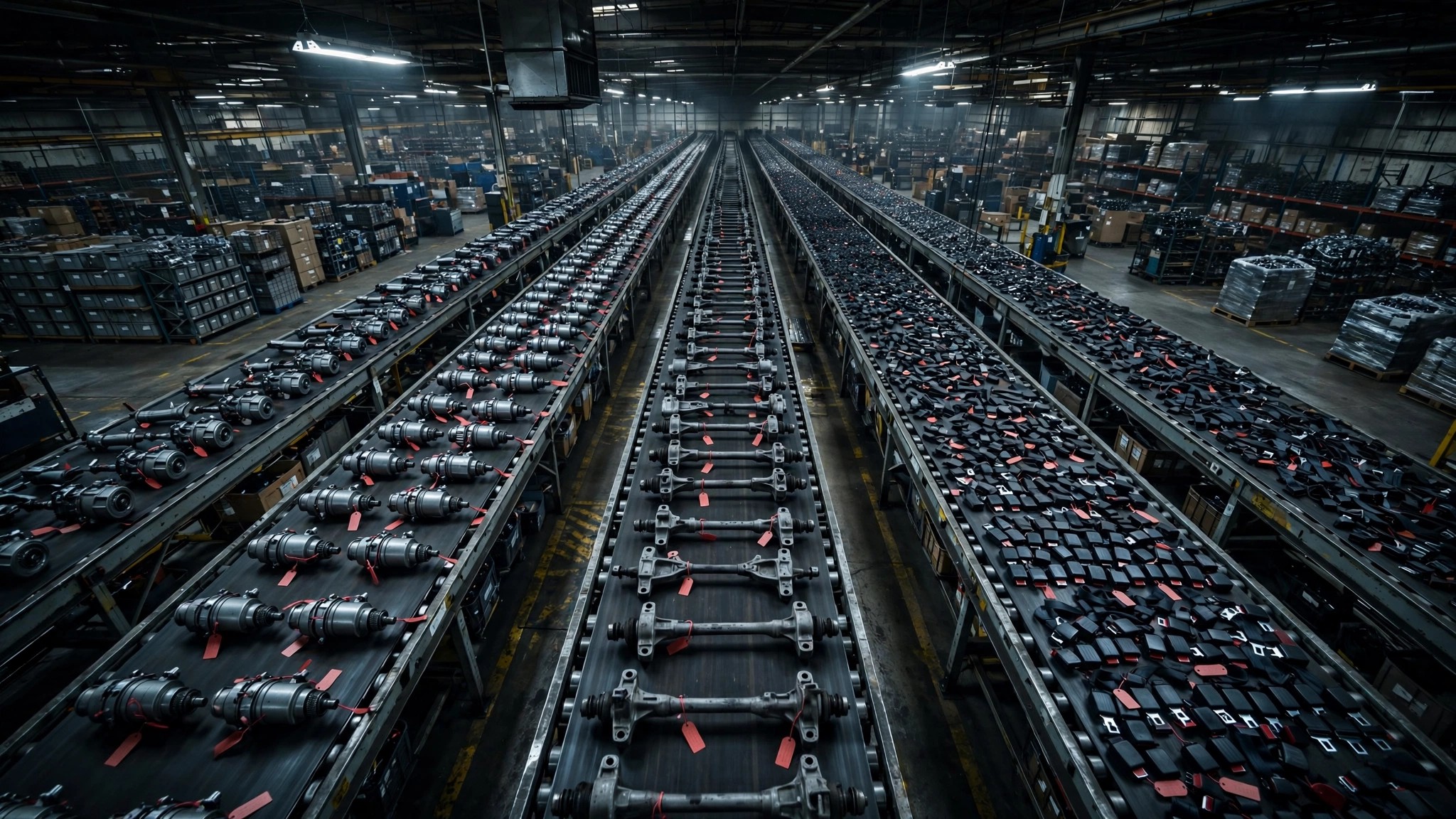
Between Monday and Wednesday, five automakers told NHTSA they needed 927,712 vehicles back: BMW, Ford, Nissan, Hyundai, and Toyota, spanning different countries, different price brackets, and different propulsion systems. The defects ranged from starters that catch fire to seatbelt buckles stamped from a worn die to forged aluminum axle carriers that skipped a step at the foundry. One thing connects four of the five: the automaker didn’t make the part that broke.
The 2026 Hyundai Kona’s rear center seatbelt buckle was manufactured “outside of specification,” per the NHTSA filing, because a stamping die at the supplier wore out from overuse and nobody caught it.[1] That covers 47,749 vehicles, and it is not a design flaw or an engineering miscalculation but rather a maintenance schedule that somebody at a parts factory missed entirely. The Kona has now been recalled three times in the seven months of 2026, which means Hyundai is averaging a Kona recall every ten weeks.
Toyota’s recall is smaller at 5,408 Grand Highlanders and Lexus TXs, but more alarming mechanically because it involves forged aluminum axle carriers that a supplier batch didn’t fully process, leaving them weaker than specification. If one fractures at the toe control arm attachment, the rear suspension geometry changes mid-drive, which is exactly the kind of failure that turns a highway lane change into a loss-of-control event.[2] Toyota’s supplier flagged the problem themselves before any crashes occurred, which is the system working as intended and also a tacit admission that the system nearly didn’t.
BMW recalled 318,495 vehicles across ten model lines because an engine starter can overheat and ignite, marking the company’s fourth fire-related recall of 2026 by our count.[3] The 3 Series, which accounts for the largest chunk at 32,094 units, carries 1,237 deaths and a fatality rate of 2.73 per 100 million VMT in FARS data, higher than either the Ford F-150 at 1.04 or the Jeep Grand Cherokee at 1.33.[4] That fatality figure has nothing to do with starter motors, but it means these are vehicles that already show up in fatal crash data at an above-average clip, and now they have a fire-risk component underneath the hood that their drivers didn’t choose and their automaker didn’t manufacture.
Ford’s 387,911-unit Explorer and Aviator recall is the ugliest operationally because it is, functionally, an admission that the previous recall for the same defect did not work.[5] The problem is a second-row seat switch that binds or sticks, letting the seat unlatch, tip, or slide while the vehicle is in motion. Ford’s own Critical Concern Review Group documented 14 reports of unintended seat movement in drive, and six of those fourteen vehicles had already received a fix from the earlier recall campaign, meaning the original remedy failed on 43% of the vehicles that reported the problem again. The Explorer already carries 3,797 deaths in FARS and led the recall count last week with 676,000 units recalled for other defects.[4]
The fifth recall covers 168,149 Nissan Armadas, QX56s, and QX80s with incorrect weight rating labels, and it is the outlier because a labeling error doesn’t cleanly trace to a tier-1 parts supplier.[6] But the pattern in the other four is consistent enough to name: the part that endangers you was not built by the company whose logo is on your steering wheel.
None of this should surprise anyone who has followed the supply chain’s long, quiet record of failure. Takata killed 27 people with defective airbag inflators supplied to nineteen automakers, and that catastrophe was not an anomaly so much as a preview of how supplier risk propagates across brands. Webasto supplied sunroofs that flew open on highways for sixteen years across multiple brands, and Joyson supplied five distinct defective components to five different automakers.[7] The modern vehicle is an assembly of 20,000 to 30,000 parts from hundreds of suppliers, and the automaker’s quality control is, in practice, a sampling exercise that trusts the tier-1 to maintain the die, hold the spec, and run every forging step. When the tier-1 doesn’t, the vehicle owner finds out via a recall letter—or via a seat that slides at 70 mph.
That is the arithmetic of this week: 927,712 vehicles recalled in three days, roughly one for every 290 registered vehicles in the United States, encompassing four supplier manufacturing defects across four countries and four component categories, plus one automaker whose own remedy from the last go-round failed on nearly half the vehicles that re-reported. If you own a 2020–2026 Explorer or a 2020–2027 Aviator, check your VIN at nhtsa.gov/recalls, and do it especially if you already took it in for the last seat recall, because the first fix didn’t work for almost half the vehicles that came back. If you own a 2026 Kona, keep the rear center seat empty until the buckle is inspected, and if you own a 2026 Grand Highlander or Lexus TX, watch for any unusual rear-end handling and call your dealer before it becomes a FARS data point.
Sources & References
- NHTSA via Autoblog, “Hyundai Tells Kona Owners Not To Use One Seat After Recall,” July 22, 2026. autoblog.com
- NHTSA via CarBuzz, “Toyota Recalls Some Of Its Biggest, Heaviest SUVs For A Serious Axle Problem,” July 23, 2026. carbuzz.com
- Reuters, “BMW to recall over 318,000 US vehicles over starter motor overheating risk,” July 23, 2026. reuters.com
- NHTSA, Fatality Analysis Reporting System (FARS), 2014–2023. nhtsa.gov
- NHTSA via Fox Business, “Ford recalls nearly 388,000 vehicles over second-row seat injury hazard,” July 22, 2026. foxbusiness.com
- Reuters, “Nissan to recall about 168,000 US vehicles over incorrect weight rating labels,” July 21, 2026. reuters.com
- NHTSA recalls database. nhtsa.gov