Subaru Just Recalled 541,000 Vehicles. The Fix Is a Sticker.
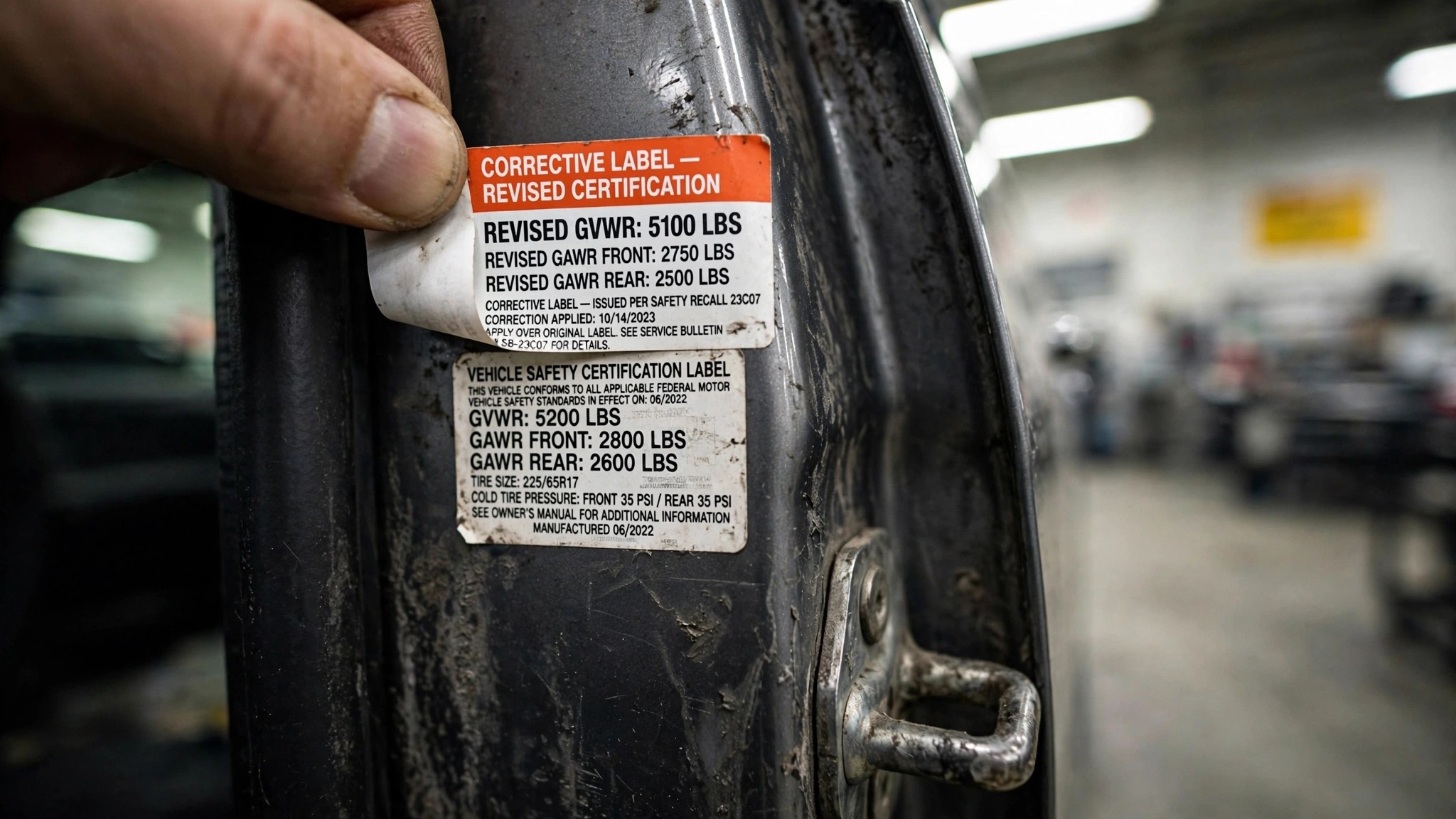
On July 13, NHTSA announced recall 26V452. Subaru is recalling 541,237 vehicles across seven model years of the Ascent, Forester, Forester Hybrid, and Crosstrek Hybrid. A sticker on the driver’s doorjamb shows the wrong number for the rear axle weight rating. Subaru will mail you a new sticker. You paste it over the old one. That is the entire recall.
No component is being replaced. No software is being updated. No technician needs to touch the vehicle unless you would rather not apply adhesive paper yourself. Mechanically, the vehicle is fine. Its axles can handle what they were designed to handle. Only the printed number was incorrect, because somewhere in Subaru’s documentation pipeline, a rear GAWR figure got transcribed wrong onto the federal safety certification label. NHTSA dutifully notes that “an incorrect GAWR label may lead to an overloaded vehicle, increasing the risk of a crash.” Technically true, in the same way that a misprinted speed limit sign could cause you to drive 3 mph faster than intended.
This recall now sits in the same NHTSA database as the Takata airbag recall. That one covered 67 million vehicles in the United States. Packed with ammonium nitrate propellant that degraded over time, the inflators could rupture during deployment and fire metal shrapnel into the cabin.[1] At least 27 Americans died.[2] Hundreds more were injured. Replacing the inflator mechanism inside each airbag module took years and still isn’t finished. In the database, both entries are “one recall.”
The GM ignition switch defect was one recall, too. That one killed 124 people because a spring inside the switch was 0.79 newton-meters below specification, allowing the key to rotate out of the “run” position during driving and cut power to the airbags, power steering, and power brakes simultaneously.[3] The Firestone/Ford Explorer tire separation was one recall. That one killed 271 people and injured over 800 when tread separated from the belt at highway speeds on hot pavement.[4] The Subaru sticker is also one recall. That one has produced zero incidents of any kind, because the sticker is, to be precise, a sticker.
In 2025, American automakers filed 670 recall campaigns covering more than 28 million vehicles, according to Recall Masters’ annual analysis.[5] Ford alone accounted for 152 of those recalls and 12.75 million vehicles. Business press dutifully reports these numbers as though they tell you something about which manufacturer is safer. They do not. A software update that fixes a rearview camera display glitch on 200,000 Teslas counts the same as a structural failure that causes rear axle carriers to snap at highway speed on 5,400 Toyota Grand Highlanders.[6] The counting system treats a cosmetic label error and a shrapnel-launching airbag as interchangeable units.
Meanwhile, in the same country where we meticulously catalog sticker errors into a federal database: 36,640 people died in traffic crashes in 2025.[7] That’s down 6.7% from 2024, which is genuinely good news and the lowest annual total since 2020. But FARS data makes clear that the overwhelming majority of those deaths have nothing to do with vehicle defects. Across all vehicle classes in our FARS 2014–2023 dataset, roughly 20% of drivers in fatal crashes test positive for alcohol or drugs.[8] Speeding. Distraction. Unbuckled occupants. These are the factors that fill the FARS tables, year after year, model after model. Not stickers.
NHTSA built the recall system to count compliance events, and it does that well. What it was never designed to do, despite what the media pretends, is tell you how dangerous a vehicle is. A manufacturer with 50 recalls a year might have 49 software patches and one catastrophic structural failure, or 50 label corrections and zero deaths. That number tells you neither. When Men’s Journal reported that “the recall leaderboard turned into a contact sport” in 2025, they were counting stickers alongside shrapnel.[9]
Subaru will begin mailing notifications August 25. If you own a 2019–2026 Ascent, a 2025–2026 Forester or Forester Hybrid, or a 2026 Crosstrek Hybrid, you will receive a letter and a sticker. Apply it at your convenience. You are not in danger. You were never in danger. All this recall fixes is a number on a label that you have almost certainly never read and would have no reason to. The recall system recorded the event, added 541,237 to the annual tally, and moved on. Somewhere in the same database, 67 million Takata vehicles are still waiting for an inflator that won’t try to kill them.
Sources & References
- NHTSA, Takata Airbag Recalls: Coordinated Remedy Program. nhtsa.gov
- NHTSA, Takata airbag fatality count (27 confirmed U.S. deaths as of latest update). nhtsa.gov
- General Motors ignition switch recalls, documented 124 deaths. Wikipedia
- Firestone and Ford tire controversy, 271 fatalities, 800+ injuries. Wikipedia
- Recall Masters, 2025 State of Automotive Recalls Report, May 2026. 447 NHTSA campaigns + 223 voluntary recalls. einpresswire.com
- NHTSA recall, Toyota Grand Highlander/Lexus TX rear axle carrier, 5,408 vehicles, July 2026. nhtsa.gov
- NHTSA/AASHTO, Traffic Deaths Declined Significantly in 2025: 36,640 fatalities, 6.7% decrease. nhtsa.gov
- NHTSA, Fatality Analysis Reporting System (FARS), 2014–2023 data. ~20% impairment rate across all vehicle classes. nhtsa.gov
- Men’s Journal, “The 2025 Recall Numbers Are In — Why You Should Check Your VIN, Not the Brand,” Dec 30, 2025. mensjournal.com
Limitations
NHTSA’s recall database does not categorize recalls by severity tier, and the agency does not publish a breakdown of how many annual recalls involve label/documentation corrections versus physical defect repairs versus software updates. The distinction drawn here between “sticker recalls” and “death-producing defect recalls” is the author’s framing based on public recall documents, not an official NHTSA taxonomy. Takata death counts vary by source and continue to be updated; the figure of 27 U.S. deaths reflects the most recent NHTSA data available at time of publication. The FARS impairment rate of ~20% is a weighted average across our 307-model toxicology dataset and may differ from NHTSA’s official aggregate figure. Recall counts from Recall Masters may differ slightly from NHTSA’s own tallies due to methodology differences in how campaigns and populations are counted.
The Strongest Counterargument
The recall system is intentionally binary — and that might be a feature, not a bug. If NHTSA introduced severity tiers, manufacturers would have an incentive to downgrade the classification of dangerous defects, and consumers might ignore “low-severity” recalls that turn out to matter. The current system forces every noncompliance, no matter how trivial, through the same process: formal notification, public database entry, remedy verification. It trades nuance for universality. A sticker recall that goes through the full process is the cost of ensuring a lethal defect can never be quietly buried as a “minor” issue. The question is whether that tradeoff produces more safety than the confusion it creates.