Every Subaru Is Safer Than Its Competitors. Every Single One.
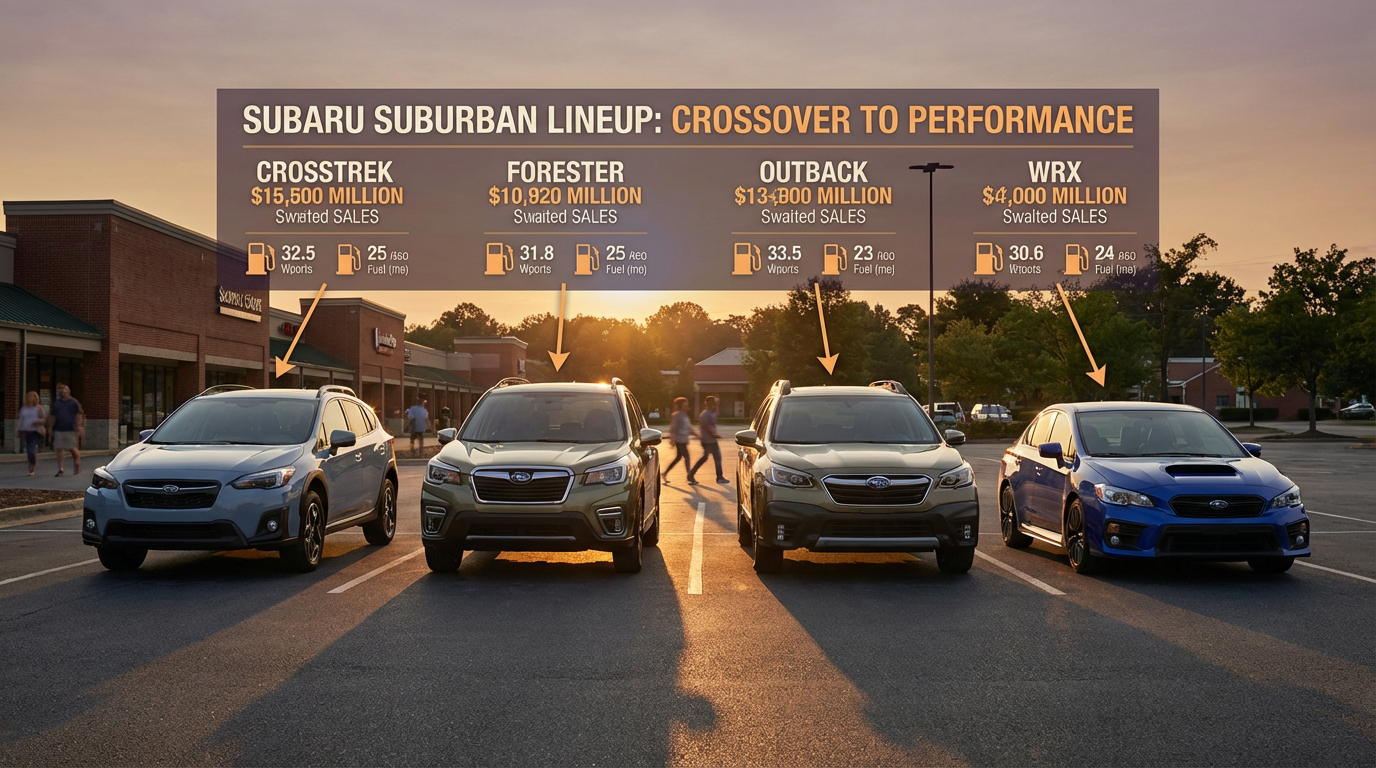
Before you sign that lease, you might want to see this. We’ve spent 57 articles dissecting the FARS database vehicle by vehicle, and one brand keeps showing up in places it shouldn’t — not at the top of the death charts, but stubbornly, consistently, almost irritatingly near the bottom. Every single Subaru in the database beats its direct class competitor. Not most. Not the popular ones. All of them.
The Full Lineup
| Subaru | Rate | Class | Nearest Rival | Rival Rate | Gap |
|---|---|---|---|---|---|
| Crosstrek | 0.08 🟢 | Compact CUV | Ford Escape | 0.95 | 12× |
| Forester | 0.26 🟢 | Compact SUV | Chevy Equinox | 0.36 | 1.4× |
| WRX | 0.29 🟢 | Sport | Ford Mustang | 6.02 | 21× |
| Outback | 0.45 🟢 | Mid-size CUV | Ford Edge | 0.46 | 1.0× |
| Impreza | 0.52 🟢 | Compact Sedan | Honda Civic | 2.25 | 4.3× |
| Ascent | 0.78 | 3-Row SUV | Ford Explorer | 1.54 | 2.0× |
| Legacy | 0.95 | Mid-size Sedan | Honda Accord | 3.07 | 3.2× |
The Crosstrek — Subaru’s entry-level crossover, starting around $30,000 — kills at 0.08 deaths per 100 million VMT. That makes it one of the safest vehicles in the entire FARS database. The Ford Escape, which competes at the same price point, kills at 0.95. Same class. Same sticker price. Nearly 12 times the death rate.
The WRX Problem
Here’s where it gets weird. The WRX has a 23.4% impairment rate — the highest of any Subaru, 3.4 points above the national average. This is a car whose drivers are more likely to be impaired than Mustang drivers (21.9%) or Camaro drivers (23.0%). And yet:
| Sport Car | Deaths | Rate per 100M VMT | Impairment |
|---|---|---|---|
| Ford Mustang | 2,739 | 6.02 🔴 | 21.9% |
| Chevy Camaro | 1,204 | 3.44 🔴 | 23.0% |
| Dodge Challenger | 385 | 1.00 | 22.5% |
| Subaru WRX | 89 | 0.29 🟢 | 23.4% |
The WRX is 21 times safer per mile than the Mustang despite having a higher impairment rate. Drunk WRX drivers die less often than sober Civic drivers. That is not a sentence you would ever expect to type, and yet here we are.
The Impreza Sedans
The Impreza competes against the Civic, Corolla, and Sentra — the three highest-selling compact sedans in America. Its rate: 0.52. The Civic kills at 2.25. The Corolla at 1.85. The Sentra at 2.13. The Impreza has a slightly higher impairment rate (21.9%) than all three competitors (19–20%), and it’s still dramatically safer. The Legacy tells the same story against the mid-size field: 0.95 vs. the Accord’s 3.07 and the Camry’s 2.03.
So What’s Actually Happening?
Standard AWD. Subaru is the only mainstream brand that includes all-wheel drive on every single vehicle. AWD doesn’t help you in a T-bone or head-on, but it provides a meaningful traction advantage in rain, snow, and on gravel — conditions that cause loss-of-control single-vehicle crashes, which are disproportionately fatal.
Boxer engine layout. The horizontally-opposed flat engine sits lower in the chassis than a comparable inline-4 or V6, lowering the center of gravity. Lower CoG means fewer rollovers. Rollovers are the most lethal crash type relative to their frequency.
EyeSight saturation. Subaru was one of the earliest brands to make its driver-assist package (stereo camera-based pre-collision braking, lane departure, adaptive cruise) standard across the lineup, starting in 2017 for most models. IIHS data shows vehicles with AEB have 50% fewer front-to-rear crashes.
Demographics. Subaru buyers skew older, suburban, Pacific Northwest/New England, and outdoor-oriented. That’s a demographic profile associated with lower crash risk. But the WRX demolishes this argument — its buyer skews younger and more impaired than Mustang and Camaro buyers, and it’s still 21× safer.
The Ascent Exception
The Ascent is Subaru’s one weak spot — at 0.78, it’s beaten by the Pilot (0.29), Highlander (0.42), and Traverse (0.20) in the three-row SUV class. But there’s a footnote: the Ascent has a 8.2% impairment rate, which is the lowest of any vehicle in the entire database. These are the most sober drivers in America. And yet their death rate is the highest in Subaru’s lineup. The Ascent was Subaru’s first three-row, introduced in 2018 on a stretched Impreza platform — a newer model with less refinement than competitors with decades of iteration.
The Brand No One Recommends for Safety
Search “safest car brand” and you’ll get Toyota, Honda, and Volvo. Consumer Reports pushes the Camry. Edmunds loves the Accord. IIHS gives Top Safety Pick+ awards to everything with curtain airbags and a nice enough crumple zone. None of these recommendations are backed by outcome data — they measure crash test performance, not whether people actually die in the car.
In the FARS database — which counts actual deaths, on actual roads, driven by actual people — Subaru’s lineup is safer than Toyota’s, safer than Honda’s, and dramatically safer than Ford’s or Chevrolet’s. Seven models. Seven wins against class competitors. A combined 2,492 deaths across the entire brand that an equivalent number of Escapes, Mustangs, Civics, and Accords would have generated over 15,000.
The numbers don’t care about your brand perception. Buy the Subaru.