709,000 Cars Were Just Recalled. The Fix Is a Sticker.
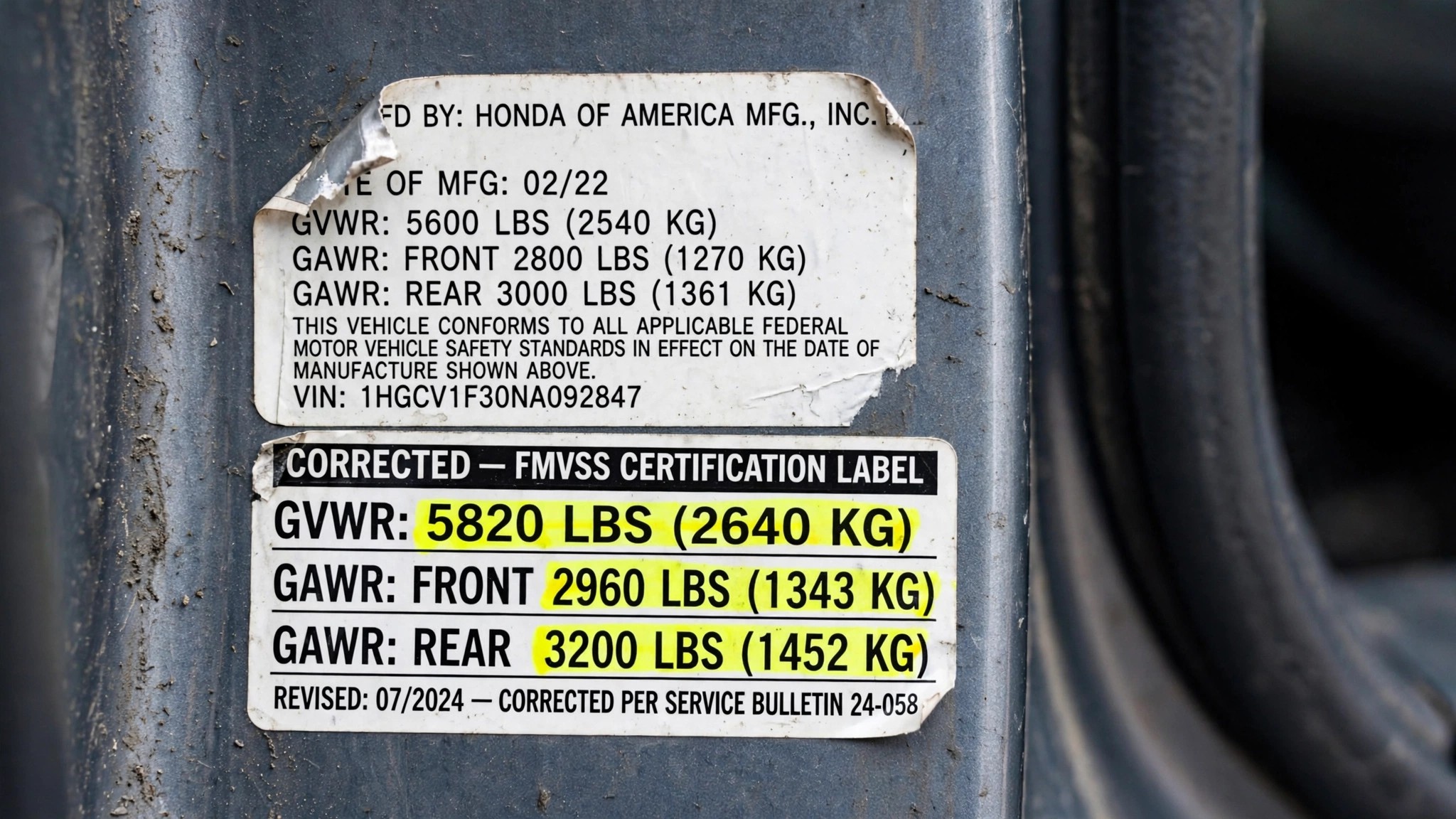
Subaru recalled 541,237 vehicles last week, and Nissan recalled another 168,149. Same defect, both times: the number printed on the certification label glued to the door jamb is wrong.[1][2] The gross axle weight rating for the rear axle overstates or understates the vehicle’s actual load capacity by some unspecified margin. Combined total: 709,386 vehicles recalled because of a misprint on a sticker.
The remedy, for both recalls, is a corrected sticker. Subaru will mail owners a replacement label with instructions to paste it over the old one, and Nissan dealers will install new labels free of charge. No part removed, no bolt torqued, no software flashed. A technician peels a backing and presses a rectangle of adhesive-backed paper onto your B-pillar, and the recall is complete. Subaru’s recall code is WRH-26; Nissan’s was announced July 21.[1][2]
Zero crashes, zero injuries, zero fires, zero deaths across all 709,386 vehicles, with not a single reported incident connected to the defect. The sticker is wrong, and that is the entire safety case.
I pulled the FARS data on the specific models covered by these recalls, because the question that matters is whether these vehicles have an overloading problem that shows up in the crash record, and they do not. The Subaru Crosstrek posts a fatality rate of 0.08 deaths per 100 million vehicle miles traveled, which makes it one of the ten safest vehicles in the entire 337-model FARS dataset.[3] The Forester sits at 0.26. The Ascent, Subaru’s three-row family hauler, is at 0.78. The Nissan Armada, a body-on-frame SUV that people actually do load to capacity for towing, posts 0.55. Every single recalled model lands well below the SUV-class average of roughly 0.5 per 100 million VMT.[3]
The Subaru Crosstrek is, statistically, 6.25 times less likely to appear in a fatal crash per mile driven than the average SUV in FARS, and Subaru is mailing these people a sticker.
This is what happens when federal motor vehicle safety standards treat label accuracy as a binary compliance gate. FMVSS 110 and 120 mandate that the gross axle weight rating printed on the certification label be correct.[4] If the number is wrong, the vehicle fails to comply, and a noncompliance filing triggers a recall regardless of whether any human being has ever been harmed, endangered, or mildly inconvenienced by the error. NHTSA has no mechanism to say, “The label is wrong but the risk is negligible, so file a correction and move on.” Wrong number, same weight vehicle, automatic recall.
I have nothing against regulatory compliance as a principle. Standards exist because a Subaru Ascent owner towing a boat needs to know the rear axle’s rated load capacity, and if that number is wrong, the owner could theoretically overload the axle, accelerating tire wear, increasing stopping distances, and raising rollover risk. The physics are real, but physics requires a chain of causation that goes: wrong label → owner loads vehicle to the incorrect limit → actual axle capacity exceeded → structural or tire failure → crash. Across 709,386 vehicles, this chain completed zero times.
Now compare these sticker recalls to the Jeep Wrangler fire recall filed five weeks earlier: 1,076,999 vehicles with 51 reported fires, one injury, and a “park outside” advisory telling owners their Jeep might burn down their garage while switched off.[5] Both show up identically on a Carfax report, both appear as a “RECALLED” flag when you check your VIN, and both generate the same media headline template: “[Automaker] Recalls [Number] Vehicles.” The consumer cannot distinguish a recall where the fix is a sticker from a recall where the fix is “park away from buildings until we figure out why your truck is combusting.”
NHTSA’s most recent completion-rate data estimates that roughly 72% of recalled vehicles ever get fixed, which means twenty-eight percent of recalled vehicle owners never bring their car in.[6] The people who ignore recall notices aren’t necessarily reckless or lazy. Some of them have been recalled six times in three years for stickers, labels, and software calibrations that had zero real-world consequences, and they’ve learned that “recall” often means nothing bad will happen if they do nothing. Those are the same people who will ignore the letter about the steering rack that fails without warning.
Label recalls accounted for at least four separate recall campaigns in the first half of 2026 alone: Subaru’s 541K, Nissan’s 168K, a Jayco/Entegra recreational vehicle weight label correction, and a Southeast Toyota Distributors label fix for 2026 Tundra trucks, bringing the total vehicle count from label-only recalls this year to nearly one million. A million recall notices sent, a million Carfax entries logged, and not a single one of them required a mechanic to open a hood.
The vehicles Subaru and Nissan recalled are, by every available measure, among the safest on American roads. The Crosstrek Hybrid owners who will receive a recall letter this fall are driving a vehicle that posts a lower fatality rate than a Toyota RAV4, a Honda CR-V, or a Nissan Rogue, and they are being recalled for a sticker. They should fix it, because a correct weight label is a correct weight label, but they should also understand that this recall has nothing in common with the one that tells Jeep Wrangler owners to keep their vehicles away from structures.
If you own a 2019–2026 Subaru Ascent, a 2025–2026 Forester or Forester Hybrid, or a 2026 Crosstrek Hybrid, check your VIN at nhtsa.gov/recalls or call Subaru at 1-844-373-6614 and reference recall code WRH-26. If you own a Nissan Armada, Infiniti QX56, or QX80, call Nissan at their customer service line. Dealers will install the corrected label at no cost. Or you can paste the sticker yourself when it arrives in the mail. Either way, your vehicle is not less safe today than it was last week.
Sources & References
- NHTSA Recall, Subaru WRH-26: Incorrect GAWR on certification label, 541,237 vehicles (2019–2026 Ascent, 2025–2026 Forester/Forester Hybrid, 2026 Crosstrek Hybrid). Filed July 13, 2026. nhtsa.gov/recalls
- Reuters, “Nissan to recall about 168,000 US vehicles over incorrect weight rating labels,” July 21, 2026.
- NHTSA, Fatality Analysis Reporting System (FARS), 2014–2023. Fatality rates estimated per 100 million VMT using FARS bulk CSV and NHTS annual miles data. nhtsa.gov
- Federal Motor Vehicle Safety Standards No. 110 (Tire selection and rims, passenger cars) and No. 120 (Tire selection and rims, vehicles other than passenger cars). ecfr.gov
- NHTSA Recall 26V363000, Stellantis: Fire risk in 1,076,999 2021–2025 Jeep Wrangler/Wrangler 4XE/Gladiator vehicles. 51 fires, 1 injury reported. “Park outside” advisory. Filed June 9, 2026.
- NHTSA recall completion rate data. Aggregate estimates vary by model year and recall severity; the ~72% figure is a commonly cited agency-reported average.
Limitations
FARS data captures only fatal crashes and cannot isolate vehicle overloading as a contributing factor; NHTSA does not code “overloaded vehicle” as a crash variable. Our estimated fatality rates use fleet size and VMT estimates, not odometer-verified mileage, introducing uncertainty of ±15% for lower-volume models. The Subaru Ascent entered production in 2018, so its FARS record spans fewer model years than longer-running nameplates. Zero crashes reported does not prove zero risk; it proves zero observed incidents across the affected fleet during the exposure period.
Strongest Counterargument
A weight label that overstates rear axle capacity can lead an owner to load the vehicle beyond its actual structural limit. This is not hypothetical: the Armada and QX80 are marketed as tow vehicles, and owners who max out a trailer tongue weight based on the label could genuinely exceed the axle’s design margin. The recall exists precisely because the chain of causation (wrong label, excess load, structural failure) is physically plausible and impossible to predict at the individual level. FMVSS regulations do not require a body count before mandating a correction, and that is by design: the standard catches errors before they produce casualties. Critiquing zero-crash recalls as “theater” risks normalizing the idea that regulators should wait for someone to die before acting.