Stellantis Told 848,000 Drivers to Use Their Mirrors. The Government Spent 11 Years Proving Mirrors Kill Kids.
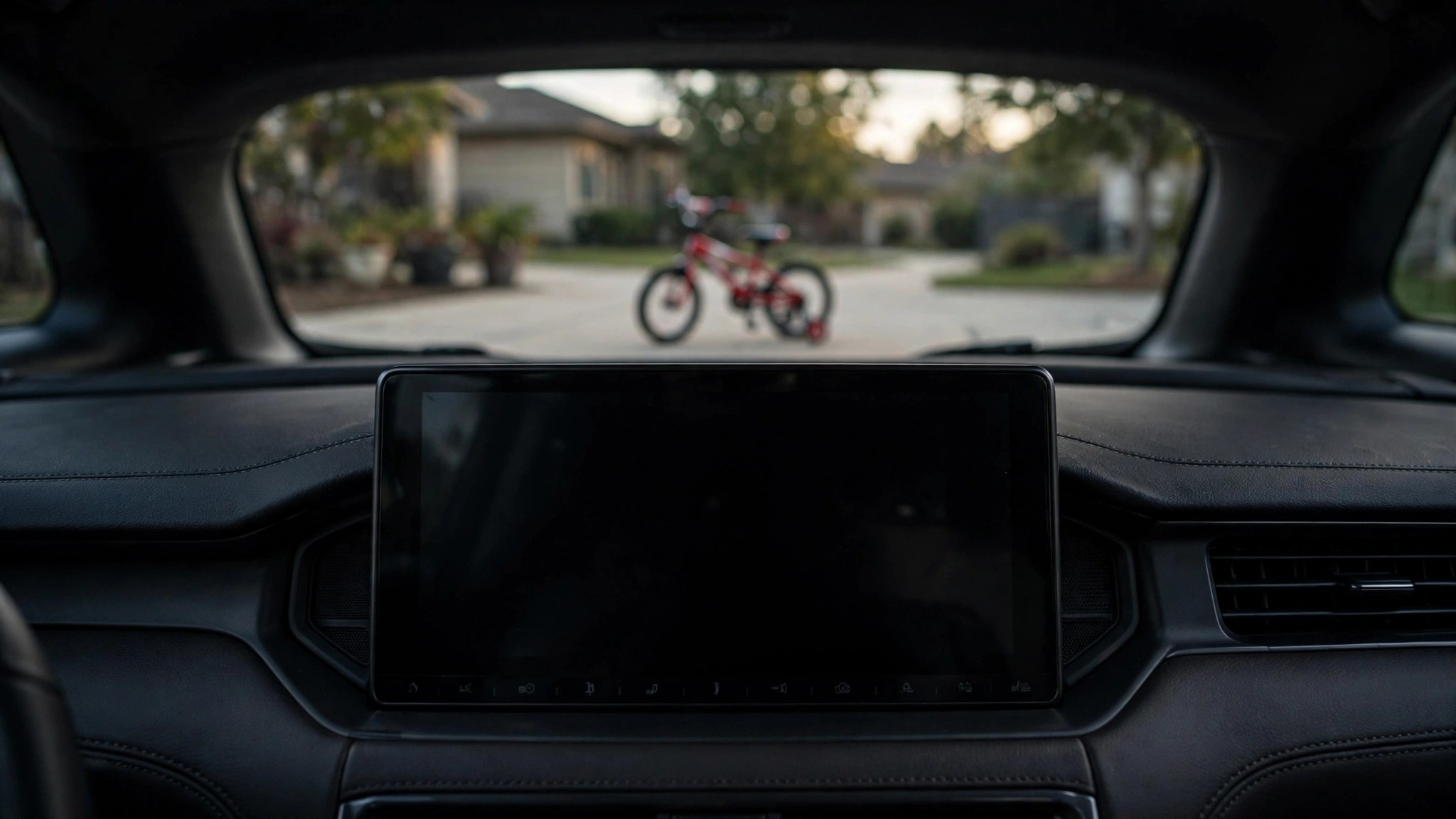
A radio software bug in Stellantis vehicles can blank out the backup camera display. The company's official advice, delivered through spokesperson Frank Matyok to the Detroit Free Press on August 17: drivers of affected vehicles should "rely on driving in reverse the old-fashioned way, using side- and rearview mirrors."[1]
The old-fashioned way. Rearview mirrors. The very technology that a 2007 federal law, a 2014 rulemaking, and an 11-year regulatory slog determined was not good enough, because it was killing roughly 210 people and injuring 15,000 every year in backover crashes.[2] The Cameron Gulbransen Kids Transportation Safety Act, named for a two-year-old boy run over by his own father in the family driveway, mandated backup cameras in every new vehicle sold after May 2018 specifically to replace what mirrors could not do.[3] KidsandCars.org documented 1,126 children under fifteen killed in backover incidents between 1991 and 2012. A third of all non-traffic child fatalities involving vehicles. Mirrors were the only rearward visibility those vehicles offered, and children kept dying behind them.
Then the cameras arrived, and the dying slowed. A UTHealth Houston study presented at the American Academy of Pediatrics conference in September 2025 found a 62% reduction in pediatric backover injuries and a 78% drop in backover fatalities at a level-one trauma center after the mandate took effect.[4] Annual backover cases fell from 7.2 to 2.7. Severe injuries nearly halved. Federal regulation that took more than a decade to finalize was, by the data, working exactly as intended.
Now one software bug undoes it for nearly a million vehicles. The recall spans the 2026-27 Chrysler Pacifica, Pacifica Plug-in Hybrid, and Voyager; the 2026-27 Dodge Charger; the 2026 Jeep Cherokee, Compass, Gladiator, Grand Cherokee, Grand Cherokee L, Grand Wagoneer, Grand Wagoneer L, and Wrangler; and the 2026 Ram 1500, 2500, ProMaster, and ProMaster EV. Four brands, fifteen vehicle lines, nearly every passenger vehicle Stellantis sells in the United States, all running the same Uconnect radio software architecture. Add 82,869 units in Canada, 7,969 in Mexico, and 15,736 elsewhere, and the global count approaches 950,000 vehicles whose federally mandated rear-visibility system can fail at startup.[1]
This is not the first time Stellantis's platform-sharing strategy has turned a single software flaw into a fleet-wide crisis. In 2015, a pair of security researchers demonstrated they could wirelessly hijack a Jeep Cherokee through the Uconnect infotainment system, taking control of brakes, transmission, and steering. That revelation forced a recall of 1.4 million vehicles across Chrysler, Dodge, Jeep, and Ram, all running the same vulnerable software stack.[5] Platform consolidation is how automakers afford to build fifteen different vehicles on profitable margins: one infotainment system, one supplier contract, one codebase. One bug does not knock out a model; it knocks out a company.
To be fair, not every one of these 848,511 vehicles has a broken camera right now. The bug manifests during startup, and Stellantis reports no injuries linked to the defect. A driver who notices the blank display and checks mirrors carefully may reverse more cautiously than one half-watching a functioning camera feed. Mirrors are not zero-value; people drove in reverse for decades before cameras existed. The highest risk falls on drivers who assume their camera works, never glance at the screen, and also do not check mirrors, a behavioral gap the camera was never designed to fill.
But the reason the mandate exists is that the aggregate data does not care about the careful individual; it measures the population. And at the population level, mirrors alone produced 210 annual deaths and 15,000 injuries, a body count that a simple camera cut by more than half. Telling 848,511 drivers to revert to the pre-mandate technology is telling them to accept the pre-mandate risk, at least until an over-the-air update "prompts on their media screen." No timeline for the fix has been announced.
What to do if you own one of these vehicles: Test your backup camera every time you start the car. If the display is blank, walk behind your vehicle before reversing, especially in driveways where children may be present. Check your VIN at nhtsa.gov/recalls and contact Stellantis at 1-800-853-1403 or recalls.mopar.com with questions. When the OTA update prompt appears on your media screen, install it immediately. If you have trouble, a dealership will perform the update at no charge.
Sources & References
- Liam Rappleye, “Stellantis recalls 900,000 vehicles over camera bug,” Detroit Free Press / USA Today, August 17, 2026. usatoday.com
- NHTSA, “Backover crashes cause about 210 deaths and 15,000 injuries each year.” Cited in: HealthDay / Drugs.com, “Backup Cameras Save Kids’ Lives, Study Says,” Sept 26, 2025. drugs.com
- NHTSA Final Rule amending FMVSS 111, effective May 1, 2018. Required rearview cameras on all vehicles <10,000 lbs GVWR. Originated from the Cameron Gulbransen Kids Transportation Safety Act of 2007. KidsandCars.org documented 3,020 non-traffic child fatalities (1991–2012), 1,126 from backover incidents. stnonline.com
- Joly J, et al., “The impact of a federally mandated car safety feature on rate and severity of pediatric backover trauma,” presented at AAP National Conference, Denver, Sept 26–30, 2025. 62% reduction in backover injuries, 78% drop in fatalities. healio.com
- Fiat Chrysler recalled 1.4 million vehicles in 2015 after Uconnect hack demonstration; same shared software architecture across Chrysler, Dodge, Jeep, and Ram. sciencealert.com
Source: NHTSA recall filings, FMVSS 111 rulemaking record, AAP 2025 conference proceedings. Stellantis has reported no injuries related to this defect. See methodology for caveats.