The Silverado’s Blind Zone Doubled in 20 Years. So Did America’s Pedestrian Body Count.
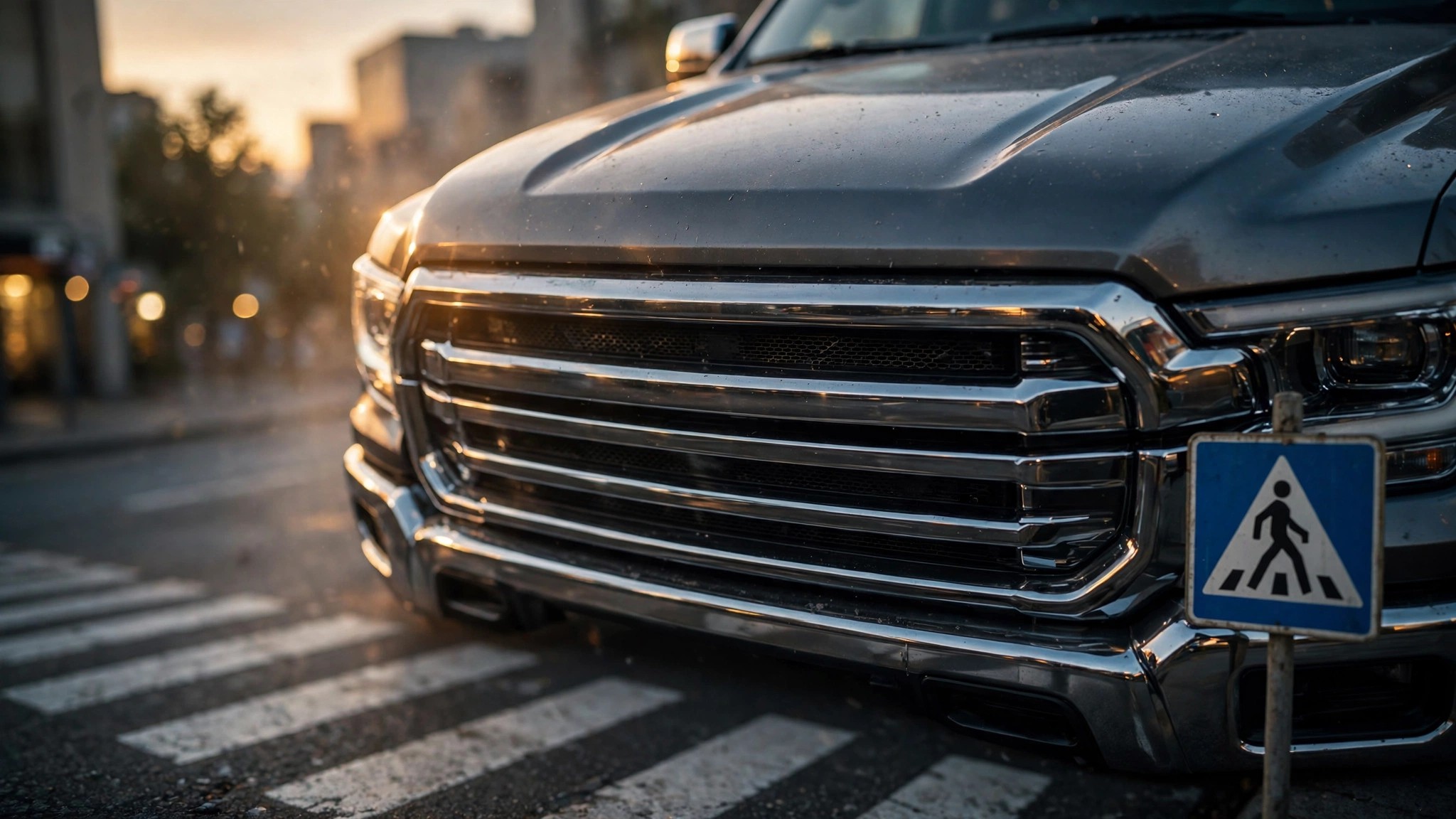
A pickup truck’s blind zone is the patch of ground ahead of the hood that the driver cannot see. In 2004, a Chevy Silverado’s was manageable. By 2024, according to measurements compiled for a New York Times investigation published in June, it had nearly doubled.[1] In that same 20-year window, pedestrian deaths on American roads rose roughly 75 percent.
Researchers cross-referenced federal crash records with vehicle-dimension data, registration filings, and crash-test results. Their conclusion: the growth of pickups and SUVs likely accounts for 200 to 400 additional pedestrian fatalities every year, a conservative estimate totaling roughly 3,000 deaths between 2016 and 2024 linked directly to taller hoods and blunter front ends. Parking lots, driveways, and private-road collisions that never enter the federal database were excluded, meaning the real number is higher.[1]
Four trucks had their blind zone growth measured specifically, and we paired each with a decade of FARS fatality data:[2]
| Pickup | Blind Zone Growth | FARS Deaths | Death Rate |
|---|---|---|---|
| Chevy Silverado | ~100% (doubled) | 9,591 | 1.25 |
| GMC Sierra | ~60% | 3,337 | 1.01 |
| Toyota Tacoma | ~60% | 2,274 | 0.80 |
| Ford F-150 | ~25% | 9,194 | 1.04 |
Silverado and Sierra share GM’s T1 platform: same bones, same A-pillar geometry, same engineering DNA. Combined, those two badges account for 12,928 deaths and 26,816 fatal crashes in a single decade. IIHS separately found that vehicles with hoods above 40 inches are 45 percent more likely to kill a pedestrian than those sitting at 30 inches or below.[3] A current Silverado hood clears roughly 45 inches. Chest height on a 5-foot-6 adult. Eye level on a child.
Impact dynamics explain why height outweighs speed in these collisions. IIHS crash research found that at 27 mph, a median-height pickup carried an 83 percent chance of causing moderate pedestrian injury and a 62 percent chance of serious injury; a median-height car, with a front end 13 inches lower, dropped those odds to 60 and 30 percent.[4] Taller hoods do not graze. They bowl. A pedestrian’s center of mass sits below the contact point, so instead of rolling onto the hood, the body is driven downward into the pavement and under the wheels.
“We see a lot of devastating collisions even at lower speeds because the pedestrian gets punted forward,” said Shawn Harrington, whose company Forensic Rock conducted crash tests for the investigation. “Before the driver knows what’s happened, the pedestrian’s head is under the wheel.”[1]
Academic researcher Justin Tyndall calculated that capping front-fascia height at 49.2 inches would prevent an estimated 509 pedestrian deaths per year, roughly seven percent of 2021’s toll, without requiring a single sensor, software update, or driver-behavior campaign.[5] A ruler. That is the entire intervention. Draw a line across the front of a vehicle; if the hood clears it, the design fails.
Why did blind zones balloon in the first place? Partly because NHTSA’s own rules created a perverse incentive. A 2009 roof-crush standard demanded roofs withstand three times the vehicle’s weight, so automakers thickened A-pillars, the structural columns flanking the windshield, which shielded occupants in rollovers but widened drivers’ blind spots. One regulation designed to protect people inside the vehicle made it harder to see people outside it.[1]
Profit math compounded the physics problem. Full-size pickups now list near $70,000, roughly double what a sedan commands, on manufacturing costs only marginally higher.[1] Ford’s car sales collapsed from over a million units in 2017 to fewer than 100,000 by 2022. Every sedan that left the showroom was replaced by a truck that is taller, heavier, more profitable, and increasingly unable to see the people standing in front of it.
NHTSA has issued no federal hood-height standard. No blind-zone testing requirement exists. No mandatory pedestrian head-impact test has been adopted, despite the EU enforcing one since 2009 under UNECE R127. Instead, the agency ran a “Speeding Catches Up With You” awareness campaign through July. It spent the month telling drivers to slow down while certifying vehicles with blind spots large enough to hide a child.
What this data cannot prove
Correlation here is directional, not causal. Silverado tops the blind zone growth chart and leads FARS pickup deaths at 9,591, but Ford’s F-150 accumulated nearly as many fatalities (9,194) with only a quarter of the blind zone expansion. Fleet size confounds: 6.56 million registered F-150s dwarf 5.69 million Silverados, and more vehicles on the road produce more fatal encounters regardless of blind zone dimensions. FARS captures all fatalities in crashes involving a given model, including occupants, opposing drivers, motorcyclists, and pedestrians. Isolating the subset caused by blind-zone-related scenarios, a child in a driveway or a cyclist beside a right-turning truck, is not possible with the public data. And automakers counter that cameras, cross-traffic alerts, and pedestrian AEB compensate for reduced direct visibility. That claim deserves testing, not faith; NHTSA does not require any of those systems.
What you can do
If you drive a full-size pickup, walk around it. Stand where a 4-year-old would stand, two feet in front of the bumper, and have someone sit in the driver’s seat. Ask them whether they can see you. Check whether your truck has front cross-traffic alert or a surround-view camera and use them at every start. If it has neither, back into parking spaces so you pull forward into traffic with better sightlines. If you are shopping: among the four trucks measured, the F-150 had the gentlest blind zone growth (25 percent) and a FARS death rate of 1.04, seventeen percent lower than the Silverado’s 1.25. Tacoma’s 0.80 rate makes it the safest on this list by a wide margin.
Sources & References
- New York Times investigation on vehicle size and pedestrian deaths, as reported by Carscoops, June 24, 2026. carscoops.com
- NHTSA, Fatality Analysis Reporting System (FARS), 2014–2023. nhtsa.gov
- IIHS, “Vehicles with higher, more vertical front ends pose greater risk to pedestrians,” November 2023. iihs.org
- IIHS, “Vehicle height compounds dangers of speed for pedestrians,” 2024. automotiveworld.com
- Justin Tyndall, “The Effect of Front-End Vehicle Height on Pedestrian Death Risk,” as reported by Autoblog. autoblog.com