The Chrysler Sebring Had the Lowest Impairment Rate in Its Class. It Killed 664 People Anyway.
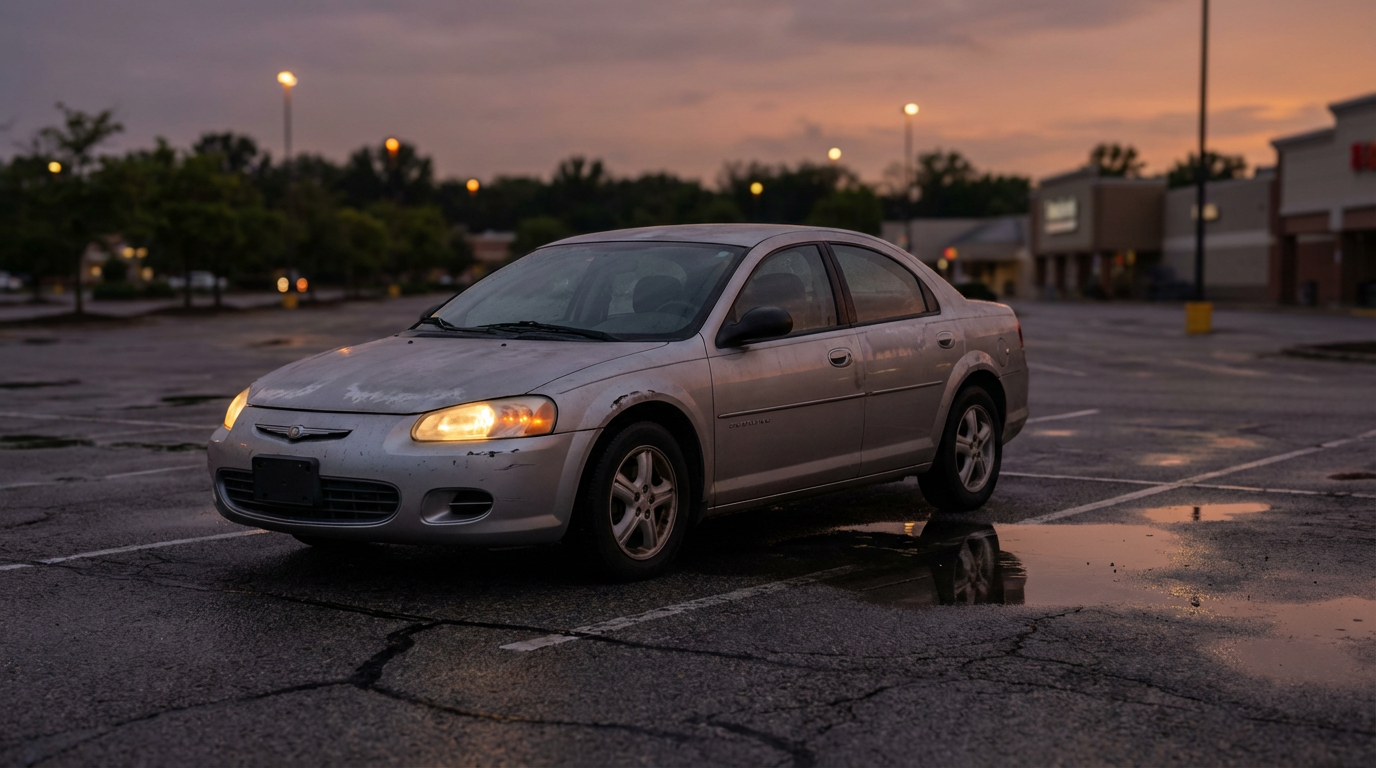
Let’s talk about what happens in the first 150 milliseconds. Actually, let’s talk about what happens in the three years before that — when someone walks into a Chrysler dealership, ignores every instinct telling them the Sebring feels cheap, and drives it home anyway. Because 664 people did that and never came back.
The Chrysler Sebring’s 17.6% impairment rate is the lowest of any midsize sedan in the entire FARS database. Lower than the Camry (19.2%). Lower than the Fusion (19.4%). Lower than the Accord (20.0%). These were, by the numbers, the soberest midsize sedan drivers in America.
And they died at 1.65 deaths per 100 million vehicle miles traveled. Here’s how that stacks up against its segment:
| Midsize Sedan | Deaths | Rate / 100M VMT | Impairment |
|---|---|---|---|
| Honda Accord | 7,102 | 3.07 | 20.0% |
| Nissan Altima | 4,787 | 2.88 | 20.0% |
| Toyota Camry | 6,328 | 2.03 | 19.2% |
| Chevy Malibu | 3,465 | 2.03 | 20.7% |
| Chrysler Sebring | 664 | 1.65 | 17.6% ↓ |
| Hyundai Sonata | 1,887 | 1.56 | 20.4% |
| Ford Fusion | 2,168 | 1.23 | 19.4% |
| Chrysler 200 | 772 | 1.18 | 21.5% |
| Mazda6 | 236 | 1.17 | 22.3% |
Notice something strange? The Sebring’s impairment rate is 2–3 percentage points below every single competitor. These weren’t drunk drivers. These weren’t reckless drivers. These were careful, sober people who happened to be sitting inside a car that folded like a beer can on impact.
The engineering tells the story. The JR platform that underpinned the Sebring from 2001 to 2010 was a cost-reduced architecture shared with the Dodge Stratus. Chrysler saved money on the crash structure, the B-pillar reinforcement, and the side-impact beams. The IIHS gave it a “Poor” rating on the small overlap front crash test — a test that simulates hitting a tree or pole, the kind of impact that actually kills people on real roads.
And then Chrysler did something remarkable: they replaced it. The Chrysler 200, which arrived in 2011 on the Fiat-derived C-Evo platform, has a death rate of just 1.18 per 100M VMT — a 28% improvement. But here’s the twist: the 200’s impairment rate is 21.5%, nearly 4 points higher than the Sebring. Chrysler fixed the car and got worse drivers. The car got safer anyway.
That’s the whole argument for structural engineering over behavioral intervention, distilled into two Chrysler nameplates. You can’t make people drive sober — the Sebring proves that even the soberest class of sedan drivers still dies when the metal fails. But you can make the metal not fail. And when you do, even drunker drivers survive.
The Sebring is gone now. Chrysler killed the 200 too, in 2017. The entire brand sells nothing but the Pacifica minivan. If there’s a lesson in 664 sober deaths, it’s this: cheapness kills. The Sebring cost $21,000 new. The Fusion cost $22,000. One thousand dollars bought you a 25% lower death rate. The market couldn’t tell. The morgue could.