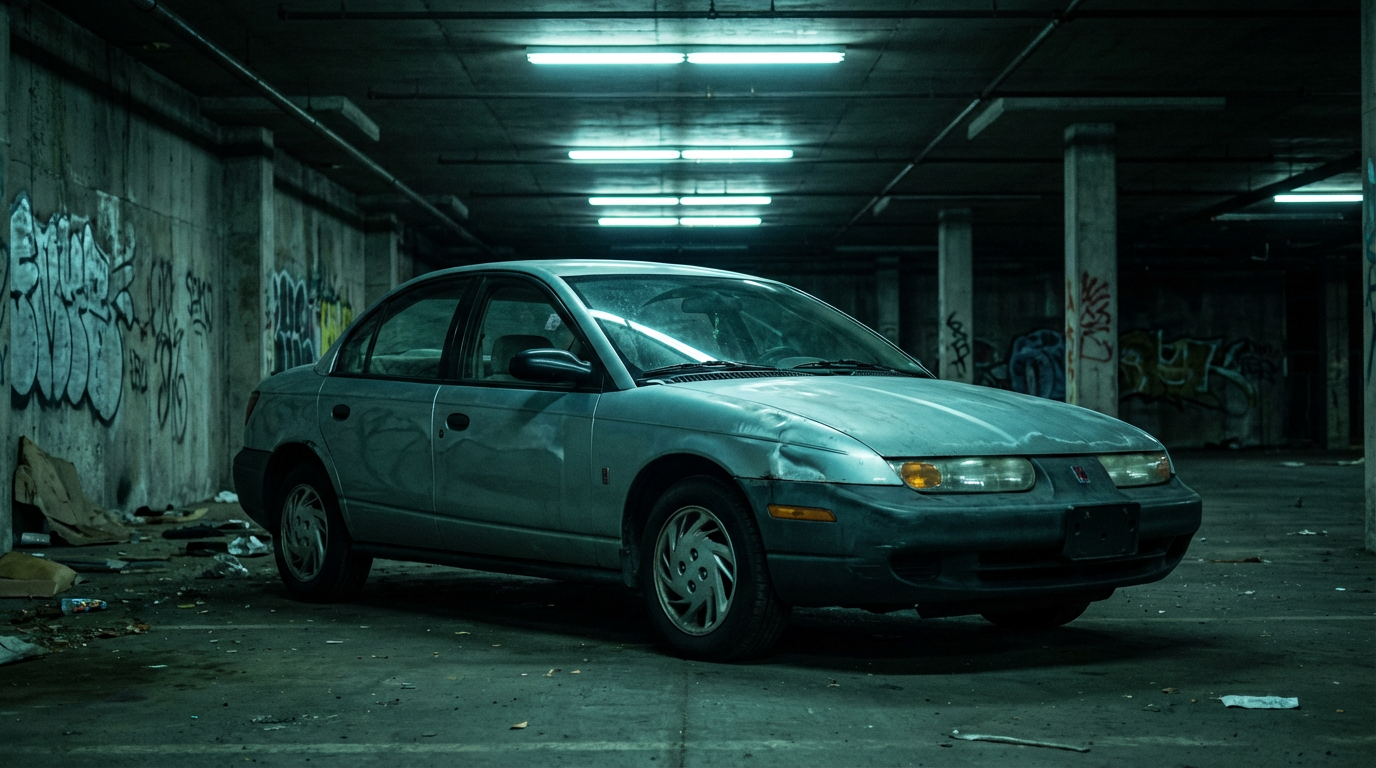
Saturn’s Dent-Proof Panels Couldn’t Stop It From Being the Deadliest Car Per Crash in America
GM spent a decade selling you a body panel. Someone in a Saturn commercial bounces a shopping cart off a door. The polymer flexes, springs back. No dent. A different kind of car company. You watched that and thought: tough car. Of 184 Saturn S Series appearances in FARS fatal crash data, 170 ended with someone dead.[1] That’s 92.4%. Highest of any vehicle with 100 or more fatal crashes in the entire database. The door that survived a shopping cart could not survive being a door.
The Honda Civic — same size, same era, same person buying it on their lunch break — manages 68.1%[1]. Toyota Corolla: 64.1%. The Dodge Neon, a car this publication has already eulogized, posts 85.6%. The Chevy Corvette, a vehicle whose entire personality is arriving somewhere fast enough to die there, comes in at 88.4%.
The S Series beat them all.
The dataset average across 337 models is 56.9%[1]. Saturn sits 35 points above that. In any other domain — test scores, shooting percentages, approval ratings — 35 points above average is remarkable. In this domain, the word is obscene.
Saturn’s polymer panels were real engineering. Genuine innovation. Dent-resistant thermoplastic over a steel spaceframe. GM filed patents, ran ad campaigns, built an entire brand identity around a fender you couldn’t hurt in a Safeway parking lot. The commercials never once mentioned that the steel skeleton underneath was designed to a budget, not a standard. The S Series rode GM’s Z-body platform from 1990 to 2002, a chassis exclusive to Saturn that never got the structural reinforcements GM was quietly bolting onto its Cavaliers and Sunfires through the ’90s[2].
Spring Hill, Tennessee built a car wrapped in cosmetic armor over a skeleton made of corporate optimism.
And it weighed nothing. Under 2,400 pounds in base trim — same as a grand piano, if the grand piano had to merge onto I-65 against a Tahoe. IIHS research shows a 1,000-pound weight disadvantage roughly doubles your fatality risk in a two-vehicle crash[3]. The average new car in 2002 tipped 3,400 pounds. Every Saturn S Series owner commuted in the lightest thing on the highway that wasn’t a motorcycle. The motorcycle at least looked dangerous.
The Corvette at 88.4% — you can tell yourself a story about that. Fast car, probably drunk, met a bridge abutment at 120. Narrative arc. Beginning, middle, end. Satisfying, almost. The Buick Park Avenue, fourth-deadliest at 88.2%, runs 31.7% impairment[1]. Also a story you can hold in your hands.
Saturn S Series impairment rate: 19.2%. Below the dataset average of 20.0%. Alcohol at 12.8%. Drugs at 9.3%.[1]
There is no story. The deadliest car per crash in America was driven by sober people running errands on state routes on Tuesdays. A vehicle that kills you most efficiently when you’re doing absolutely nothing wrong isn’t a car. It’s a philosophical problem wearing a license plate. The universe has a sense of humor but it isn’t funny.
Model year 2002 accounts for 38 of those 170 deaths. 2001 adds 28. 1997 contributes 26.[4] The later models hit hardest because they were still limping through the 2014–2023 study window — 15, 18-year-old Saturns still starting every morning, too cheap to replace and too cheap to have been built right. Cars that outlived their warranty by a decade but couldn’t outlive a Tuesday.
GM killed Saturn in 2010. The S Series was already gone by 2003, replaced by the Ion, which posts an 80.7% lethality rate[1]. Twelfth-worst in the database. Progress. The way falling from the 90th floor is an improvement over the 100th.
Two of the twelve deadliest vehicles in FARS rolled off the same assembly line in Spring Hill. Both wore polymer body panels. Both carried the slogan of a company that positioned itself as the thinking person’s alternative to Detroit. Same factory. Same marketing. Same outcome, twice.
The shopping cart never stood a chance against that door panel.
Neither did anyone sitting behind it.