Ford Sells a Vehicle 43 Times Deadlier Than Another Ford
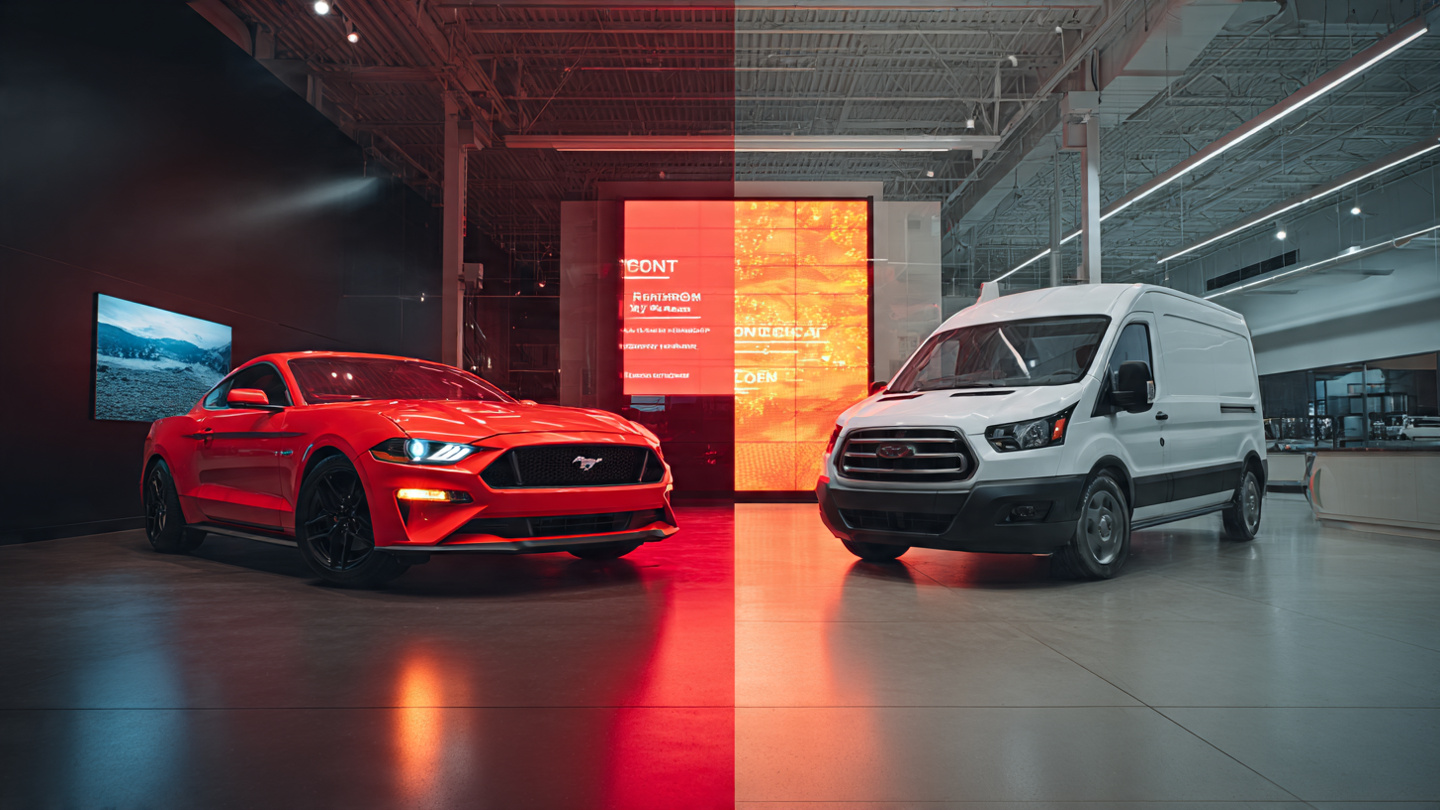
Walk into a Ford dealership and you can leave in a Transit with a fatality rate of 0.14 per 100 million vehicle miles traveled, or a Mustang at 6.02.[1] Same blue oval on both hoods. Forty-three times deadlier.
Ford is not unique in this, because cross-tabulating FARS death rates by make and ranking each automaker's safest model against its deadliest reveals a within-brand safety chasm at every single manufacturer: Chevrolet stretches 25.5× from Traverse (0.20) to Cobalt (5.10), Honda spans 23.6× from HR-V (0.13) to Accord (3.07), Toyota reaches 22.4× from RAV4 (0.19) to Solara (4.25), and Nissan lands at 14.6× from Rogue (0.35) to Maxima (5.11).[1] Even BMW, operating a lineup roughly one-quarter the size of Ford's, stretches 11.9× from X3 (0.23) to 3 Series (2.73), which means brand loyalty buys you absolutely nothing when it comes to keeping your family alive, and picking the wrong model from the right brand is statistically equivalent to rolling the dice on a brand you have never heard of.
Put it in dollars and the picture gets worse. A 2024 Ford Escape lists at approximately $29,000 and kills at 0.95 per 100 million VMT; a 2024 Mustang starts around $32,000 and kills at 6.02.[1] Spend $3,000 more and multiply your fatality odds by 6.3×. Nobody at the dealership will volunteer this information, and window stickers certainly do not carry it, because NHTSA publishes star ratings by individual crash test scenario rather than aggregate fatality rates across the actual fleet, so the single most predictive safety metric available to consumers sits buried in a government database that requires a statistics degree to query.[2]
A pattern emerges across every make in the dataset that should embarrass anyone marketing sedans as safe family vehicles. SUVs and crossovers consistently anchor the safe end of each manufacturer's spectrum while sedans and sports cars dominate the lethal end: Honda HR-V at 0.13 versus Accord at 3.07, Toyota RAV4 at 0.19 versus Solara at 4.25, Mazda CX-5 at 0.12 versus Mazda3 at 1.63.[1] Mass, ride height, and modern crash structures compound into survival advantages that no quantity of airbag marketing can overcome. IIHS vehicle size and weight research has confirmed this relationship for more than two decades, finding 56 deaths per million registered vehicle years for minicars versus 15 for very large SUVs.[3]
What to do before you sign
Check fatality rates by model before you shop, not after; IIHS publishes them at iihs.org/topics/fatality-statistics. If you are deciding between two vehicles from the same manufacturer and the FARS rates differ by more than 3×, that gap should be a mandatory decision factor, weighted above trim level, above color, above whether the dealer throws in floor mats. Newer model years of any given vehicle are dramatically safer because of cumulative ESC, curtain airbag, and structural improvements since NHTSA's 2012 ESC mandate.[4] And for vehicles with fewer than 200,000 registered units, FARS rate estimates carry wider confidence intervals, so cross-reference against IIHS crash test ratings rather than relying on rate alone.[5]
Limitations
FARS captures only fatal crashes, roughly 36,000 of the 6.7 million annual U.S. crashes. A vehicle with a low fatality rate might still produce devastating injury rates invisible to this analysis. Estimated VMT denominators rely on national household travel survey data and fleet registration estimates, introducing approximately ±15% uncertainty for low-volume models.[6] Discontinued vehicles like the Chevrolet Cobalt (subject to GM's ignition switch recall, which itself killed at least 124 people) and Toyota Solara remain in the fleet but skew older; pre-ESC engineering inflates their rates relative to current-production models that benefit from the 2012 mandate.[7] Fatality rates also do not distinguish between occupant deaths and deaths the vehicle caused to pedestrians, cyclists, and other road users.
Strongest counterargument
Vehicles do not randomly assign their drivers. A Mustang attracts a younger, more aggressive driving population than a Transit, which is operated overwhelmingly by commercial fleet drivers subject to employer oversight, drug screening, and route discipline. If IIHS size research explains a 3.7× gap from vehicle mass and geometry alone, and the observed within-make spread reaches 43×, the remaining ~11.6× factor must be some combination of driver selection bias, fleet age effects, and use-case divergence that this cross-tabulation cannot disaggregate.[3] Both vehicle choice and driver behavior independently predict crash outcomes; honest analysis cannot assign their relative contributions from FARS data alone, and some fraction of that 43× headline number is people, not engineering.
Sources & References
- NHTSA, Fatality Analysis Reporting System (FARS), 2014–2023. Cross-tabulation of fatality rates per 100M VMT by vehicle make and model. nhtsa.gov
- NHTSA, FARS Query Tool. Interactive access to fatal crash data by vehicle, person, and crash characteristics. cdan.dot.gov
- IIHS, Vehicle Size and Weight. Driver death rates by vehicle type and size category, 2017–2020 models. iihs.org
- NHTSA, Federal Motor Vehicle Safety Standard No. 126: Electronic Stability Control, Final Rule, 72 FR 17236 (2007). ESC mandate effective 2012 model year. govinfo.gov
- IIHS, Fatality Statistics. Annual fatality facts including rates per registered vehicle and per VMT. iihs.org
- FHWA, National Household Travel Survey (NHTS). Vehicle miles traveled estimates by household, vehicle type, and geography. nhts.ornl.gov
- General Motors ignition switch recalls. At least 124 deaths linked to defective ignition switches in Cobalt, Ion, and related models. Wikipedia