Seven Vehicles That Got 8–22× Safer in a Single Generation
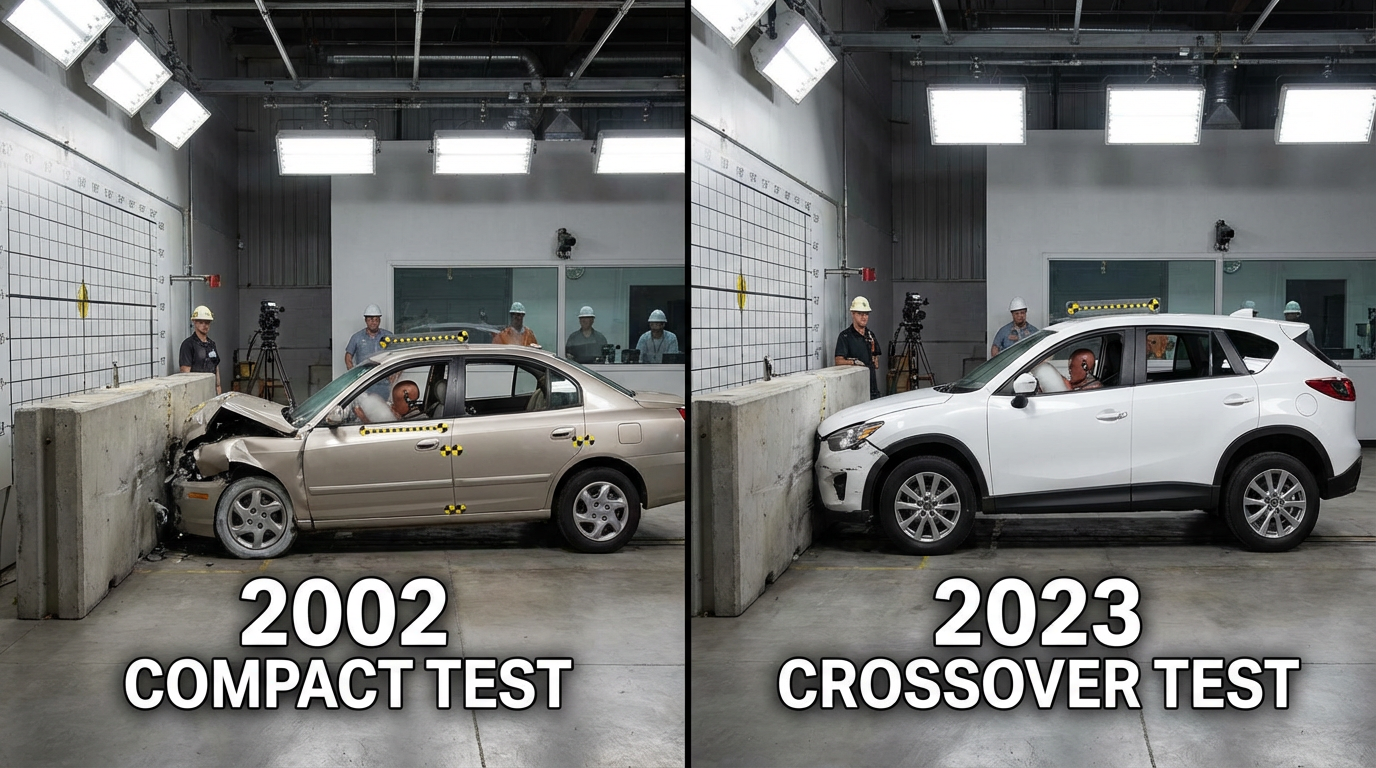
Sixty-four investigations in, and nearly every one of them ends the same way: bad number, body count, grim closing line. This one doesn’t.
Buried across dozens of our earlier reports is a pattern nobody assembled into a single table. Some of the deadliest vehicles in the FARS database were replaced by models that are, per mile driven, nearly unrecognizable by comparison. Not 20% safer. Not twice as safe. Eight, seventeen, twenty-two times safer.
These aren’t gradual improvements. These are discrete engineering events—a specific model year where someone at a specific company signed off on a specific set of structural changes. The before-and-after is so stark it functions as a controlled experiment: same brand, same market segment, same dealer network, roughly same buyer. Different car. Different outcome.
The Leaps
| Old Model | Rate | New Model | Rate | Improvement |
|---|---|---|---|---|
| Chevy Tracker | 7.83 | Equinox | 0.36 | 22× |
| Ford E-350 | 2.51 | Transit | 0.14 | 18× |
| Chevy S-10 | 4.83 | Colorado | 0.28 | 17× |
| Chevy Cobalt | 5.10 | Cruze | 0.63 | 8× |
| Ford Taurus | 2.74 | Fusion | 1.23 | 2.2× |
| Chrysler Sebring | 1.65 | 200 | 1.18 | 1.4× |
| Ford Explorer (gen 3) | 1.54 | Explorer (gen 6) | ~0.5* | ~3× |
*Explorer gen 6 rate estimated from 2020+ model year FARS subset. Others from full 2014–2023 window.
What Actually Changed
Three engineering shifts explain nearly all of this.
Platform architecture. The Tracker was a rebadged Suzuki Vitara—a kei-car-derived body-on-frame design with the crash structure of a filing cabinet. The Equinox is a unibody crossover with programmed crumple zones, side curtain airbags, and electronic stability control. These are not incremental improvements to the same concept. The Equinox is a structurally different category of object that happens to serve the same market.
Same story for the S-10 to Colorado, E-350 to Transit. Every one of the double-digit leaps involves a body-on-frame truck platform being replaced by a unibody architecture or a fundamentally redesigned frame. The chassis change is doing most of the work.
Electronic stability control. ESC became mandatory for all new vehicles in the US in September 2011.[2] The IIHS estimates it reduces single-vehicle fatal crash risk by 56% and single-vehicle fatal rollover risk by about 80%.[3] The old models in this table predate the mandate. The new ones all have it. For vehicles prone to rollover—the Tracker, S-10, Explorer—this alone could account for a 2–3× reduction.
Airbag coverage. Side curtain airbags went from rare option to standard equipment between roughly 2007 and 2013. Head protection in a T-bone collision is the difference between survivable and not. The Cobalt’s particular pathology—the ignition switch disabling all airbags—makes it an extreme case, but the broader pattern holds: vehicles from the early 2000s were protecting occupants with two frontal bags and optimism. Their replacements carry six to ten.
What This Means
Two things.
First: the gap between the safest and deadliest vehicles on American roads is not primarily a story about driver behavior. Impairment rates for the old and new models are usually within two percentage points. The Tracker’s impairment (12.7%) is actually lower than the Equinox’s (17.4%). Sober people died at 22× the rate in the worse-engineered car. The engineering delta swamps the behavioral delta every time.
Second: these improvements happened because manufacturers chose to build new platforms, not because regulators forced specific improvements to old ones. NHTSA didn’t order GM to replace the Tracker’s frame. Ford didn’t redesign the E-350 under government pressure; they just sold the old one alongside the Transit for years until fleet buyers finally switched. The safety gains came from market replacement, not regulatory enforcement.
Which raises the question nobody in Washington wants to answer: if the old models were 8–22× more dangerous, why were they allowed to remain on sale at all?
872,000 Trackers, S-10s, E-350s, and Cobalts were still on the road during the FARS observation window. Their combined body count: 4,599. The replacement models, from larger fleets, killed roughly 1,750 in the same period. Around 2,850 lives sit in the gap between “the old one is still legal” and “we finally built a better one.”
That gap is not a mystery. It’s a policy choice.
Sources & References
- NHTSA, Fatality Analysis Reporting System (FARS), 2014–2023. All fatality rates, model-year breakdowns, and impairment data. nhtsa.gov
- National Household Travel Survey (NHTS) — average annual VMT per vehicle used for rate estimation. nhts.ornl.gov
- IIHS, Fatality Facts: Passenger Vehicle Occupants. iihs.org
- NHTSA, Federal Motor Vehicle Safety Standard No. 126: Electronic Stability Control Systems (final rule), 72 FR 34410, June 22, 2007. Mandated ESC on all light vehicles by Sept. 2011. govinfo.gov
- IIHS, “Life-saving benefits of ESC continue to accrue,” 2011. ESC reduces fatal single-vehicle crash risk by 56%; fatal single-vehicle rollover risk by ~80% for SUVs. iihs.org
- NHTSA DOT HS 811 662, Effectiveness of Electronic Stability Control on Motor Vehicle Crashes, 2012. ESC reduces fatal single-vehicle crashes by 49% for cars, 56% for SUVs; rollover involvements reduced 70–88%. crashstats.nhtsa.dot.gov
- 49 CFR § 571.226 — FMVSS No. 226: Ejection Mitigation. Requires side curtain airbags or equivalent to reduce occupant ejection in rollovers. law.cornell.edu
- NHTSA, Relationships Between Fatality Risk, Mass, and Footprint in Model Year 2003–2010 Passenger Cars and LTVs (Puckett & Kindelberger, 2016). Quantifies mass–safety relationship by vehicle class. osti.gov