 ← Back to The Crash Report
The Gap
← Back to The Crash Report
The Gap
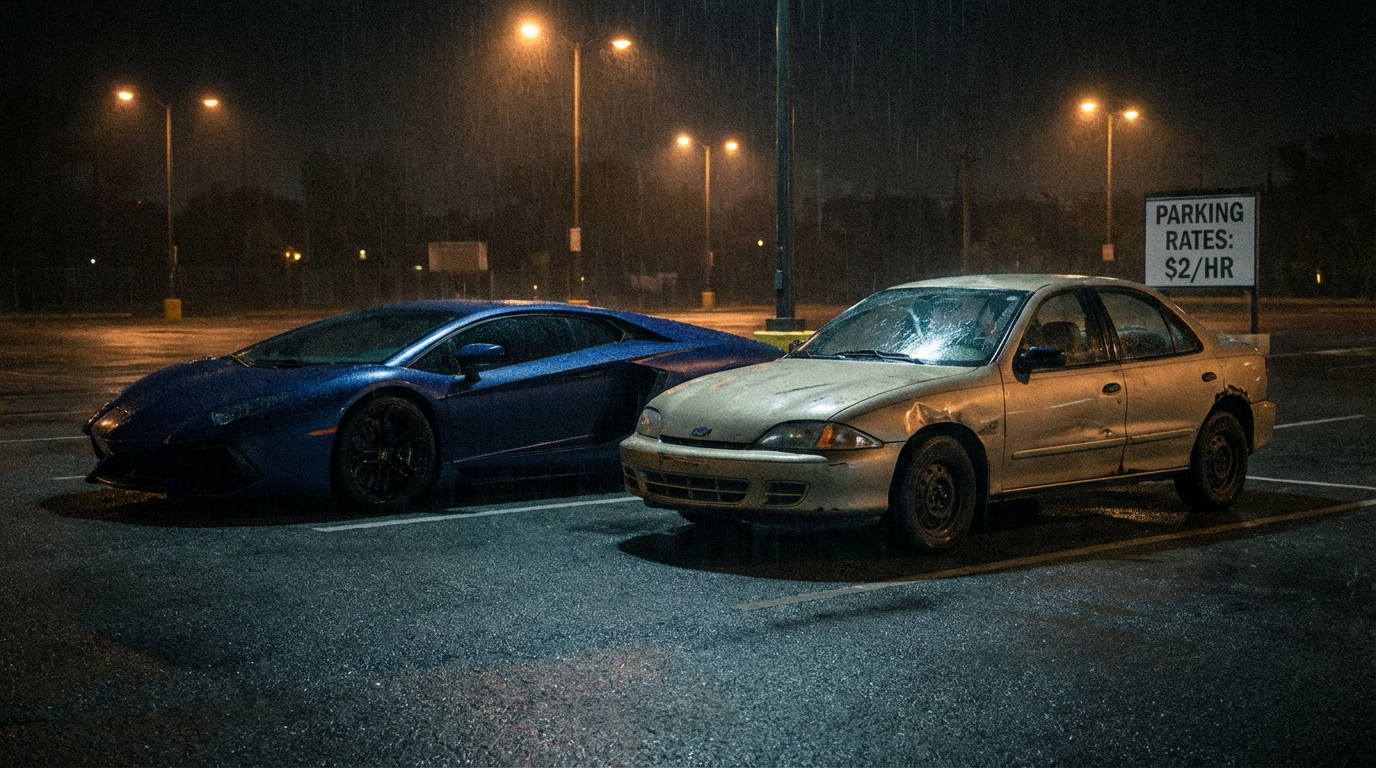
A Porsche 911 Driver Drinks as Much as a Cobalt Driver. One Is 7× More Likely to Survive.
26.5× — the death rate gap between an Audi Q5 and a Ford Ranger. Their impairment rates are within 2.4 percentage points of each other.
The Porsche 911 has a 22.8% impairment rate in fatal crashes. The Chevrolet Cobalt has 22.4%.[1]
Read that again.
Same percentage of drivers in fatal crashes were drunk or drugged. But the 911 has a death rate of 0.69 per 100 million VMT. The Cobalt’s is 5.10.[2] That’s a 7.4× gap, and it has nothing to do with who was sober.
| Luxury / Premium | Rate | Impairment | Economy / Budget | Rate | Impairment | Gap |
|---|---|---|---|---|---|---|
| Audi Q5 | 0.11 | 22.5% | Ford Ranger | 2.91 | 20.1% | 26.5× |
| BMW X5 | 0.40 | 19.7% | Chevrolet Tracker | 7.83 | 12.7% | 19.6× |
| Volvo S60 | 0.44 | 22.2% | Nissan Maxima | 5.11 | 20.9% | 11.6× |
| Mercedes E-Class | 0.64 | 23.5% | Chevrolet Impala | 5.00 | 21.4% | 7.8× |
| Porsche 911 | 0.69 | 22.8% | Chevrolet Cobalt | 5.10 | 22.4% | 7.4× |
| Lexus RX | 0.43 | 17.7% | Chevrolet Trailblazer | 2.83 | 22.1% | 6.6× |
The impairment column is almost flat. Twenty percent here, twenty-two percent there. A couple of percentage points either way. Behavior doesn’t change much with income. What changes is what happens when things go wrong.
That BMW X5 versus Tracker line is the worst of it. The Tracker’s drivers are soberer than the BMW’s—12.7% impairment versus 19.7%—and still die at nearly twenty times the rate. Better behavior, worse car, dead.
This isn’t a Porsche-versus-Cobalt story. It’s a structural inequality story wearing seatbelts. The features that keep you alive—electronic stability control,[3] advanced airbag arrays, rigid passenger cells, automatic emergency braking—correlate almost perfectly with price. IIHS research confirms that vehicle weight and structure explain the majority of occupant protection, and those attributes track directly with sticker price.[4]
The 2011 ESC mandate narrowed the gap for new cars. But the FARS data covers 2014–2023, and millions of pre-mandate vehicles remained on the road throughout that window. The Cobalt, the Tracker, the S-10—they never got ESC. Their drivers couldn’t buy their way out.
The average new-car transaction price in 2023 was $48,759.[5] A Mercedes E-Class starts above $58,000. An Audi Q5 above $45,000. A used Cobalt on Craigslist runs about $4,000. The 7.4× death rate gap maps almost linearly onto the 14× price gap.
We spend $800 million a year on DUI enforcement.[6] We spend nothing helping people in $4,000 cars get into $25,000 ones. Every pair in that table has nearly identical behavior and radically different outcomes. The policy intervention that would save the most lives isn’t a breathalyzer. It’s a down payment.
Sources & References
- NHTSA, Fatality Analysis Reporting System (FARS), 2014–2023 — toxicology records, driver-level impairment. nhtsa.gov
- NHTSA FARS 2014–2023, estimated fatality rate per 100M vehicle-miles traveled using NHTS annual miles by vehicle class. nhts.ornl.gov
- IIHS, “Life-saving benefits of ESC continue to accrue,” 2011. iihs.org
- IIHS, “Supersizing vehicles offers minimal safety benefits, but substantial dangers,” 2024. iihs.org
- Kelley Blue Book, Average New-Vehicle Transaction Price Analysis, June 2023. kbb.com
- Pacific Institute for Research and Evaluation (PIRE), Costs of Alcohol-Impaired Driving in the United States. nhtsa.gov
Data: NHTSA FARS 2014–2023. Rates estimated from fleet size and annual VMT by class. Editorial analysis by The Crash Report.