GM Built the Deadliest Compact Pickup in America. Then It Built the Safest.
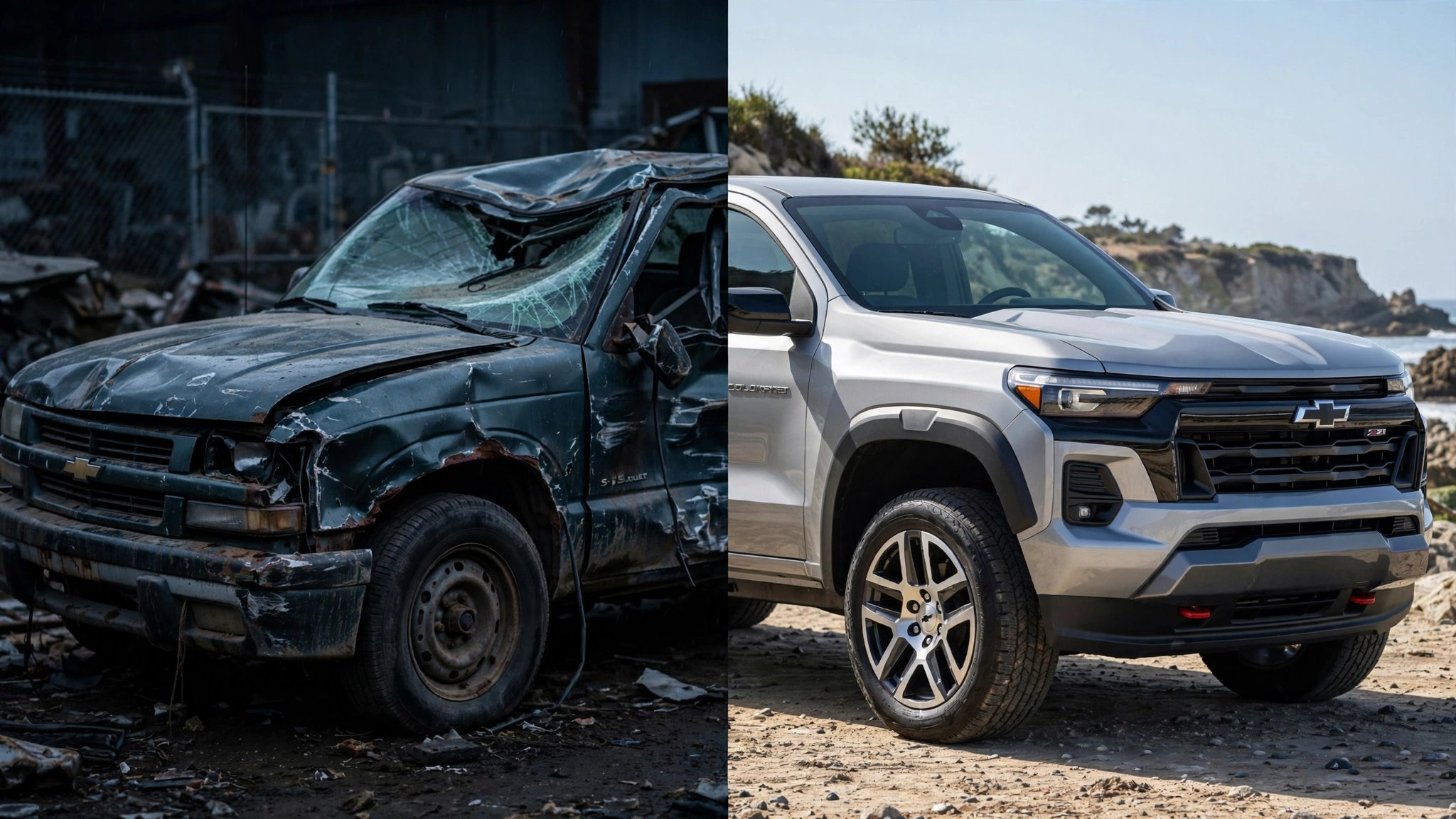
Let's talk about what happens in the first 150 milliseconds. In a 1998 Chevrolet S-10 hitting the IIHS moderate overlap barrier, the footwell crushes inward 29 centimeters, the A-pillar retreats 16 centimeters toward the driver's skull, and the steering column rams 14 centimeters rearward while the dummy rebounds off the airbag, slams toward a bowed-out driver door, and nearly strikes the windowsill with its head.[2] IIHS rated restraint performance "Poor."
In a 2025 Colorado taking the same test, footwell intrusion measures six centimeters, A-pillar rearward movement is zero, and the steering column actually shifts one centimeter forward, retreating from the driver.[3] Twenty years of engineering turned a collapsing cabin into a rigid survival cell.
FARS data from 2014 through 2023 records 1,427 deaths in the S-10 at a rate of 4.83 per 100 million VMT, while the Colorado posted 348 at 0.28.[1] Same badge, same segment, and one kills at 17.3 times the rate of the other.
Fleet size makes the gap worse: 918,750 Colorados share the road against only 218,750 S-10s, yet the S-10 accumulates four times more deaths per mile driven. Crashworthiness ratios explain why: for every fatal S-10 crash in FARS only 1.32 total crashes appear, meaning 76 percent killed someone, while the Colorado's ratio of 2.04 means roughly half let someone walk away.
Impairment plays no meaningful role: S-10 drivers test positive at 20.5 percent, nearly identical to the Colorado's 19.0 percent and the national fleet average, and what separates these trucks is two decades of structural engineering, not driver behavior.
Among compact pickups with at least 200 deaths, the S-10 sits dead last: Ford Ranger at 2.91, Dodge Dakota at 2.62, even GM's own platform twin the Sonoma at 2.13.[1] At the safe end, the Tacoma manages 0.80 and the Colorado anchors the bottom at 0.28.
A fair counterargument: fleet age explains much of the gap, because vehicles twenty-two years past production inherit every safety deficit of their era. But the S-10 was already dead last among compact pickups when its peers were the same age, and its platform twin, the Sonoma, performs measurably better with identical vintage. Age amplifies bad design; it does not create it. One caveat: FARS captures only fatal crashes, so the S-10's crash-to-death ratio might look different in a non-fatal injury dataset, and VMT-based rate estimates carry ±15% uncertainty for smaller registered fleets.
If you own or are considering a used S-10, check your VIN at nhtsa.gov/recalls for outstanding recalls, and understand that this vehicle's structural crash protection sits a generation behind every compact pickup sold after 2004. If you're shopping used, the Colorado's 0.28 and the Tacoma's 0.80 are your benchmarks.
GM discontinued the S-10 in 2004, but twenty-two years later 218,750 remain on the road. By the standards of 2026, they are rolling monuments to what "acceptable risk" used to mean.