20% of Americans Live in Rural Areas. 41% of Traffic Deaths Happen There. Here’s Why the Math Keeps Getting Worse.
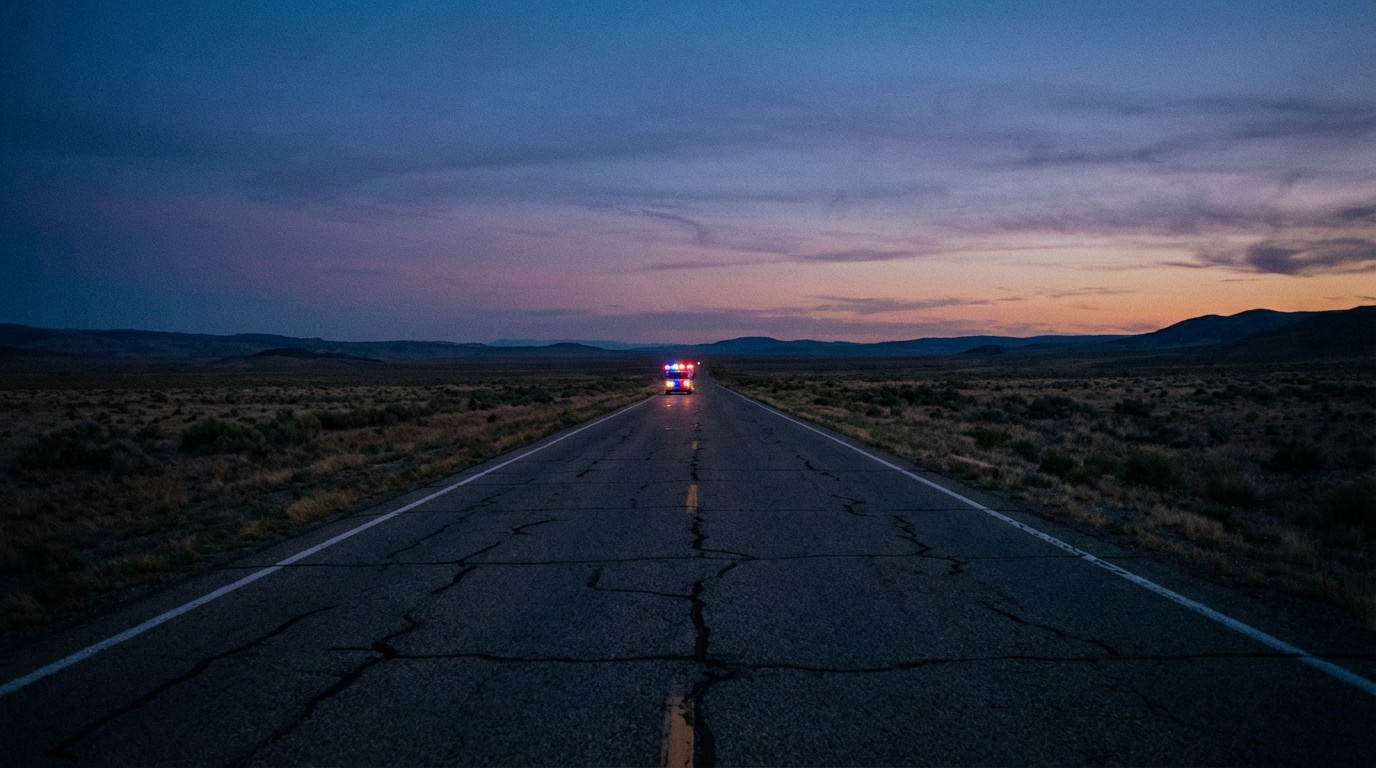
I ran the numbers. Then I ran them again. They didn’t get better.
Sixty-six million Americans live in rural areas. That’s 20% of the population. They drive 31% of the vehicle miles traveled. They account for 41% of all traffic fatalities.[1]
Per-capita rural traffic death rate: 25.2 per 100,000 residents. Urban: 9.1 per 100,000.[1] That’s a 2.8x multiplier for living outside a metro area. Not 10% worse. Not 50% worse. Nearly three times as deadly.
And that 2.8x actually understates the problem, because the usual metric everybody reaches for is per-VMT, not per-capita. Per-VMT, rural roads are 1.65 deaths per 100 million miles vs. 1.07 urban, a 54% gap.[1] Sounds more manageable. Except rural people don’t choose to drive more. There is no bus. There is no subway. The grocery store is 18 miles away. Per-VMT normalizes away the forced exposure. Per-capita captures it.
Three clocks, one patient
A crash on a rural two-lane at 11 PM starts three independent clocks. Each one ticks against you. None of them care about the others.
Clock one: speed
Seventy-two percent of rural traffic fatalities involve speeds at or above 55 mph.[1] Urban: 29%. The crash severity gap is baked in before anyone dials 911.
| Speed at Impact | Kinetic Energy Multiplier (vs. 35 mph) |
|---|---|
| 35 mph (urban arterial) | 1.0× |
| 45 mph | 1.65× |
| 55 mph (rural highway) | 2.47× |
| 65 mph (rural interstate) | 3.45× |
At 55 mph, kinetic energy is 2.47 times what it is at 35. That’s not a linear increase. Energy scales with velocity squared. A rural crash at posted speed delivers roughly two and a half times the destructive force of an urban crash at posted speed. Same car, same driver, same seatbelt. Completely different injury severity.
Rural roads also have narrower lanes, fewer barriers, more fixed objects (trees, utility poles, ditches) within the clear zone, and higher rates of head-on collisions due to two-lane undivided layouts. The road itself offers fewer second chances. No median cable barrier. No forgiving shoulders. Miss the curve and you hit whatever is on the other side of the ditch.
Clock two: EMS response
A study presented at the American College of Surgeons Clinical Congress in 2025 analyzed 4,647 high-acuity trauma patients and found rural patients waited a median of 97.1 minutes from 911 call to operating room, compared to 69 minutes nationally.[2] That’s 28 extra minutes when bleeding. And 39.3% of rural EMS calls are classified as high-acuity, compared to 26.4% nationally.[2] The injuries are worse and the wait is longer.
Twenty-eight minutes sounds abstract. Huang et al. (2024) made it concrete: each additional minute of EMS transport delay increases the odds of fatality by 2.6%.[3]
Compound that across 28 minutes and the rough math suggests a 73% higher fatality probability from delay alone. The caveat: this is a simplified compounding estimate, not a direct measurement from the ACS study. Real-world outcomes depend on injury type, hemorrhage rate, and pre-hospital interventions. But the direction is clear and large. Time kills trauma patients, and rural America has less time.
Many rural EMS agencies are volunteer-staffed. Response times are measured from pager activation to arrival, and in some counties that window stretches past 20 minutes before a single wheel turns. The ambulance itself may be a BLS (basic life support) unit, not ALS (advanced life support), meaning no paramedic on board, no blood products, and limited interventions en route. Clock two is not just a distance problem. It’s a capability problem.
Clock three: the disappearing hospital
One hundred eighty-two rural hospitals have closed since 2010.[4] Four hundred thirty-two more are rated vulnerable to closure. That’s not a medical infrastructure problem that might happen. It’s one that’s been happening for 16 years.
Rural trauma patients are four times more likely to be treated at a Level III or Level IV trauma center (or a facility with no trauma designation at all) compared to urban patients.[5] The difference between a Level I trauma center and a Level III is the difference between a full surgical team on standby and a general surgeon who might be 30 minutes from the building.
When the nearest Level I or Level II center is a helicopter ride away, clock three doesn’t just tick. It determines whether clocks one and two matter at all. A survivable crash at 55 mph with a 28-minute EMS response becomes unsurvivable if the destination is a critical access hospital that can stabilize but not operate.
The convergence
Each clock is documented independently. Nobody publishes the compound.
| Clock | Rural Disadvantage | Source |
|---|---|---|
| Speed | 72% of fatalities at 55+ mph (vs. 29% urban) | IIHS/FARS |
| EMS | 97.1 min vs. 69 min (28 min longer) | ACS 2025 |
| Hospital | 4× more likely at lower-level trauma center | Rural Health Info Hub |
A crash at 60 mph on a county road at night. Volunteer EMS arrives in 22 minutes. Nearest hospital is 40 miles away and has no surgeon on call after midnight. That’s not a hypothetical. It’s a Tuesday in most of rural America.
16,656 people died in rural traffic crashes in 2023.[1] Divide by 66 million rural residents: 25.2 per 100,000. Urban: 23,921 deaths among 264 million residents: 9.1 per 100,000. The 2.8x gap isn’t one factor. It’s three clocks running simultaneously, each independently lethal, none of them being stopped.
The objection: “Rural people just drive more”
Fair. Rural residents drive approximately 40% more annual miles than urban residents.[6] More exposure should mean more crashes. This is the standard dismissal: normalize for VMT and the gap shrinks from 2.8x to 1.54x.
But 1.54x means each individual mile on a rural road is still 54% more likely to kill you than the same mile in a city. Even after accounting for the extra driving, rural roads are substantially more dangerous per mile traveled. The VMT normalization doesn’t explain the gap. It just makes it smaller.
The behavioral data makes this harder to dismiss. Rural alcohol involvement in fatal crashes: 28%. Urban: 30%. Rural speeding involvement: 28%. Urban: 30%.[1] Nearly identical. Rural drivers aren’t drunker. They aren’t driving faster relative to posted limits. The posted limits are just higher, the roads are less forgiving, and the system behind the crash is worse.
And the VMT framing ignores the core injustice: rural driving isn’t optional. There is no alternative. Normalizing per-VMT treats forced exposure the same as elective exposure. A commuter who chooses to drive 60 miles because housing is cheaper and a rural resident who drives 60 miles because it’s the nearest hospital show up as identical in the denominator. They are not.
Sweden closed the gap. America closed the hospitals.
Sweden has rural roads. Long ones. Dark ones. Sparsely populated counties where the nearest trauma center is an hour away. Their rural fatality rate is roughly one-quarter of the US rate.[7]
The difference is 2+1 roads. Sweden systematically rebuilt its rural two-lane highways into alternating three-lane configurations: two lanes in one direction, one in the other, separated by a cable barrier, swapping every few kilometers. Head-on collisions, the most lethal rural crash type, become nearly impossible. Rollovers into ditches are caught by the cable. Cost: a fraction of building a new divided highway.
America’s solution to the rural driving problem was to close 182 hospitals, cut EMS budgets, and leave the roads untouched. Three clocks, ticking in the same direction, for 16 years.
The numbers, stripped bare
| Metric | Rural | Urban | Ratio |
|---|---|---|---|
| Population share | 20% | 80% | — |
| VMT share | 31% | 69% | — |
| Fatality share | 41% | 59% | — |
| Deaths per 100K residents | 25.2 | 9.1 | 2.8× |
| Deaths per 100M VMT | 1.65 | 1.07 | 1.54× |
| % fatalities at 55+ mph | 72% | 29% | 2.5× |
| Median 911-to-OR (high acuity) | 97.1 min | ~69 min | +28 min |
| High-acuity call share | 39.3% | 26.4% | 1.5× |
| Alcohol involvement | 28% | 30% | ~equal |
| Speeding involvement | 28% | 30% | ~equal |
| Hospitals closed since 2010 | 182 | — | — |
Twenty percent of the population. Forty-one percent of the deaths. Three clocks that nobody is winding back. Every data point in this table is getting worse, not better. Hospital closures are accelerating. EMS volunteer recruitment is declining. Speed limits on rural roads haven’t changed. The math keeps getting worse because nothing is being done to change any of the three inputs.
Methodology and limitations
Fatal crash counts use IIHS compilations of NHTSA FARS data (2023). “Rural” follows FARS definitions based on Census Bureau urban-rural classification, which categorizes by population density, not county boundaries. Per-capita calculations use Census estimates of 66 million rural and 264 million urban residents (2023).
EMS response time data comes from the ACS Clinical Congress 2025 study (n=4,647 high-acuity trauma patients). The 2.6% per-minute fatality increase comes from Huang et al. (2024), a separate study with different methodology. Compounding the two to estimate a 73% increase is an approximation, not a directly measured outcome from either study.
Hospital closure data comes from the Chartis Center for Rural Health (2025), which tracks closures and vulnerability using financial metrics. “Four times more likely at lower-level trauma center” is from the Rural Health Information Hub, aggregating HRSA and ACS data. Sweden’s rural fatality comparison uses OECD/ITF transport safety data; direct comparison is complicated by different vehicle fleets, speed limits, and road geometries.
The three-clock framework structures three independently documented risk factors. No single study has measured the compound effect of all three simultaneously in the same patient cohort. Each clock is well-documented individually; the convergence is analytical, not empirical. Statistical analysis performed with computational assistance.