A Concrete Circle Prevents 82% of Fatal Intersection Crashes. America Builds 409 a Year.
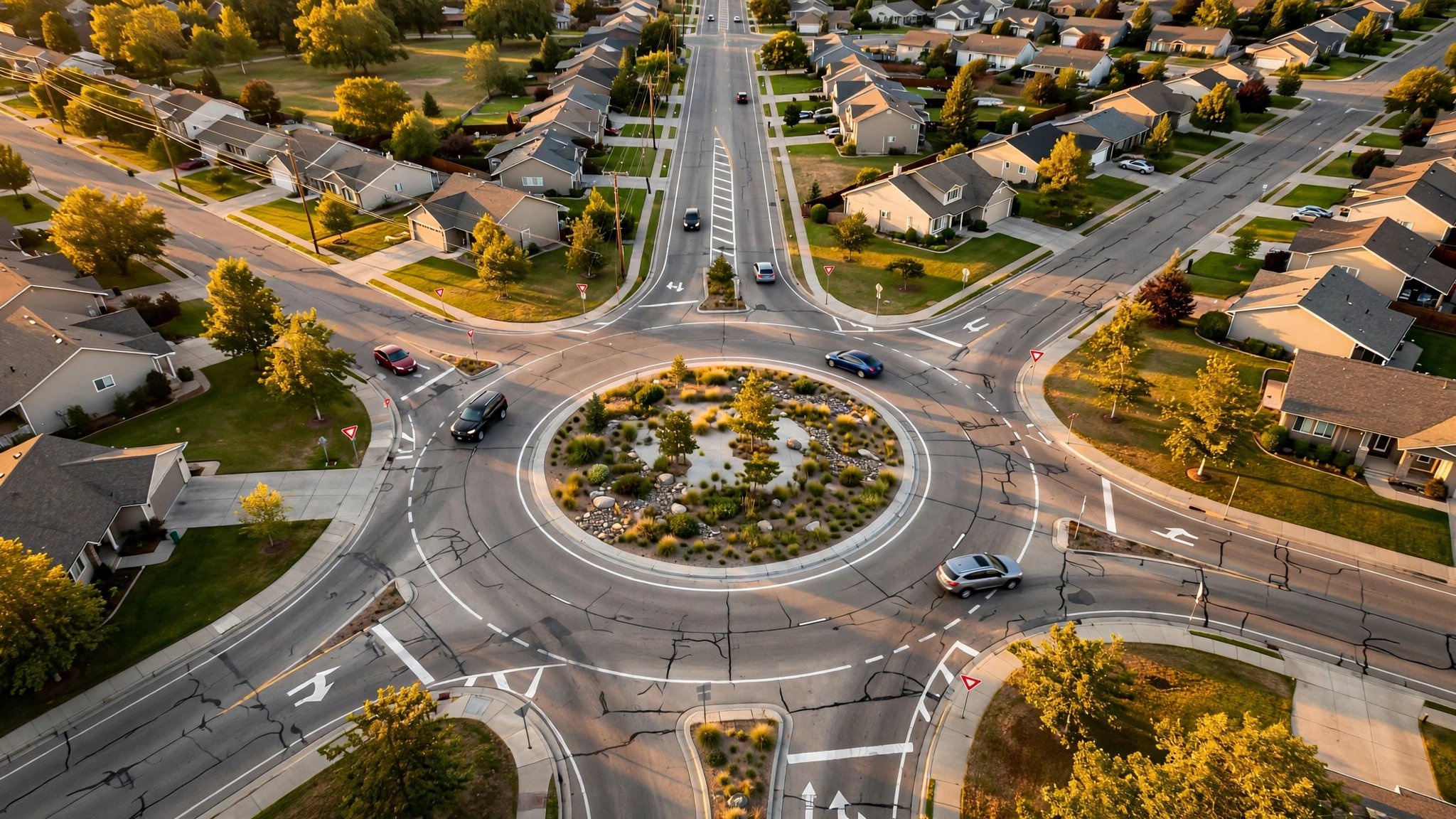
Intersections kill about 9,400 Americans a year. That is 23 percent of all traffic fatalities, a proportion that has barely moved in two decades, logged by NHTSA year after year in the Fatality Analysis Reporting System while engineers on three continents have been sitting on a fix that cuts the death rate by 82 percent.[1][2] Not a theoretical fix requiring software validation or fleet-wide OTA rollout, but a circle of concrete with a landscaped island in the middle.
The math here is so clean it is almost insulting. The Federal Highway Administration classifies roundabouts as a Proven Safety Countermeasure, the highest designation in its toolkit, and publishes the number: 82 percent average reduction in fatal and injury crashes when a traditional intersection is converted to a roundabout.[1] An IIHS study of 24 US intersections found 90 percent fewer fatal and incapacitating crashes after conversion, 76 percent fewer injury crashes overall.[4] Pedestrian crashes drop by roughly 75 percent because crossings are shorter, speeds are lower, and drivers only have to process one direction of traffic at a time.[2]
In 2000, the United States had 356 roundabouts.[5] Twenty-six years later, that number has crept past 11,000.[1] Progress, if your definition of progress is adding 409 per year while roughly 9,400 people die annually at the intersections you did not convert. The Institute of Transportation Engineers counted 327,860 signalized intersections in its 2018 census.[3] Current roundabout penetration: 3.4 percent. At the current build rate, converting every signalized intersection would take approximately 800 years, which puts the completion date somewhere around 2826, by which point the cars will presumably be flying and this entire discussion will be moot.
IIHS researchers modeled what a less glacial pace would look like. Converting just 10 percent of signalized intersections, roughly 33,000 conversions, would prevent an estimated 290 fatal crashes and 50,000 total crashes per year.[2] At the current pace of 409 per year, achieving that 10 percent threshold would take 80 years. During those 80 years, approximately 23,200 people would die in fatal crashes at intersections that a concrete circle could have rendered 82 percent safer.
The cost argument dissolves on contact with a spreadsheet. A single-lane roundabout costs $250,000 to $500,000 to build, which is comparable to installing a traffic signal. Over 20 years, roundabouts cost less because they require no electricity, no bulb replacements, no signal timing optimization, and no left-turn-phase engineering. Maintenance runs $3,000 to $8,000 a year for a traffic signal; a roundabout needs periodic landscaping and paint.[6] The infrastructure that kills fewer people also costs less to operate, which is not a trade-off but a free lunch that America is too stubborn to eat.
Why it is not happening faster
Community opposition. That is the primary barrier cited in virtually every state DOT roundabout report, and it is real. People hate unfamiliar intersections with a fervor normally reserved for airport redesigns and neighbors who leaf-blow before 8 AM. Surveys taken before roundabout construction consistently show majority opposition; surveys taken after construction show majority approval, often exceeding 70 percent.[5] The familiarity gap is a documented phenomenon. Voters fight the thing that will save their lives, approve of it after it exists, and then fight it again at the next intersection down the road.
Not every intersection is a roundabout candidate. Constrained urban parcels, high-volume multi-lane corridors, intersections with heavy freight traffic, and sites near schools for visually impaired students all present legitimate engineering challenges. Blind and visually impaired pedestrians in particular face real navigational difficulty at roundabouts without audible crossing signals, a concern the Access Board has flagged repeatedly.[7] Multi-lane roundabouts also show higher crash rates initially before drivers acclimate, though IIHS data from Washington state found that two-lane roundabout crashes decreased an average of 9 percent per year as familiarity grew.[2]
What other countries did
France has over 30,000 roundabouts, roughly one for every 2,200 residents, and the United Kingdom has more than 10,000. Australia converted thousands of intersections in the 1990s and measured injury crash reductions between 45 and 87 percent, depending on the site.[2] New York and Virginia adopted "roundabout first" policies requiring engineers to justify choosing a traffic signal over a roundabout rather than the reverse.[5] Florida has built 750. North Dakota, South Dakota, and Wyoming have built fewer than 50 combined.[5]
What you should check
Look up your daily commute on Google Maps and count the signalized intersections you pass through. Each one operates at the baseline risk level. A roundabout at that same location would reduce your odds of a fatal or serious-injury crash by 82 percent. If your city or county is reviewing an intersection redesign, the single most effective comment you can submit is a request to evaluate roundabout feasibility, because state DOTs respond to volume. FHWA publishes a free roundabout informational guide; your local traffic engineer has read it and is probably waiting for someone to ask.[1]
Limitations
The 82 percent figure is an average across study sites. Individual intersection conversions range from 25 to 90 percent reduction depending on geometry, traffic volume, and pre-conversion crash profile. The IIHS 10 percent conversion estimate originated from a 2004 study (Eisenman et al.) and has not been formally updated for 2020s traffic volumes and fleet composition. Not all 328,000 signalized intersections are suitable for conversion. FARS intersection fatality percentages include all intersection types, not only signalized ones, so the 9,400 figure slightly overstates the population addressable by signal-to-roundabout conversion alone.
Strongest counterargument
The 82 percent reduction applies to intersections that were specifically selected for conversion, often because they had high crash rates or favorable geometry. Applying that figure to all signalized intersections assumes the effect is uniform, which it is not. Some intersections will see smaller reductions; some may see marginal increases in certain crash types, particularly sideswipe and single-vehicle crashes at multi-lane roundabouts. The selection bias in existing studies overstates the benefit of mass conversion. This is fair. But even if the real-world average were half the studied figure, 41 percent, converting 10 percent of US signalized intersections would still prevent roughly 145 fatal crashes per year. A 41 percent reduction in deaths at a 3.4 percent penetration rate, after 26 years of building, remains a policy failure that no amount of methodological hedging can explain away.
Sources & References
- FHWA, National Roundabouts Week. “Reduce fatal and injury crashes by 82% on average with roundabouts.” highways.dot.gov
- IIHS, Roundabouts. Studies of US intersections converted to roundabouts; Eisenman et al. (2004) 10% conversion estimate; Hu & Cicchino (2019) two-lane familiarity improvement. iihs.org
- ITE (Institute of Transportation Engineers), Traffic Signal Benchmarking and State of Practice Report, 2018. Estimated 327,860 signalized intersections in the US. Cited in INRIX U.S. Signals Scorecard.
- Retting, R.A. et al., “Crash and injury reduction following installation of roundabouts in the United States,” Am J Public Health, 2001. PMCID: PMC1446639. pmc.ncbi.nlm.nih.gov
- Eustace, D. (University of Dayton), “Are roundabouts really safer?” via Fast Company / The Conversation. US had 356 roundabouts in 2000; “roundabout first” state policies. fastcompany.com
- FHWA, Roundabouts: An Informational Guide, NCHRP Report 672. Cost comparisons between roundabouts and signalized intersections over 20-year lifecycle.
- U.S. Access Board, Accessible Pedestrian Signals and Roundabouts. Challenges for blind and visually impaired pedestrians at roundabout crossings.