Robotaxis Can't See Fire Trucks. NHTSA Had to Write Them a Letter About It.
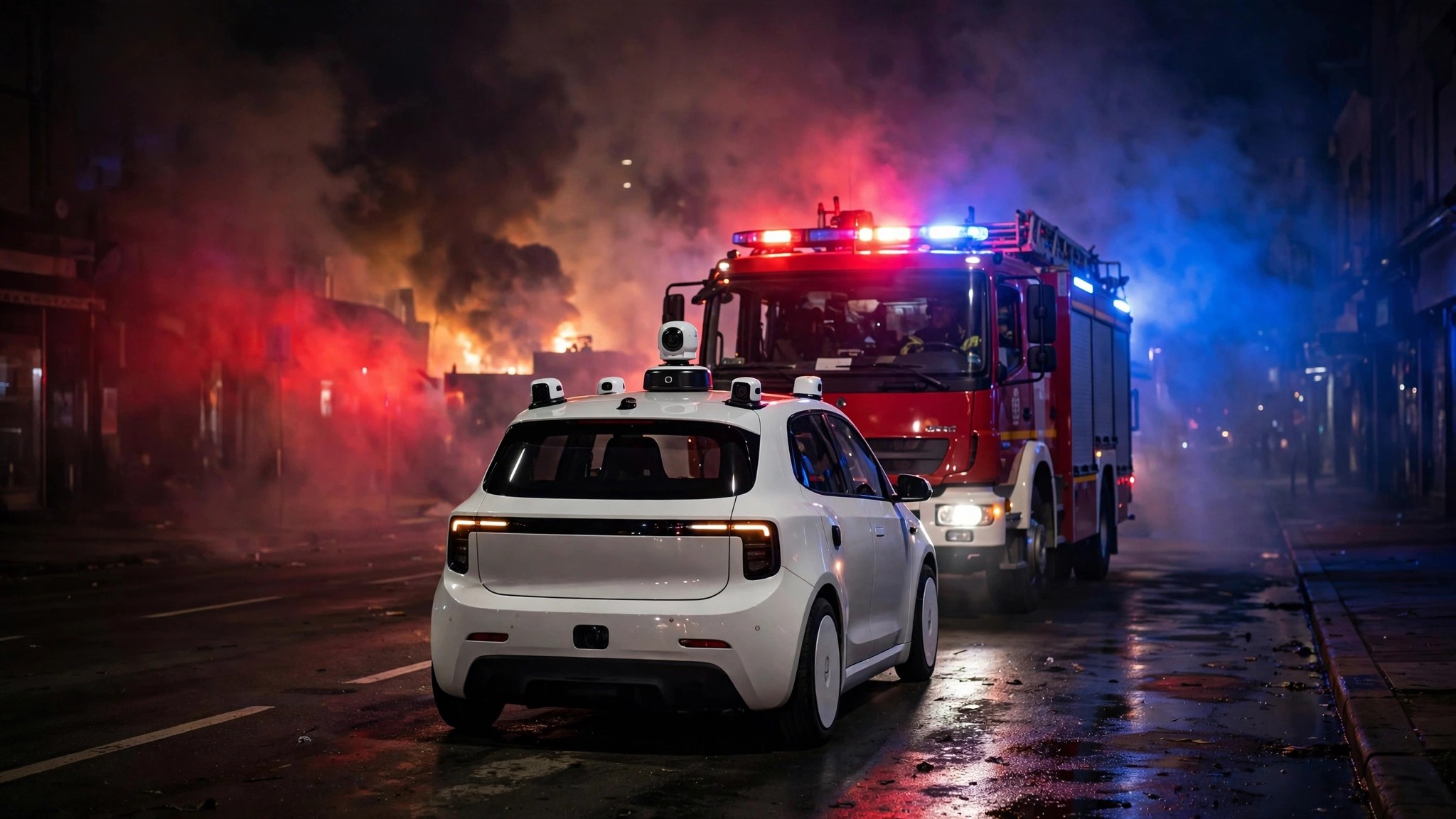
On June 20, an empty Zoox robotaxi in San Francisco encountered heavy smoke from an active fire and drove straight into the emergency scene. It braked hard, tried to swerve, and stopped in the middle of the road. A remote operator had to back it out.[1] First responders then placed cones across two lanes to prevent more autonomous vehicles from doing the same thing.
Think about that sequence: the machine that was supposed to eliminate human error couldn't identify smoke or recognize an emergency, and a person sitting at a screen miles away had to take over. And after the car was finally extracted, firefighters had to physically barricade the road against the possibility that another robot might wander in.
Amazon's Zoox recalled its entire fleet of 105 vehicles over the incident.[2] But the smoke wasn't an isolated failure. On July 8, NHTSA Administrator Jonathan Morrison sent a letter to every autonomous vehicle developer in America, and it was the bureaucratic equivalent of a controlled detonation: "Over the past several months, NHTSA has identified a clear pattern of driverless AVs interfering with law enforcement and other first responders."[3]
The documented failures read like a satirical catalog: robotaxis driving into active emergency scenes, blocking ambulance routes, rolling through police cordons, failing to recognize flashing lights, flares, smoke, fire, and traffic cones. A TechCrunch investigation found at least six incidents through March 2026 where officers had to physically commandeer Waymo vehicles to move them out of traffic. In one case, a cop was responding to a mass shooting.[4] In late May, a Waymo in Dallas partially blocked the route fire trucks were taking to an apartment building on fire.[5] Both NHTSA and the NTSB are now investigating separate incidents of Waymo vehicles passing stopped school buses with their lights flashing, in violation of Texas law.
Morrison's letter contained a line the industry should tattoo on every whiteboard in every AV engineering bullpen: "Emergency scenes are not rare or extreme 'edge cases.'"
He's mathematically correct. U.S. fire departments responded to 36.7 million calls in 2018, according to NFPA data, which works out to 100,548 per day and about 4,189 per hour.[6] Even narrowing to fire-specific responses, you're at 1.3 million per year, or 3,613 per day. If your vehicle can't navigate something that happens 4,000 times an hour across America, it's not encountering an edge case. It's failing a basic driving competency that every 16-year-old with a learner's permit handles by instinct: see the flashing lights, pull over, get out of the way.
The regulatory asymmetry is what lands hardest. Morrison explicitly noted that "human drivers who impede these operations are subject to fines and even jail time."[3] In California, failure to yield to an emergency vehicle under CVC 21806 carries a $490 fine with penalty assessments; in states with more aggressive statutes, repeat offenders face misdemeanor charges and potential jail time. These are the penalties for a person who makes a mistake in a high-stress, split-second moment. The consequence for a company whose product systematically drives into fire scenes? NHTSA will "schedule meetings with vehicle developers by the end of the month."
There's no penalty outlined in the letter for ignoring the request, no timeline for compliance beyond the vague "by month's end" meetings. The agency described the industry's failures as a "functional insufficiency," which is the most diplomatically devastating phrase in the regulatory lexicon, and it means exactly what you think: your product doesn't work.
The counterargument from the AV industry will be familiar: these vehicles have driven hundreds of millions of miles with lower crash rates than human drivers, emergency scenes represent a tiny fraction of total driving time, and the technology will improve. All of this may be true and misses the point entirely. A human driver who blocks a fire truck once gets a ticket. A fleet of robots that does it repeatedly gets a letter. The asymmetry exposes a simpler question: do the same laws apply to machines as to people?
Morrison seems to understand this, and his own words carry the weight of someone who has run out of diplomatic patience: "To state it bluntly," he wrote, "an AV that cannot safely interact with first responders is a danger to the general public."[3]
What Morrison didn't write was the obvious follow-up: what happens next month when the meetings end and the robotaxis still can't see smoke.
Sources & References
- Zoox Recall Filing, NHTSA Campaign No. 26V-XXX, July 2026. Gizmodo, “Zoox Issues Recall After Heavy Smoke Caused a Robotaxi to Enter an Active Emergency Scene,” July 18, 2026. gizmodo.com
- Reuters, “Zoox recalls self-driving cars because they may not detect smoke,” July 18, 2026. reuters.com
- NHTSA Administrator Jonathan Morrison, Letter to Autonomous Vehicle Developers, July 8, 2026. Reported by TechCrunch, Reuters, InsideEVs. nhtsa.gov
- TechCrunch, “Feds demand autonomous vehicle companies stop interfering with first responders,” July 9, 2026. techcrunch.com
- Reuters reporting on Waymo school bus and fire truck incidents in Texas, July 2026. reuters.com
- NFPA, Fire Loss in the United States, 2018 Fire Department Response data (Table 8). Total responses: 36,746,500. nfpa.org