16 Robot Crashes Got a Federal Investigation. 13,000 Human Deaths Got a Press Release.
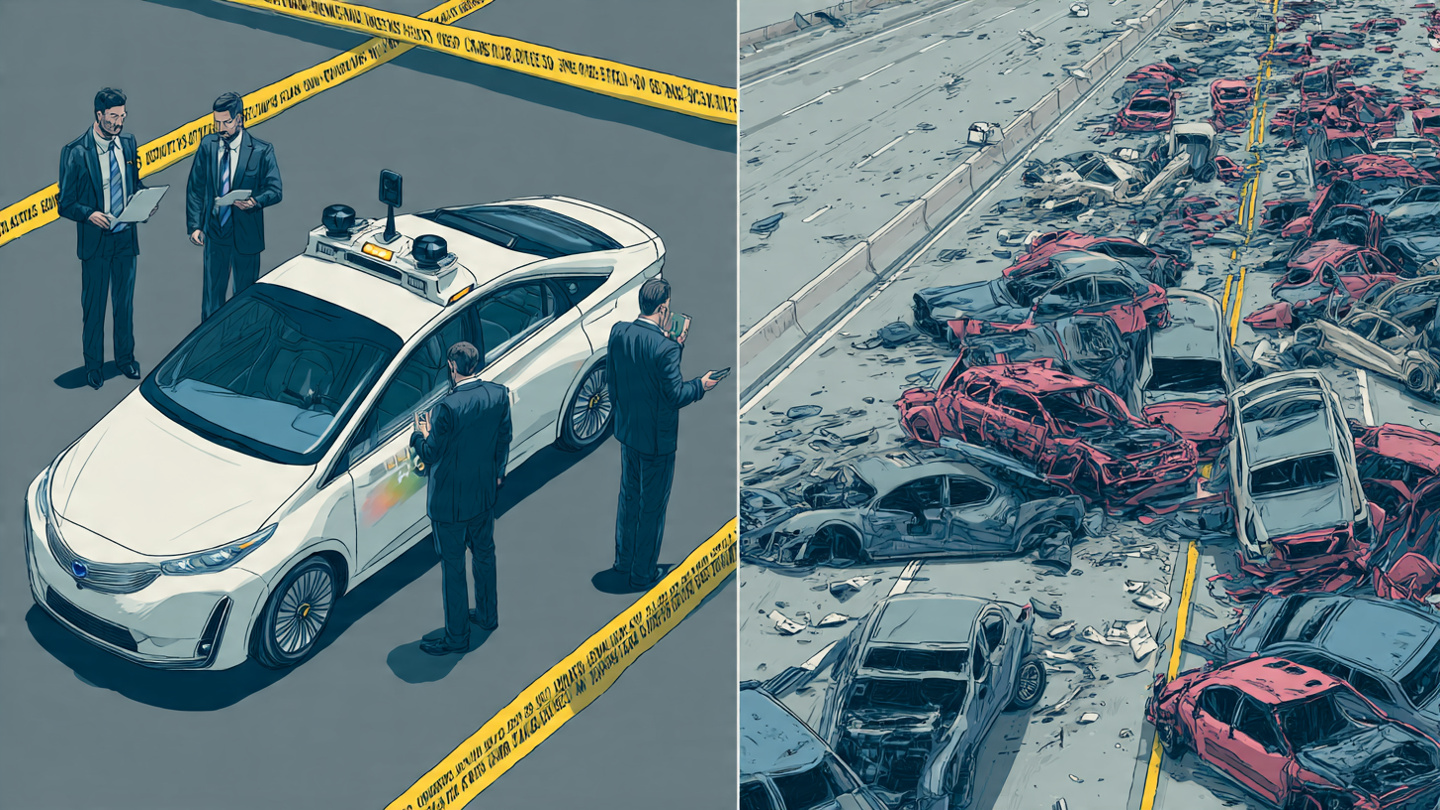
Between December 2025 and March 2026, Avride's fleet of modified Hyundai Ioniq 5 robotaxis crashed 16 times on the streets of Dallas and Austin. Nobody died, and the sole injury was minor enough that the victim walked away from the scene. NHTSA opened a formal Preliminary Evaluation, citing “excessive assertiveness” and “insufficient capability” in the autonomous driving system.[1]
That number comes from dividing the 2024 FARS total of 39,254 fatalities by three and rounding down.[2] Thirteen thousand and change. Enough to fill every seat in Madison Square Garden and still leave 600 bodies in the corridor. No investigation was opened, no one described human driving as “excessively assertive,” and the agency published a quarterly estimate, issued a press release about the continued decline, and moved on to the next budget hearing.
The ratio is absurd on its face. For every one Avride crash that contributed to the federal probe, human drivers produced 817 fatalities that contributed to nothing except a PDF on a government website. Under the NHTSA Standing General Order, AV and ADAS operators must report crashes involving injury or tow-away damage within one calendar day, and all other incidents within ten days.[3] That reporting pipeline captured 5,202 incidents through November 2025, roughly 7% resulting in injury and 1.2% in fatalities.[4] A critical caveat: the overwhelming majority of those SGO fatalities involved driver-assist systems like Tesla Autopilot on human-operated vehicles, not Level 4 robotaxis. Fully driverless platforms have killed in the single digits. Human drivers still do that by Wednesday morning every single week of the year.
There is a defensible reason for the asymmetry, and I want to state it at full strength before dismantling the complacency it enables. A software bug in an autonomous fleet is systemic. If Avride's lane-change algorithm fails in Dallas, it fails the same way in Austin, and it will fail the same way in Houston once the fleet expands. One defect, every car, simultaneously. A human driver's texting-and-drifting mistake is individual and non-replicable. You cannot patch the human fleet with an over-the-air update, and you certainly cannot recall 280 million brains. The low investigation threshold for robots is preventive medicine. Catching a pattern at 16 crashes means you catch it before the fleet scales to sixteen thousand vehicles. GM learned this lesson the hard way: the ignition-switch defect killed 124 people across 12 years before NHTSA opened a file.[5] The Avride threshold is immeasurably better.
But the counterargument has a blind spot the size of a Chevy Silverado, and it is this: we do know which human-driven vehicles kill people at systemic rates. FARS tracks fatality rates by make, model, and model year. The Chevrolet Impala averaged 377 deaths per year across the 2014–2023 dataset. The Ford Mustang ran 274 a year at a rate of 6.02 per 100 million VMT, more than triple the F-150’s rate on the same roads. The Hyundai Veloster posted 8.54 per 100 million VMT, the highest of any vehicle with meaningful fleet representation.[6] These are not random events. They are statistical patterns as repeatable as any software bug, embedded in vehicle design, fleet demographics, and road infrastructure. We just choose not to investigate them with the same urgency we bring to a robot that bumped a traffic cone in a parking lot.
NHTSA knows about every Avride fender-bender within 24 hours. It cannot tell you, in any timeframe, how many people the 2006 Chevrolet Impala killed this year. FARS data runs two to three years behind. The agency responsible for 39,000 annual deaths operates on the informational equivalent of a horse-drawn carriage while demanding real-time accountability from the self-driving car that sent one person home with a bruise.
Limitations worth stating plainly: FARS captures only fatal crashes, not the 6.7 million annual total. A low fatality rate does not mean a safe vehicle; it may mean better crashworthiness masking high crash frequency. Per-model VMT estimates carry ±15% uncertainty for low-volume vehicles. And the AV comparison is structurally unfair in the opposite direction, too: robotaxi fleets log far fewer total miles than the human fleet, so small-number statistics inflate apparent safety.
Sources & References
- NHTSA Preliminary Evaluation of Avride ADS-equipped vehicles, May 2026. Reported by CarComplaints.com: carcomplaints.com
- NHTSA/Advocates for Highway & Auto Safety, 2024 and 2025 Crash Data, 2026. 39,254 deaths and 2.42M injuries in 2024. saferoads.org
- NHTSA Standing General Order 2021-01 (Second Amended), requiring ADS/ADAS crash reporting within 1 day (injury/tow-away) or 10 days (all others). nhtsa.gov
- Craft Law Firm analysis of NHTSA SGO data through November 2025: 5,202 AV/ADAS incidents, 7% injury rate, 1.2% fatality rate. Note: the majority of fatalities are from ADAS (driver-assist) systems, not fully autonomous vehicles. craftlawfirm.com
- GM ignition switch recalls: 124 deaths confirmed across 2003–2015 model years, investigation opened 2014. wikipedia.org
- NHTSA FARS 2014–2023, per-model fatality data. Impala: 3,774 deaths / 10 years. Mustang: 2,739 deaths / 10 years, rate 6.02 per 100M VMT. Veloster: 598 deaths, rate 8.54. nhtsa.gov
What to do with this: If you ride in an Avride, Waymo, or Cruise vehicle, know that every incident is federally tracked and every pattern triggers investigation. That is more oversight than any human Uber driver receives. If you drive a vehicle model with a FARS fatality rate above 3.0 per 100M VMT, you are operating a machine that kills at rates the federal government would never tolerate from a robot. Check your model at nhtsa.gov/fars. Then ask yourself why we built the strictest safety apparatus in transportation history for the thing that kills 12 people a year, and settled for a biennial PDF for the thing that kills 39,000.