72 People a Year Die Dodging Mattresses on the Highway
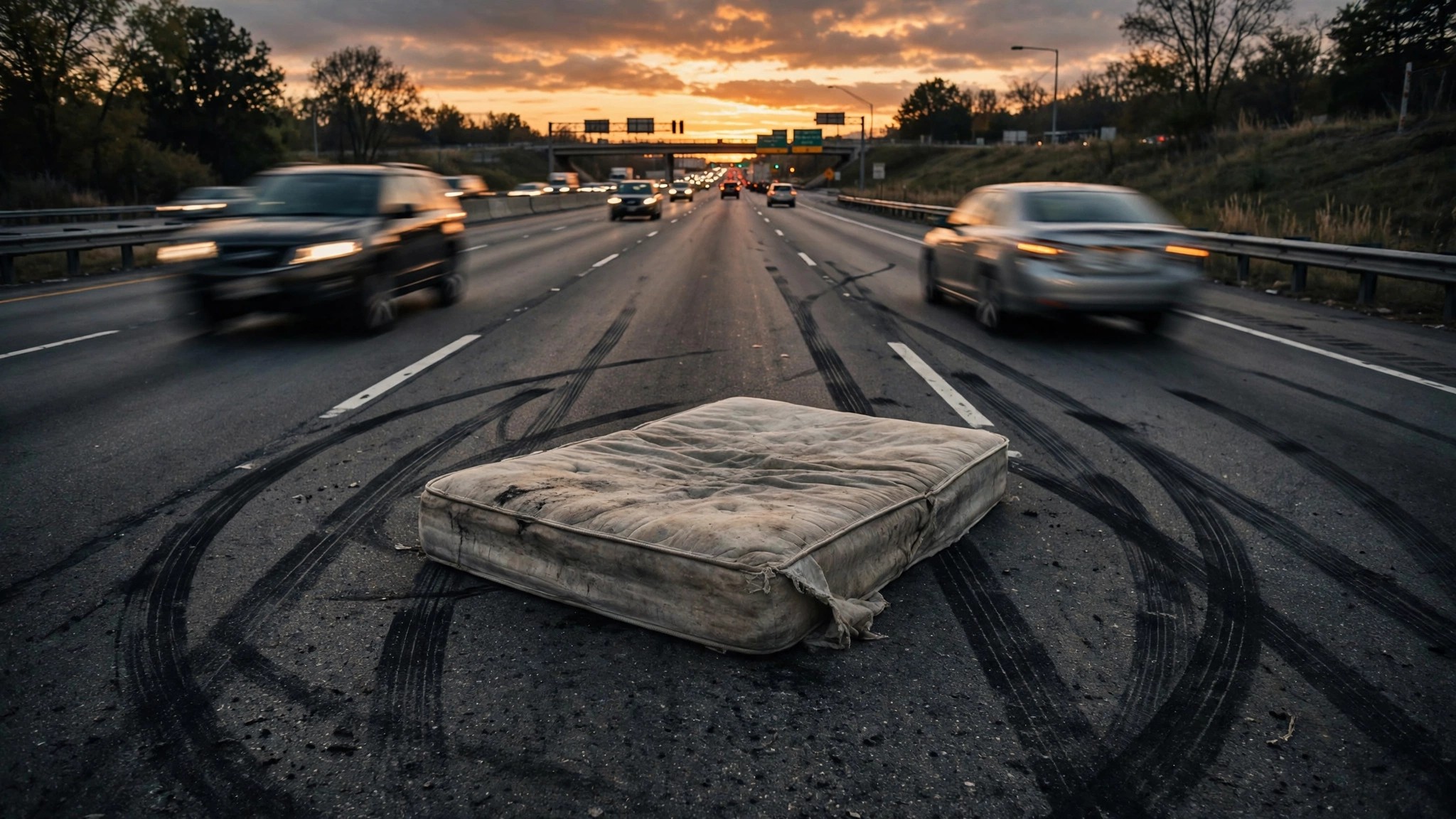
A couch cushion at mile marker 114 killed a 34-year-old in Ohio last summer, though she never touched it. She swerved left at 67 miles per hour, crossed the median at an angle her stability control couldn't correct, and met a Kenworth T680 head-on while the cushion sat unblemished on the shoulder.
The AAA Foundation published updated figures in late 2025 spanning 2018 through 2023: 319,724 crashes tied to objects on the roadway, averaging 53,000 per year, producing 5,500 injuries and 72 deaths annually.[1] In a country that kills 39,000 people on its roads every year, 72 barely registers.[3] But approximately half of those fatalities resulted not from striking the object but from the overcorrection at highway speed that sent a vehicle into a concrete divider or across the yellow line into oncoming steel.
Modern vehicles are engineered to absorb frontal impacts through crumple zones, airbags, and seatbelt pretensioners calibrated to distribute crash forces across the strongest bones in the human body. Plowing through a mattress or a detached bumper at 65 will cost you a headlight and possibly an unneeded airbag deployment, but the occupant survivability envelope for that collision is enormous compared to what happens when a panic-swerve induces an uncontrolled yaw past the limits of electronic stability control, departing the travel lanes and hitting fixed barriers or opposing traffic at angles the restraint system was never tested against.
Two-thirds of these crashes trace back to items that fell off other vehicles because of improper maintenance or loads that were never secured.[1] Blown treads, separated bumpers, and disintegrating wheel assemblies account for 30% of all debris incidents, while unsecured cargo like furniture, construction material, and barbecue grills covers another 19%.[2] All 50 states mandate load securement by law, with penalties from $10 to $2,500, but enforcement is functionally nonexistent because the driver who dropped the object is typically miles ahead by the time anyone crashes into it. Dropping a recliner on I-95 and killing someone three minutes later is, in practical legal terms, indistinguishable from littering.
The counterintuitive advice that every driving instructor should teach: if you cannot change lanes safely, hit the debris. Your car's crash protection architecture exists for exactly this class of impact, and thousands of hours of frontal engineering stand between you and serious injury in that scenario. What no amount of engineering can do is save you from the moment the wheel jerks ninety degrees at highway speed and physics takes over entirely. Given the choice between a mattress and a jersey barrier, take the mattress.
Sources & References
- AAA Foundation for Traffic Safety, The Safety Impact of Road Debris: Updated Prevalences of Crashes, Injuries, and Deaths in the United States, 2018–2023. aaafoundation.org
- AAA Foundation for Traffic Safety, Road Debris Study (2011–2014): 200,000+ crashes, 39,000 injuries, 500+ deaths over four years. newsroom.aaa.com
- NHTSA, Fatality Analysis Reporting System (FARS), 2024 data: 39,254 total traffic fatalities. nhtsa.gov
Source: AAA Foundation for Traffic Safety (2018–2023 crash data). Debris death percentages are approximate, based on AAA’s national crash analysis. Individual circumstances vary. See methodology for caveats.