Three Million Vehicles Got Recalled in One Week. Every Automaker Said ‘Only 1% Are Affected.’
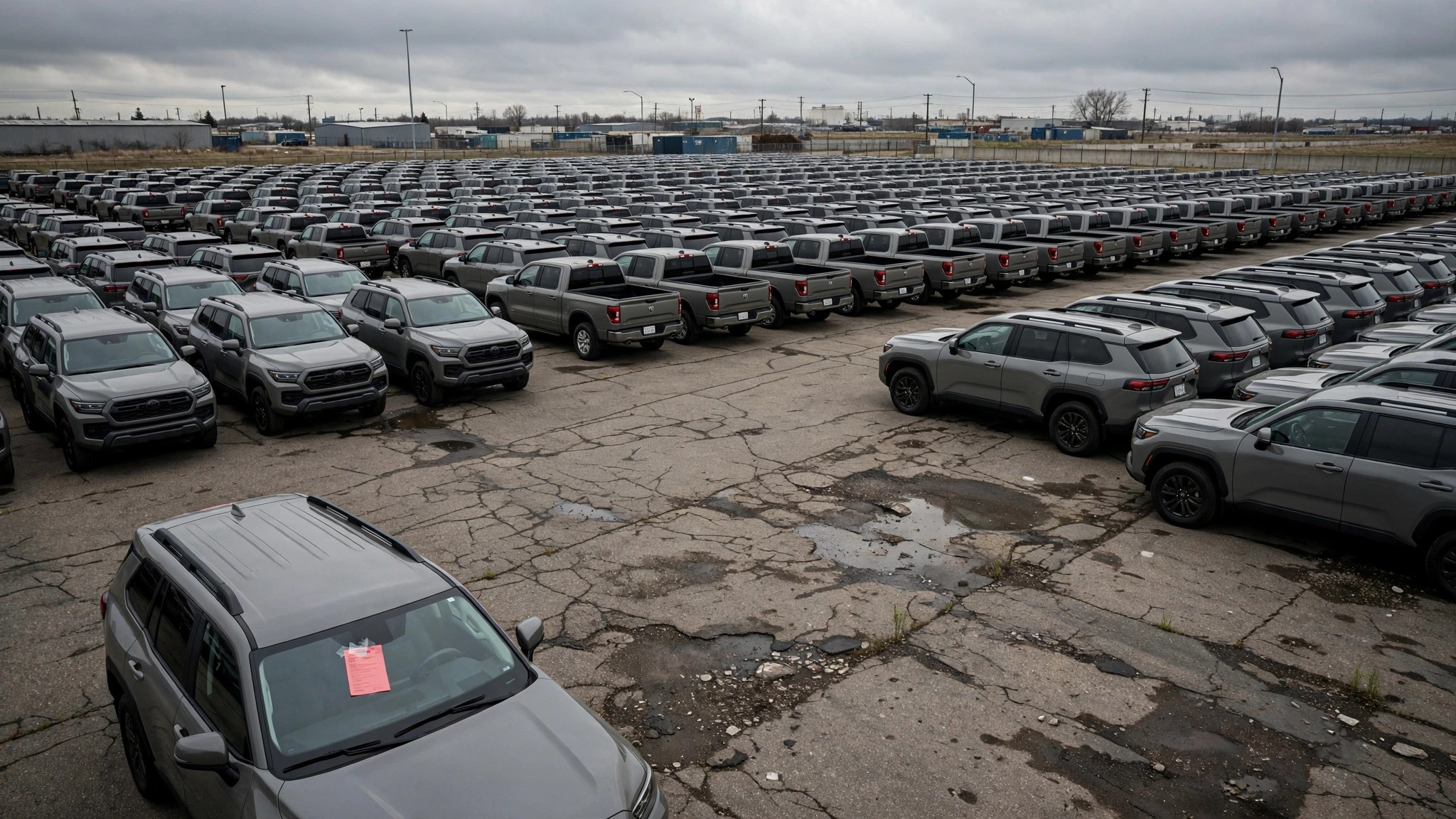
Between June 10 and June 30, four manufacturers filed recalls covering 2,794,019 vehicles in the United States. Ford flagged 741,195 SUVs and pickups for a transmission defect that lets them roll away in park. Stellantis told 1,076,999 Jeep owners to park outside because their power steering wiring might catch fire while the engine is off. Honda pulled 880,514 Pilots and Passports for rear subframes that corrode in salt-belt states until the suspension geometry collapses entirely, a structural failure that develops silently over years of winter driving and can leave the rear axle disconnected from the chassis without warning. Hyundai recalled 96,310 Tucsons whose instrument panels reboot mid-drive, leaving drivers staring at a blank screen at highway speed.
Four manufacturers. Four completely different failure modes: mechanical, electrical, structural, software. Yet every filing used nearly identical language. Ford: "estimated percentage of vehicles with defect: 1%." Honda: "estimated 1%." Hyundai: "estimated 1%." Stellantis didn't cite 1%, but their math is worse: 72 confirmed fires out of 1,076,999 vehicles puts the known rate at 0.007%.[1][2][3]
One percent is a magic number in recall filings. Small enough to sound reassuring. Round enough to require no precision. And universal enough that it shows up whether the defect is a corroded subframe in a Minnesota salt belt or a software glitch in a brand-new Tucson rolling off the assembly line in Alabama. Maybe modern manufacturing really does produce a consistent 1% escape rate across every failure mode and every assembly plant on the continent. Or maybe 1% is just the number you write when NHTSA asks how bad it is and you want the answer to sound manageable.
But even if we take every manufacturer at their word, 1% of 2.8 million is roughly 30,000 vehicles with confirmed active defects driving American roads right now. Thirty thousand cars that might roll away, catch fire in a garage, lose their rear suspension on I-95, or display nothing but a black rectangle where the speedometer should be. That is more vehicles than the entire municipal fleet of a mid-sized American city, more than every school bus, garbage truck, police cruiser, and fire engine in a metro area of half a million people combined.
What FARS says about these same vehicles
We ran this week's recalled models through the Fatality Analysis Reporting System. Combined, they account for 23,231 occupant deaths in the FARS database from 2014 to 2023.[4] Annualized, that is roughly 2,323 deaths per year from routine fatal crashes in these exact vehicles, not from the recalled defects, but from ordinary driving on American roads.
Consider Ford's 741,195 recalled Expeditions, Explorers, Navigators, Aviators, and F-150s, models that collectively represent the best-selling vehicle lineup in America and the backbone of suburban driveways from Dallas to Detroit. FARS records 14,506 deaths across those models over the data period, an annual average of 1,451 people killed in crashes that never made the recall database, never triggered a congressional hearing, and never prompted a manufacturer press release. Ford's filing lists nine alleged injuries from the rollaway defect and zero confirmed deaths, a toll so low it would not earn a single bullet point in any automaker's quarterly safety briefing. A driver in a recalled 2021 F-150 is orders of magnitude more likely to die in a routine crash (rate: 1.04 per 100 million VMT) than from the specific transmission defect that triggered a recall.[5]
Honda's recalled Pilots and Passports sit at the opposite end. With fatality rates around 0.29 per 100 million VMT and comparable safety numbers, these are among the safest SUVs in the FARS dataset. Honda built a vehicle that excels at not killing its occupants in crashes, then left the subframe unprotected from the road salt that eats through steel in every state north of the 40th parallel. A Pilot owner in Ohio faces a corrosion risk that Honda's own filing says has produced zero warranty claims and zero injuries. But the recall, not the cumulative death toll, made national headlines. The 514 total FARS deaths across all Honda Pilots over ten years, a body count that dwarfs every subframe corrosion complaint in Honda's history, never made a single local newscast.
What 1% actually means
If you own one of the 2.8 million recalled vehicles, you have about a 99-in-100 chance that your specific car is fine. Those are genuinely good odds for any individual owner. Better than most lottery tickets, better than the weather forecast, better than your chances of getting through a Costco parking lot without someone cutting you off.
Except 30,000 people do own the defective ones. And for those owners, the defect rate is not 1%. It is 100%. NHTSA's recall system, despite having the VIN-level production data that could theoretically narrow the defect window to specific assembly plants, specific shifts, and specific supplier lots, does not tell individual owners whether they are the 1% or the 99%. It tells all of them to visit a dealer and hope for the best, and in Stellantis's case to park their Wrangler outside and away from structures that might burn down while waiting for a repair that may not arrive for months. Imagine telling a million people to keep their car away from their house because there is a 0.007% chance it will burn down their garage.
Ford's permanent fix for the rollaway defect will not be ready until April 2027, meaning owners face nearly a full year of parking with a transmission system the manufacturer itself has acknowledged cannot be trusted to hold a vehicle in place. Owners get an interim software patch starting August 2026, a digital Band-Aid applied to a transmission system Ford engineered to hold vehicles stationary without driver intervention from the day each one rolled off the Louisville assembly line. For the nine months between recall announcement and permanent remedy, 741,195 owners have been told to use their parking brake every time they park. Practical advice. Also an admission that a fundamental drivetrain system does not work as designed, and that for nine months the only thing standing between 741,195 parked vehicles and a downhill roll is driver memory.
Actionable
Check your VIN at nhtsa.gov/recalls. If your vehicle appears, do not assume you are in the 99%. Schedule the repair or software update. For Jeep Wrangler and Gladiator owners specifically: park outside, away from structures, until the dealer fix is complete. For Ford Expedition, Explorer, Navigator, Aviator, and F-150 owners in the affected model years: use the parking brake every single time. Do not rely on the transmission park feature alone.
Sources & References
- NHTSA recall filing, Ford Motor Company, filed June 24, 2026. Transmission parking pawl defect, 741,195 vehicles. nhtsa.gov
- NHTSA recall filing, Stellantis/Chrysler, 1,076,999 Jeep Wrangler and Gladiator vehicles (2021–2025). Electric hydraulic power steering pump wiring fire risk. nhtsa.gov
- Reuters, “Honda America recalls more than 880,000 vehicles over rear suspension components failure,” June 10, 2026. reuters.com
- NHTSA, Fatality Analysis Reporting System (FARS), 2014–2023. nhtsa.gov
- NHTSA FARS query tool, crash data by vehicle make and model. cdan.dot.gov
Limitations
Manufacturer-reported "1% affected" estimates are self-certified in NHTSA filings, a regulatory structure in which the same companies whose engineering failed badly enough to trigger a recall are also the ones estimating how badly it failed, with no independent verification from the agency that exists to oversee them. FARS data covers 2014–2023 and includes all fatal crashes involving these models, not just occupant deaths or defect-related incidents. Comparing lifetime FARS fatality data against single-defect recall risk conflates different time windows and failure modes. Recall completion rates historically average 60–70% within 18 months, meaning a significant fraction of recalled vehicles may never receive the fix.
Counterargument at full strength
Manufacturing defect rates genuinely cluster around 1% across industries. Automotive quality control catches roughly 99 of every 100 production anomalies during in-plant testing, and a 1% escape rate reflects that engineering reality, not corporate spin. Recalls are proactive by design: manufacturers file them when they discover a defect, not after proportionate harm has occurred. Filing early and broadly (covering all potentially affected VINs rather than only confirmed-defective units) is the system working as intended. A uniform 1% estimate across manufacturers may simply reflect that modern assembly lines, regardless of brand, share similar quality control architectures and tolerance thresholds.