America Recalled 1.5 Million Cars This Week. The Ones Actually Killing People Weren't on the List.
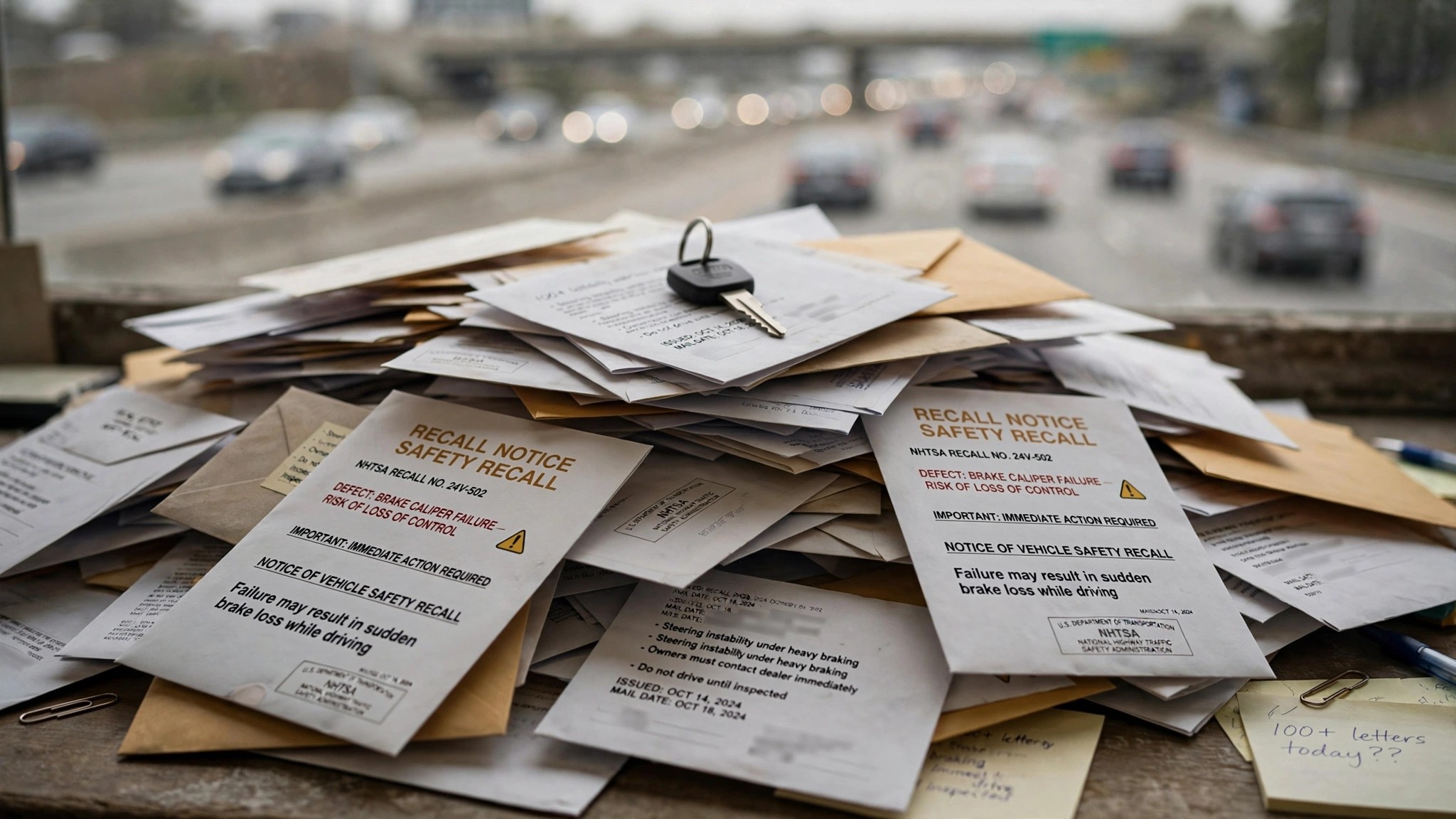
Between Monday and Thursday, five automakers filed recalls covering 1,487,995 vehicles. Ford alone accounted for nearly a million. BMW followed with 318,000. Defects ranged from wiring that could spark a fire to seatbelt buckles stamped out of spec. Standard stuff. Every gear in the regulatory machine turned exactly as designed.
So I ran those five recalled models through FARS and added up the bodies. Combined annual fatalities across all five: 531.
Then I pulled every vehicle in FARS with a fatality rate above 2.0 per 100 million VMT and at least 1,000 total deaths. There are 24 of them. Honda Accord. Toyota Camry. Civic. Altima. Impala. Mustang. Combined annual fatalities: 6,527. Not one has ever been recalled for being inherently lethal.
Disorienting math follows. For every annual death the recall system touched this week, 12.3 deaths went completely unaddressed by any regulatory mechanism. Consider: the Hyundai Kona, recalled three times in 2026 alone, kills at a rate of 0.12 per 100 million VMT. A Honda Accord, never recalled for its death rate, kills at 3.07. That makes the Accord 25.6 times deadlier than the Kona, yet the Kona is the one getting letters from NHTSA.
To be precise about what happened this week: Ford pulled 565,691 Broncos for a wiring harness that could short-circuit and start a fire.[1] The Bronco has 25 FARS deaths across its entire production run. Rate: 0.05. That is, statistically, one of the safest vehicles on American roads. Ford also recalled 387,911 Explorers and Lincoln Aviators because a seat switch could bind, letting a second-row seat tip forward in a crash.[2] BMW pulled 318,495 vehicles for a starter motor that might overheat and catch fire.[3] Nissan recalled 168,149 Armadas and Infinitis because someone printed the wrong number on a weight label.[4] And Hyundai recalled 47,749 Konas because a stamping die wore out and produced seatbelt buckles slightly out of tolerance.[5]
All real defects. All worth fixing. And collectively responsible for a rounding error compared to what the Accord, Civic, and Camry contribute to the national body count every single year.
In the FARS dataset, a Honda Accord has killed 7,102 people. Annual average: 710. Rate: 3.07 per 100 million vehicle miles traveled. A Toyota Camry: 6,328 dead, rate 2.03. A Honda Civic: 6,553 dead, rate 2.25. These three sedans, by themselves, average 1,998 deaths a year. Nearly four times the combined annual toll of every vehicle recalled this week.
Why doesn't anyone recall the Accord? Because the recall system doesn't have a category for "this car kills people at an elevated rate due to its mass, geometry, occupant demographics, and the roads its buyers drive on." NHTSA recalls address manufacturing defects: a bolt torqued wrong, a sensor that fails, a label that's inaccurate. They do not address the fact that certain vehicle designs, sold to certain demographics, driven on certain roads, produce fatality rates 3 to 6 times the fleet average.
A regulatory tool that could address this already exists. It's called FMVSS, Federal Motor Vehicle Safety Standards. NHTSA can mandate minimum crash geometry. It can set front-end height limits relative to weight. It can require pedestrian-impact performance. Authority is there. Political will is not.
Nationally, traffic fatalities fell 6.7% in 2025 to 36,640, the second-lowest rate in recorded history at 1.10 per 100 million VMT.[6] Progress is real. But progress on the aggregate obscures the vehicles that defy the trend. An Impala still kills at 5.0. A Mustang at 6.02. No recall, no investigation, no rulemaking.
Recalls are the visible part of vehicle safety. They produce press releases, mailing campaigns, dealer visits. They look like accountability. But they operate on a tiny slice of the problem, the slice where a specific manufacturing error can be identified and corrected. A larger slice, where a vehicle's fundamental characteristics produce elevated death rates year after year, has no regulatory home at all.
If your seatbelt buckle is slightly out of spec, the government will send you a letter. If your car kills at 25 times the rate of the vehicle with the out-of-spec buckle, enjoy the drive.
What You Can Do
Check your VIN at nhtsa.gov/recalls. If you're in one of this week's recalled models, get the fix. It's free. But if you're shopping for a car, look beyond the recall history. A clean recall record doesn't mean a safe vehicle. Cross-reference your shortlist against IIHS fatality statistics and FARS data. A Hyundai Kona has three recalls this year and a 0.12 death rate. A Honda Accord has none and a 3.07. Which one would you rather crash in?
Sources & References
- Reuters, “Ford to recall more than 565,000 US vehicles over engine compartment fire risk,” July 24, 2026. reuters.com
- NHTSA recall notice, Ford Explorer / Lincoln Aviator second-row seat defect, 387,911 units, July 22–23, 2026. nypost.com
- Reuters, “BMW to recall over 318,000 US vehicles over starter motor overheating risk,” July 23, 2026. reuters.com
- Reuters, “Nissan to recall about 168,000 US vehicles over incorrect weight rating labels,” July 22, 2026. reuters.com
- Autoblog, “Hyundai Tells Kona Owners Not To Use One Seat After Recall,” July 22, 2026. autoblog.com
- NHTSA, “2025 Traffic Death Estimates & 2024 FARS,” April 2026. nhtsa.gov
- NHTSA FARS (Fatality Analysis Reporting System), 2014–2023. nhtsa.gov