The Safety Machine Processed 3.3 Million Cars This Week. The #1 Risk Has No Recall.
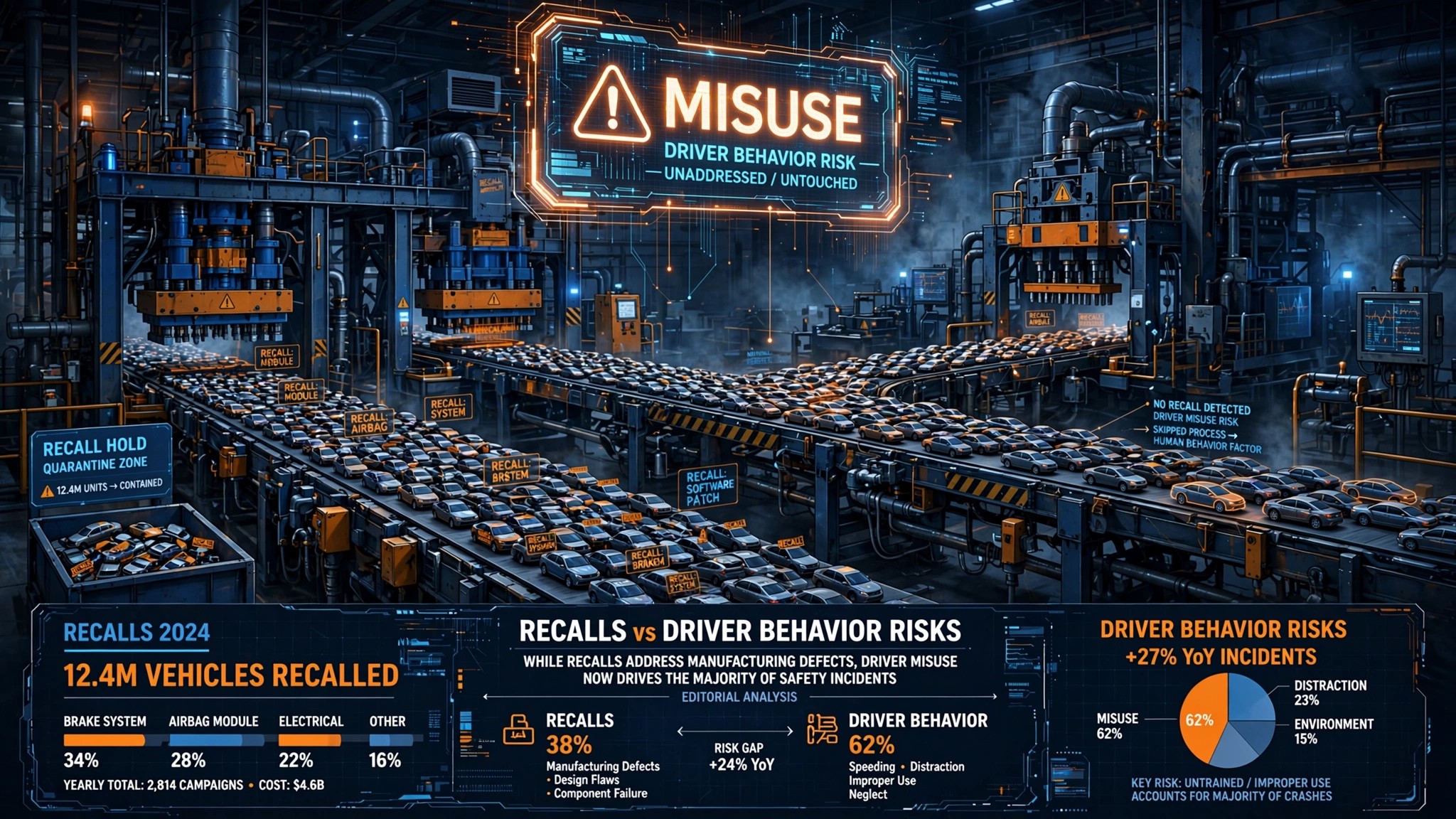
Between Monday and Sunday, NHTSA logged recalls covering 3,299,737 vehicles. Tesla patched 2 million cars' hood sensors with a software update. Ford pulled 676,225 Explorers and Aviators for seats that unlatch and roof rails that fly off. Subaru mailed 541,237 corrected weight stickers. Hyundai replaced 47,749 seat belt buckles made by Joyson Safety Systems, the company that inherited Takata's crisis. Toyota inspected 5,408 rear axles that might snap. BMW swapped 29,119 starter relays before they caught fire.[1]
That same week, a Brembo-commissioned survey of 1,000 transport specialists across ten countries delivered a finding that makes every one of those recalls feel like rearranging deck chairs.
Not drunk driving. Not mechanical failure. Not speeding. Human misuse of driver-assistance systems. That is what the people who design, regulate, and study transportation infrastructure consider the leading threat to road safety in 2026.[2] Two-thirds of the same professionals said automaker advertising overstates what these systems can do. No recall mechanism exists for that. NHTSA can mandate a buckle replacement. It cannot mandate that a driver understands what "Autopilot" actually means.
Weight the week's recalls by FARS death rate and a different picture emerges. Tesla's 2 million vehicles represent 60% of the recall volume but only 23% of the death-rate-weighted impact, because Model 3 and Model Y fatality rates run 0.05 and 0.03 per 100 million VMT. Ford's 676,225 Explorers and Aviators represent 20% of the volume but 62% of the weighted impact: the Explorer kills at 1.54 per 100M VMT, fifty percent above the sedan average, and Ford is expanding two previous recalls on the same vehicle.[3] Volume is not risk. Headlines are not the numbers that matter.
Subaru's 541,237 recalled vehicles have FARS death rates between 0.08 and 0.78. A sticker with the wrong weight printed on it. Kona's defective seat belt buckle affects 47,749 vehicles with a FARS rate of 0.12, among the lowest of any SUV ever measured. Hyundai builds one of the safest small SUVs on the road. Their supplier, the company that bought Takata's bankruptcy estate, undermined it with worn-out stamping dies.[1]
That is the system working exactly as designed. A mechanical defect is discovered. A recall is issued. A fix is deployed. Buckles get swapped, stickers get reprinted, software gets patched. It is, by any measure, a triumph of regulatory infrastructure.
It is also a triumph built for a problem that is shrinking. FARS data shows the average death rate across tracked vehicle models falling for a decade. Modern crash structures, ESC, curtain airbags, and active safety systems are doing precisely what they were engineered to do. Meanwhile, that mechanical-defect recall pipeline processes millions of units per year with grinding bureaucratic efficiency. And the actual frontier of automotive death has moved somewhere the recall system cannot follow.
Thirty percent of specialists. Not a margin-of-error fluke. Not a fringe concern from an advocacy group. Brembo, a brake manufacturer with $4 billion in annual revenue, paid Economist Enterprise to survey the industry's own professionals, and the industry's own professionals said the thing nobody wants to say out loud: the machines are fine. Where human meets machine is not.
What this means for you: Check your VIN at nhtsa.gov/recalls. If you own a 2025-2026 Kona, do not use the rear center seat until fixed. If you drive anything with lane-keep assist, adaptive cruise, or a system branded with a name that implies it drives itself, read the actual manual. Not the marketing page. The manual. Because no recall is coming for what you think your car can do.
Sources & References
- NHTSA, recalls 26V452 (Hyundai), 26S52/26S54 (Ford), WRH-26 (Subaru), 26TB13 (Toyota), Jul 2026. nhtsa.gov/recalls
- Reuters, “Misuse of driver-assistance systems biggest risk to road safety, survey finds,” Jul 15, 2026. Brembo/Economist Enterprise survey of 1,000+ transport specialists across 10 countries. reuters.com
- NHTSA, Fatality Analysis Reporting System (FARS), 2014–2023. Death rates per 100M VMT estimated from FARS fatal-crash data, fleet size estimates, and NHTS annual mileage. nhtsa.gov
Source: NHTSA FARS 2014–2023. Recall vehicle counts from NHTSA filings week of Jul 14–20, 2026. Death-rate weighting uses estimated rates per 100M VMT; see methodology for caveats. Survey findings from Brembo/Economist Enterprise, Jul 2026.