Mountain Lions Cut Deer-Vehicle Deaths by 76%. No Federal Safety Program Comes Close.
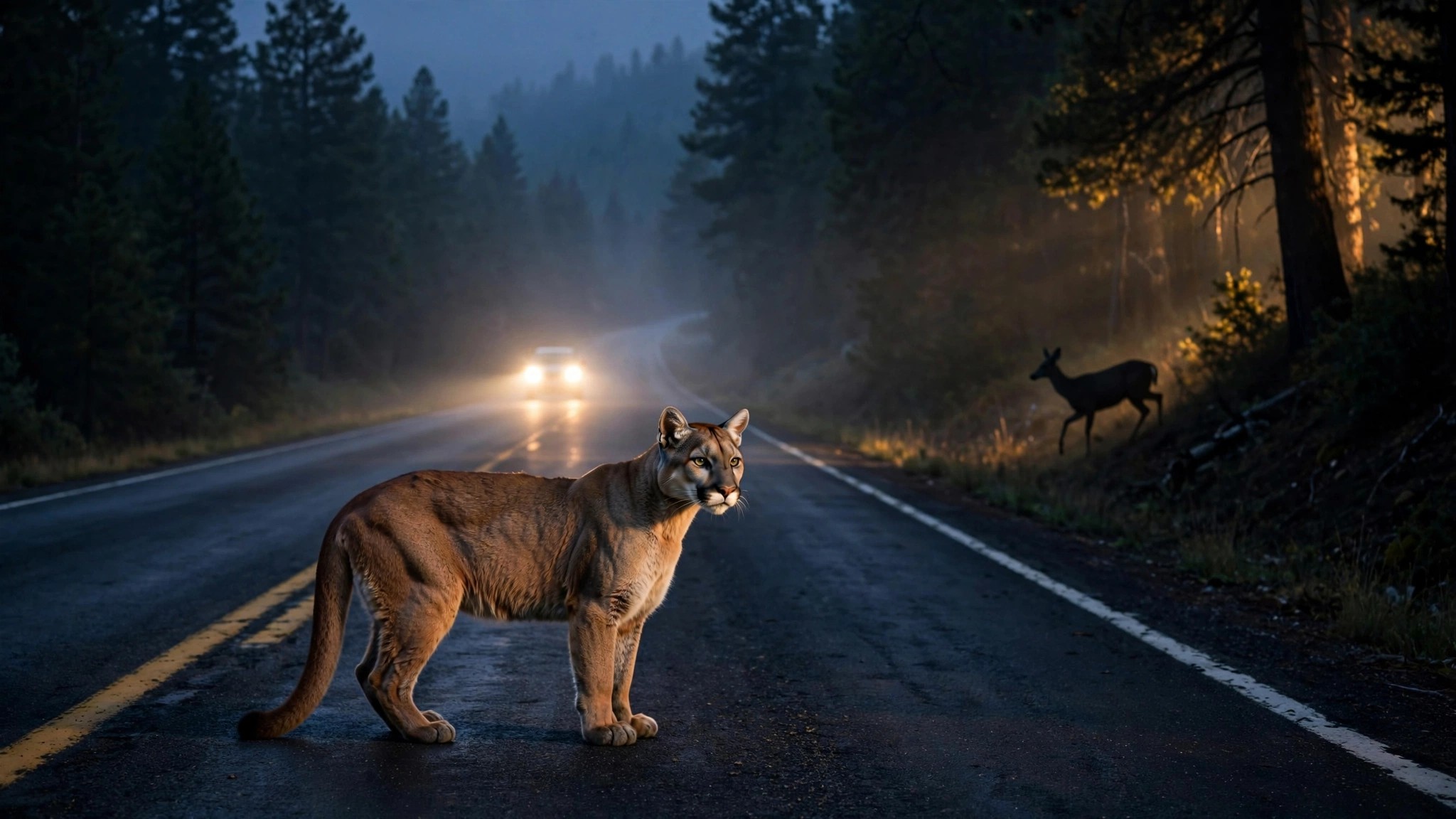
A study published this week in Current Biology found that pumas in Washington's Olympic Peninsula reduce deer-vehicle collisions by 76 percent simply by being mountain lions in the general vicinity.[1] The mechanism is not some kind of feline AEB system. Deer don't want to be near roads when something that weighs 150 pounds with retractable claws is hunting them, so they retreat into denser forest, shift their activity to daylight hours when drivers can actually see them, and stop treating your headlights as an invitation to stand frozen in the middle of a two-lane highway at 7:42 PM in November.
About 2.1 million deer-vehicle collisions happen every year in the United States, killing roughly 200 people, injuring 26,000, and generating upward of $10 billion in insurance claims and vehicle damage.[2] State Farm processed 1.7 million animal collision claims between July 2024 and June 2025 at an average of $5,620 per claim in high-risk regions.[3] November is the worst month, and the two hours after sunset are 14 times more dangerous than the two hours before it, a window that a University of Washington analysis found widens by an additional 16 percent in the week following the annual fall clock change, when evening rush hour suddenly crashes into darkness and nobody at the relevant agencies thought to ask why.[4]
Lead author Justin Suraci of Conservation Science Partners found that pumas alter deer behavior across two dimensions simultaneously: deer in puma territory are 15 percent less likely to be near roads at all, and those that do remain near roads shift from nighttime to daytime activity, moving them out of the collision window that kills the most people. The combined behavioral change translated to a 67 percent reduction in the probability of any given deer encountering a vehicle at speed.
Consider what existing interventions deliver for that $10 billion in annual damage. Deer fencing runs about $10,000 per mile and cuts collisions by roughly 87 percent, but only on that specific stretch of road, and good luck fencing 4 million miles of American roadway. Wildlife crossing structures cost $150,000 to $600,000 each and achieve 85 to 95 percent reductions at the crossing point. Speed reduction campaigns lower fatal deer-vehicle crashes by maybe 40 percent on targeted roads. Deer whistles, still sold at every truck stop in America, have been shown by IIHS to do effectively nothing.[5] Current-generation AEB systems struggle to detect deer because the radar cross-section of a white-tailed doe falls somewhere between "mailbox" and "cardboard box that blew into the road." A puma delivers 76 percent effectiveness across an entire landscape for the price of not shooting it.
Between 1890 and 2020, confirmed fatal puma attacks in the US and Canada averaged about one every five years, roughly 0.21 deaths annually. Deer-vehicle collisions kill 200 people per year, and pumas suppress them by three-quarters. For every human a mountain lion kills, deer-vehicle collisions that pumas would otherwise prevent kill somewhere between 700 and 2,000 people depending on whose fatality estimate you use, and thirty states still allow or are actively expanding puma hunting seasons.
If you're driving through deer country this fall: keep your high beams on, stay alert between 6 and 9 PM, and remember that your comprehensive coverage handles animal strikes but your liability policy almost certainly does not. And if you're in a state debating mountain lion management, the peer-reviewed data now suggests an alternative framing: you're voting on whether to defund the most cost-effective traffic safety program in the Western Hemisphere.
Sources & References
- Suraci, J. et al., “Large carnivores reduce deer-vehicle collisions through behavioral modification of prey,” Current Biology, August 5, 2026. cell.com/current-biology
- Pew Charitable Trusts, “Wildlife-Vehicle Collisions Are a Big and Costly Problem,” May 2021. pew.org
- State Farm / IIHS deer-vehicle collision data, 2024–2025 claims period. moneygeek.com
- Cunningham, C. et al., University of Washington, analysis of 1M+ deer-vehicle collisions 1994–2021. newscientist.com
- IIHS, fatality statistics and vehicle safety research. iihs.org