A Dead Child Made GM Check Its Own Seats. Nobody Made Anyone Else.
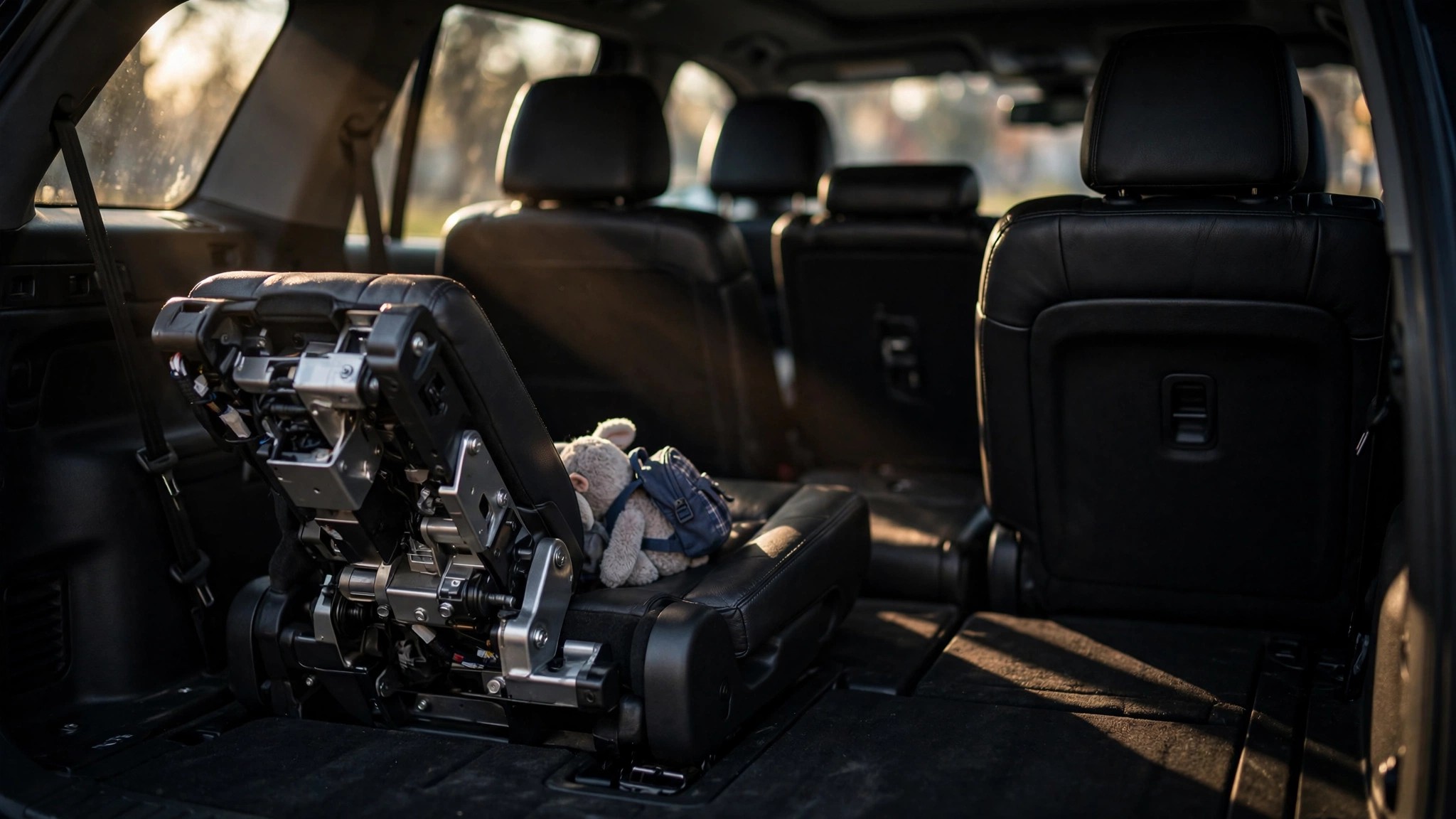
On March 7, a two-year-old named Lucia Ayala was pinned by a power-folding third-row seatback in a 2026 Hyundai Palisade at a Restaurant Depot in Akron, Ohio. Bystanders freed her. She had already suffocated. Hyundai recalled more than 60,000 Palisades and issued a stop-sale order. Kia pulled 568 Telluride Hybrids with the same platform. And then something genuinely unusual happened.
Twenty-four days after the Palisade recall went public, a General Motors engineer submitted a report through the company's internal Speak Up For Safety program. Working from the Palisade's failure mode, the engineer placed a 33-to-40-pound box on a Vistiq's third-row seat and triggered the power-fold sequence. What followed was damning: the seatback kept folding, trapped the box against the seat cushion, and refused to reverse. Freeing it required manually forcing the seat back up. GM recalled every Vistiq it had ever sold: all 14,540 of them, 100% estimated defective, and halted shipments of the 2027 model on June 8.
This is the part where the system is supposed to feel reassuring. One manufacturer's catastrophe prompted another to proactively check, and check it did. GM found the same flaw, issued the recall, and nobody at Cadillac got hurt because the dominoes fell in the right direction for once. Genuinely good. But read GM's recall filing closely: the company cited "the March 2026 announcement of a recall by a different vehicle manufacturer" as the reason for the test. Not an internal audit triggered by its own six prior complaints, which dated back to May 2025. Not an NHTSA mandate. Not a federal safety standard requiring cross-manufacturer defect checks. An individual engineer decided to look, and the difference between that engineer deciding to look and not looking was a two-year-old's funeral.
No NHTSA rule requires automakers to test their own vehicles when a competitor issues a recall for a similar feature. Federal Motor Vehicle Safety Standard 207 governs seat strength during crashes, but it was written for impact loads, not for powered mechanisms that can pin a 33-pound child in a parking lot. That distinction is the gap through which Lucia Ayala fell: she did not die in a crash, and no federal standard addressed her scenario before it killed her.
Three brands, three recalls, roughly 75,000 vehicles pulled from roads or frozen on dealer lots. That is the current count. But the roster of three-row SUVs sold in the U.S. with available power-folding rear seats that have not been recalled or publicly tested for the same defect runs considerably longer: Honda Pilot, Toyota Grand Highlander, Ford Explorer, Chevrolet Tahoe, Chevrolet Suburban, GMC Yukon, Mazda CX-90, Nissan Pathfinder, Volkswagen Atlas, Subaru Ascent, Lincoln Aviator, Lexus TX, Volvo XC90, Jeep Wagoneer, and Ford Expedition. Not all of these use identical folding mechanisms, and not all of them are necessarily defective. But GM only found its flaw because someone chose to test, and there is no public evidence that every manufacturer on that list has done the same.
FARS, the federal fatal crash database, records approximately 40,000 road deaths annually across 337 tracked vehicle models, but it captures crashes and only crashes. A child crushed by a power-folding seat in a parking lot falls outside its scope entirely, alongside toddlers strangled by power windows and occupants killed by carbon monoxide in enclosed garages. We measure what we measure because the system was designed for collisions, and the expanding universe of powered mechanisms that can injure occupants when the vehicle isn't even moving has outgrown the database built to count the dead.
GM's SUFS program deserves credit, and the engineer who ran the test deserves more. But the structural problem persists: the recall system is reactive, manufacturer-specific, and dependent on individual initiative for cross-brand checks. NHTSA can investigate, and NHTSA can order recalls, but what it cannot do under current authority is require every automaker selling a vehicle with power-folding seats to demonstrate anti-pinch compliance after a competitor's feature kills someone. Three recalls and one dead child later, that gap is exactly as wide as it was on March 6.
If you own any three-row SUV with power-folding seats, test the mechanism yourself before your next trip. Place a heavy bag or box on the seat, press the fold button, and watch what happens when the seatback meets resistance. If it doesn't immediately reverse, contact your dealer and file a complaint at nhtsa.gov/report-a-safety-problem. Catching the Vistiq defect started with one person choosing to check, and catching the next one might have to start with you.
Sources & References
- NHTSA Recall 26V160000, Hyundai Palisade power-folding seat defect. nhtsa.gov/recalls
- NHTSA Recall 26V173000, Kia Telluride Hybrid power-folding seat defect. nhtsa.gov/recalls
- NHTSA Recall N262555780, Cadillac Vistiq third-row seat entrapment. nhtsa.gov/recalls
- Jalopnik, “Cadillac Recalls Every Vistiq After Internal Investigation Spurred By Deadly Hyundai Palisade Power-Folding Seat Incident,” July 7, 2026. jalopnik.com
- Consumer Reports, “Hyundai Issues Recall for Palisade After Child’s Death.” consumerreports.org
- NHTSA, Fatality Analysis Reporting System (FARS), 2014–2023. nhtsa.gov
- 49 CFR §571.207, Federal Motor Vehicle Safety Standard No. 207: Seating Systems. ecfr.gov
Limitations
The list of untested vehicles is based on publicly available trim specifications and does not reflect whether any manufacturer has conducted internal anti-pinch testing without issuing a public recall. Some vehicles listed may use entirely different folding mechanisms that do not share the Palisade/Vistiq defect pattern. FARS scope limitation applies to fatal crashes only; non-crash vehicle death data cited is derived from NHTSA's broader complaint and investigation databases, which are self-reported and likely undercount actual incidents. We contacted no manufacturers for this article and cannot confirm whether internal testing has occurred at any company not named in a recall.
The Strongest Counterargument
GM found the defect before anyone was hurt, and the recall cascade from Hyundai to Kia to Cadillac is exactly the kind of cross-manufacturer vigilance the industry claims it practices. Mandating formal cross-brand defect checks could impose enormous regulatory burden for marginal safety gains, and most power-folding seat designs may already include adequate anti-pinch protections that make a recall unnecessary. Absence of a recall is not evidence of a defect. That said, GM's own filing confirms six complaints dating to May 2025 — a full ten months before the Palisade death forced anyone's hand, and a full ten months in which the defect could have been caught by any of the internal reviews those complaints should have triggered. Whether the system eventually worked is not the question. Whether ten months of complaints and a dead child should have been the prerequisite is.