Three Out of Four Full-Size Pickups Can't Protect a 12-Year-Old in a Crash
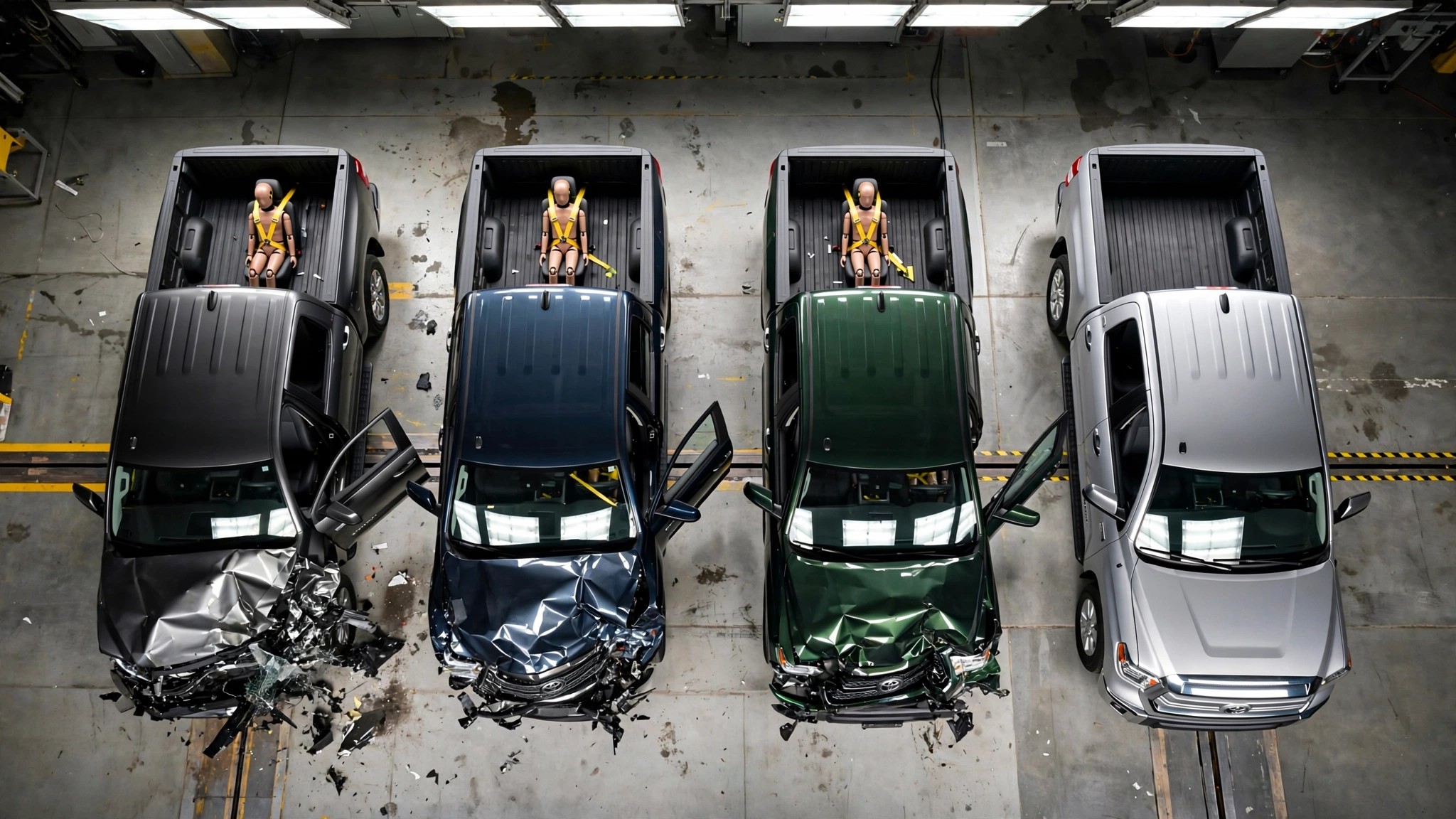
The IIHS puts a crash dummy the size of a 12-year-old in the back seat of a full-size pickup, slams it into a barrier at 40 mph, and checks whether the seatbelt held. In 2026, three of America's four best-selling full-size trucks failed: the F-150 and RAM 1500 both scored Poor, the Silverado scraped to Marginal, and only the Toyota Tundra earned a passing grade.
The test isn't exotic. A 40 percent frontal overlap at 40 mph mimics a head-on with an oncoming vehicle of similar size, the kind of wreck that happens on a Tuesday afternoon when someone drifts across the center line. Structurally, every truck's cab is fine in every case; it holds its shape, the front dummy walks away with measurements that would make any engineer proud. But the smaller rear dummy gets whipped forward because the seatbelt slid out of position on impact, concentrating force on the abdomen instead of distributing it across the pelvis and chest the way a properly anchored belt would. On the F-150, the result is "likely risk of injury to the head or neck and chest" plus elevated abdominal injury risk, and on the RAM the assessment reads nearly identically. On the Silverado, the structure itself is the problem too: the passenger-side small overlap test gave it a Poor rating for "survival space not maintained well," and the driver dummy's head hit the steering wheel hard enough to register through the airbag.
Toyota fixed this in a single model-year refresh. When the test launched in 2023, the Tundra scored Marginal, but for the 2025 model year Toyota redesigned the rear seatbelt geometry and every single measurement jumped to Good. The whole intervention amounted to better seatbelt buckle positioning so the belt stays on a smaller occupant's pelvis and chest instead of riding up into the abdomen. Ford, with three years of data showing the same failure mode, changed nothing. In practice, Ford's 2026 F-150 is functionally identical to the 2023 F-150 in rear seat protection.
Scale makes this more than an abstract test result. The F-150 appeared in 20,066 fatal crashes over the decade ending 2023, killing 9,194 people.[1] The Silverado: 19,732 fatal crashes, 9,591 dead. These aren't sports cars racking up fatalities on canyon roads or exotics wrapped around telephone poles at two in the morning. They're the commuter vehicles of suburban America, and the F-150 has been the nation's best-selling vehicle for over 40 years running, with roughly 6.5 million on the road at any given time.
And here's the part that should keep seatbelt engineers up at night: the F-150 has the lowest driver impairment rate of any major pickup in the FARS toxicology data. Only 18.9 percent of F-150 drivers in fatal crashes tested positive for alcohol or drugs, compared to 20.6 percent for the Silverado and 21 percent for the Sierra.[2] A low impairment rate means more of those 9,194 deaths happened to sober drivers on ordinary trips. Families. People with car seats and booster seats and 12-year-olds riding shotgun to soccer practice in the back of a SuperCrew cab that Ford specifically markets to them.
This is a seatbelt problem, not a physics problem. The trucks are massive, structurally robust, and perfectly capable of absorbing frontal crash energy; the front occupant compartment scores Good on every test for every truck in the segment. RAM at least tried to improve, redesigning restraints for the 2025 model year so that head and neck protection jumped from Poor to Good, but chest protection stayed Marginal and the overall rating remained Poor. Credit for the effort, but more credit to Toyota for actually finishing the job.
The obvious counterargument: one test doesn't define a vehicle's safety, and the F-150 scores Good in small overlap, side impact, and pedestrian crash prevention. Most real-world crashes don't match the IIHS test geometry exactly. Fair enough. But the moderate overlap front crash is the single most common configuration in multi-vehicle head-on collisions,[3] and Toyota's fix proves the problem isn't an engineering moonshot requiring years of structural redesign. It's a seatbelt buckle repositioning exercise that one manufacturer completed in a single model-year refresh while the other three sat on their hands and watched children's crash dummy readings print Poor, year after year after year.
If you own a full-size pickup and carry kids in the back seat, check your truck's IIHS rear seat rating at iihs.org/ratings. If you're shopping, the Tundra is the only gas-powered full-size that earns a 2026 Top Safety Pick. For whatever else you think of it, the Cybertruck is the only pickup with Top Safety Pick+. Ford's cheapest path to protecting your kid is a software update and a seatbelt buckle redesign. Three years is a long time to wait for a company that issues 51 recalls in six months.
Methodology
Fatality counts and impairment rates from NHTSA FARS 2014–2023 bulk CSV data, processed via our standard pipeline. "Impairment" means any BAC > 0 or positive drug toxicology in the driver of a FARS-recorded fatal crash. Fleet estimates and VMT calculations carry ±15% uncertainty for high-volume models and wider margins for lower-volume trucks. IIHS ratings from the 2026 evaluation cycle, which requires Good in the moderate overlap front test (with rear seat dummy) for Top Safety Pick eligibility.
Sources & References
- NHTSA, Fatality Analysis Reporting System (FARS), 2014–2023 bulk data. nhtsa.gov
- FARS toxicology data for pickup-class vehicles. Impairment defined as BAC > 0 or positive drug screen. F-150 n=21,195 drivers; Silverado n=23,675; Sierra n=9,319. cdan.dot.gov
- IIHS, 2026 Top Safety Pick Award Criteria and moderate overlap front crash test results for large pickups. iihs.org
- Matt Maran, “Toyota Tundra Beats Ford F-150 In IIHS Rear Seat Safety Test,” CarBuzz, June 28, 2026. carbuzz.com