America's Three Bestselling Vehicles Can't Pass a Crash Test
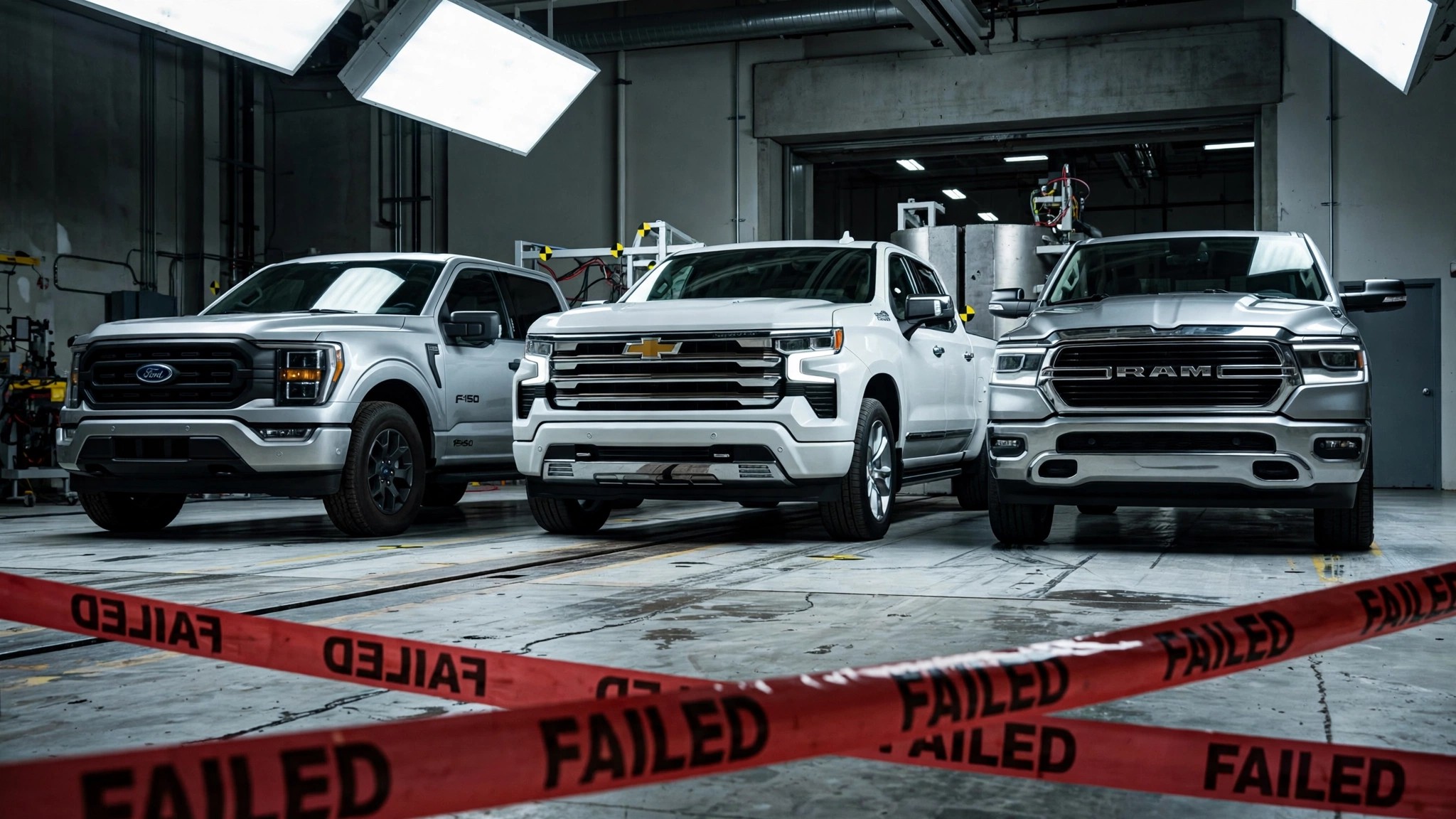
Before you sign that truck lease, consider what the Insurance Institute for Highway Safety thinks of your shortlist. When IIHS released its 2026 pickup results, only two models earned safety awards: the Tesla Cybertruck (Top Safety Pick+) and the Toyota Tundra (Top Safety Pick). The Ford F-150, Chevrolet Silverado, and Ram 1500 all failed to qualify.[1] Those happen to be the three vehicles Americans buy more than anything else on wheels.
That failure matters because these trucks kill at industrial scale. FARS data from 2014 through 2023 records 9,194 deaths inside F-150s, 9,591 inside Silverados, and 5,121 across the Ram lineup, totaling 23,906 occupant fatalities in a single decade. Those three nameplates were involved in more than 52,000 fatal crashes, a figure that includes everyone who died in or around them.[2]
Full-size pickups are also net death exporters, a pattern the FARS lethality ratios expose clearly. For every F-150 occupant killed in a fatal crash, 1.18 people in other vehicles or on foot died instead. The Ram 1500 is the most extreme example in our dataset, with a crash lethality ratio of just 0.341, meaning in roughly two out of three fatal crashes involving a Ram 1500, the person who died was not inside the Ram. Its death export ratio reaches 1.93-to-1, which means buying one is statistically purchasing a vehicle that kills nearly two other road users for every one of your own occupants lost.
Toyota's Tundra earned its IIHS award with 1,223 occupant deaths over the same period and a per-mile fatality rate of 0.94 per 100 million VMT, comparable to the Big Three but with the structural design to actually pass independent crashworthiness evaluation. The Cybertruck, which didn't exist during the FARS window, earned the highest possible rating after Tesla revised its front underbody structure and footwell geometry to handle the small-overlap test that conventional body-on-frame trucks routinely fail.[1]
The strongest counterargument from Detroit is volume: the F-150 and Silverado each have fleets exceeding five million registered vehicles, so their raw death counts reflect ubiquity as much as danger. That objection has weight for raw totals but does nothing to explain the IIHS failure, which tests a single vehicle in a controlled lab regardless of fleet size. Volume also doesn't help the other people who die in those crashes at disproportionate rates.
A limitation worth noting: FARS only captures fatal crashes, not the millions of survivable collisions where these trucks may perform differently. And the death export ratio attributes all non-occupant fatalities in a crash to the truck, including cases where the truck driver wasn't at fault. The metric identifies a structural pattern, not a causal verdict on every individual crash.
If you're shopping for a full-size pickup in 2026, the buying advice is unusually simple: check whether your truck has an IIHS award before you negotiate the trim package. Right now that means the Tundra or the Cybertruck. Everyone else is selling you America's most popular way to die in a vehicle without an independent safety endorsement to show for it. You can verify any truck's current IIHS rating at iihs.org/ratings.
Sources & References
- AutoGuide / IIHS, “Only Two Pickup Trucks Survived 2026 IIHS Crash Testing,” May 2026. iihs.org/ratings
- NHTSA, Fatality Analysis Reporting System (FARS), 2014–2023. nhtsa.gov
- IIHS, 2026 Top Safety Pick criteria and award methodology. iihs.org