A Sedan Breaks Your Legs. An SUV Breaks Your Ribs, Your Skull, and Your Chances.
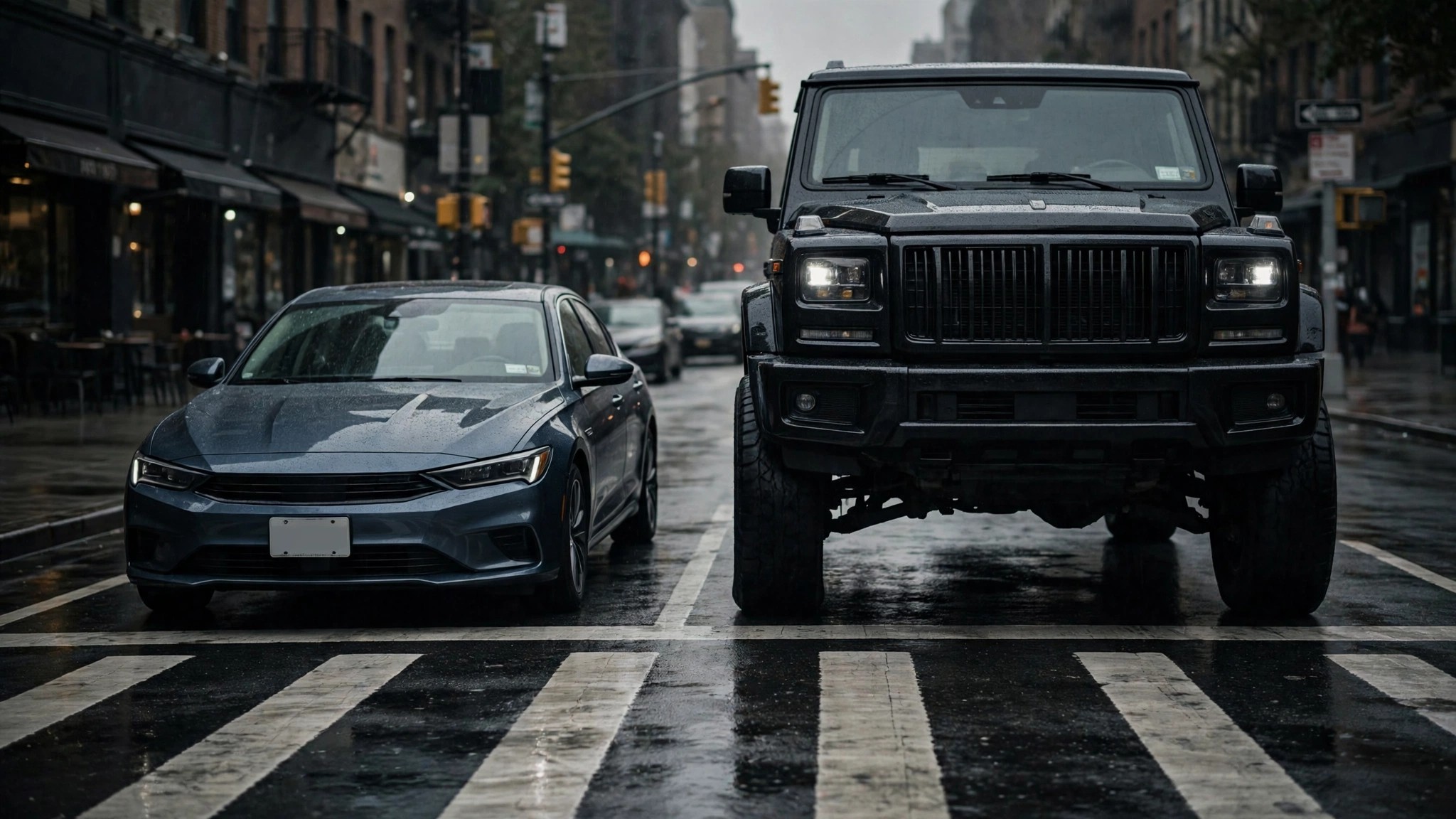
Forensic pathologists at the University of Michigan autopsied 102 pedestrians and cyclists killed in vehicle crashes, then mapped their injuries against the vehicles that struck them.[1] What they documented confirms something traffic safety researchers have suspected but rarely verified at the autopsy table: the height of a vehicle's front end determines where on your body the lethal damage concentrates, and that height difference separates survivable injuries from fatal ones.
When a sedan strikes a pedestrian, the bumper catches the legs below the center of mass, sweeping the person's feet and rotating them over the hood. Tibial and fibular fractures dominate the injury profile in these collisions, and while they are painful and sometimes career-ending, they are rarely fatal because the critical organs in the chest and head stay relatively protected during the rotation over the vehicle's surface.
SUVs and pickups produce a mechanically different collision sequence. Their front ends contact the pedestrian at torso height, with the bumper striking the pelvis or abdomen and the hood's leading edge catching the chest or head directly, so instead of rotating over the vehicle the pedestrian gets driven forward and downward into the pavement.[1] Michigan's pathologists documented more severe head injuries, more thoracic organ damage, and fundamentally different fracture distributions in SUV fatalities compared to sedan crashes at similar speeds.
IIHS validated this at scale across approximately 18,000 pedestrian crashes: vehicles with hood heights above 40 inches were 45% more likely to kill the pedestrian they hit than those below 30 inches.[2] The study's lead author offered a verdict that deserves a bumper sticker: "There's no functional benefit to these massive, blocky fronts." Those massive fronts now account for 79% of new vehicle sales in America, with hood heights up 11% since 2000 and full-size truck grilles standing 55 inches off the pavement, which is chest-height on the average adult and above the roofline of some sedans.
Beneath the biomechanics, the Michigan study exposed an infrastructure collapse: 63% of the pedestrian fatality locations had no sidewalks, and 85% had no bike lanes.[1] These were people walking where there was physically nowhere else to walk, in a country that designed its roads for vehicles and then recorded surprise when the vehicles started killing the humans who couldn't afford to be inside one. Nationally, GHSA counted 6,732 pedestrian deaths in 2025, now representing 10.1% of all traffic fatalities, more than double the 4% share measured in 2015.[3]
A caveat on scope: 102 autopsies from a single jurisdiction cannot establish national injury distributions by themselves, and variables like speed, impact angle, and pedestrian body position were not fully controlled in the pathology analysis. IIHS's 18,000-crash dataset provides the statistical power the Michigan study lacks, but the autopsy data provides the anatomical specificity that crash databases never capture, and both converge on the same conclusion from opposite directions.
If you're shopping for a vehicle and care about what happens to the person you might hit, check the hood leading edge height before you check the horsepower. Anything under 30 inches with a sloped profile is dramatically less lethal to pedestrians, and IIHS publishes this data for every rated vehicle. If you're a pedestrian in a neighborhood without sidewalks, the infrastructure already failed you before the collision did.
Sources & References
- Herb T, Snyder A, Wilson A. “Anatomy of a Crash: Analysis of 102 Pedestrian and Bicyclist Fatalities.” Am J Forensic Med Pathol. 2025;46(2):111–117. pubmed.ncbi.nlm.nih.gov
- IIHS, “Vehicles with higher, more vertical front ends raise risks for pedestrians,” Nov. 2023. iihs.org
- Governors Highway Safety Association, “U.S. Pedestrian Deaths Fall for Third Straight Year,” Jul. 2026. ghsa.org