NHTSA Celebrates a 7.6% Decline in Fatality Rates. A Single Vehicle Swap Delivers 90%.
NHTSA released its 2025 preliminary data last month and the press release practically glowed: traffic deaths fell 6.7%, from 39,254 to 36,640, the fatality rate dropping from 1.19 to 1.10 per 100 million vehicle miles traveled.[1] Deaths declined in 39 states plus DC and Puerto Rico. Real progress. Genuine celebration.
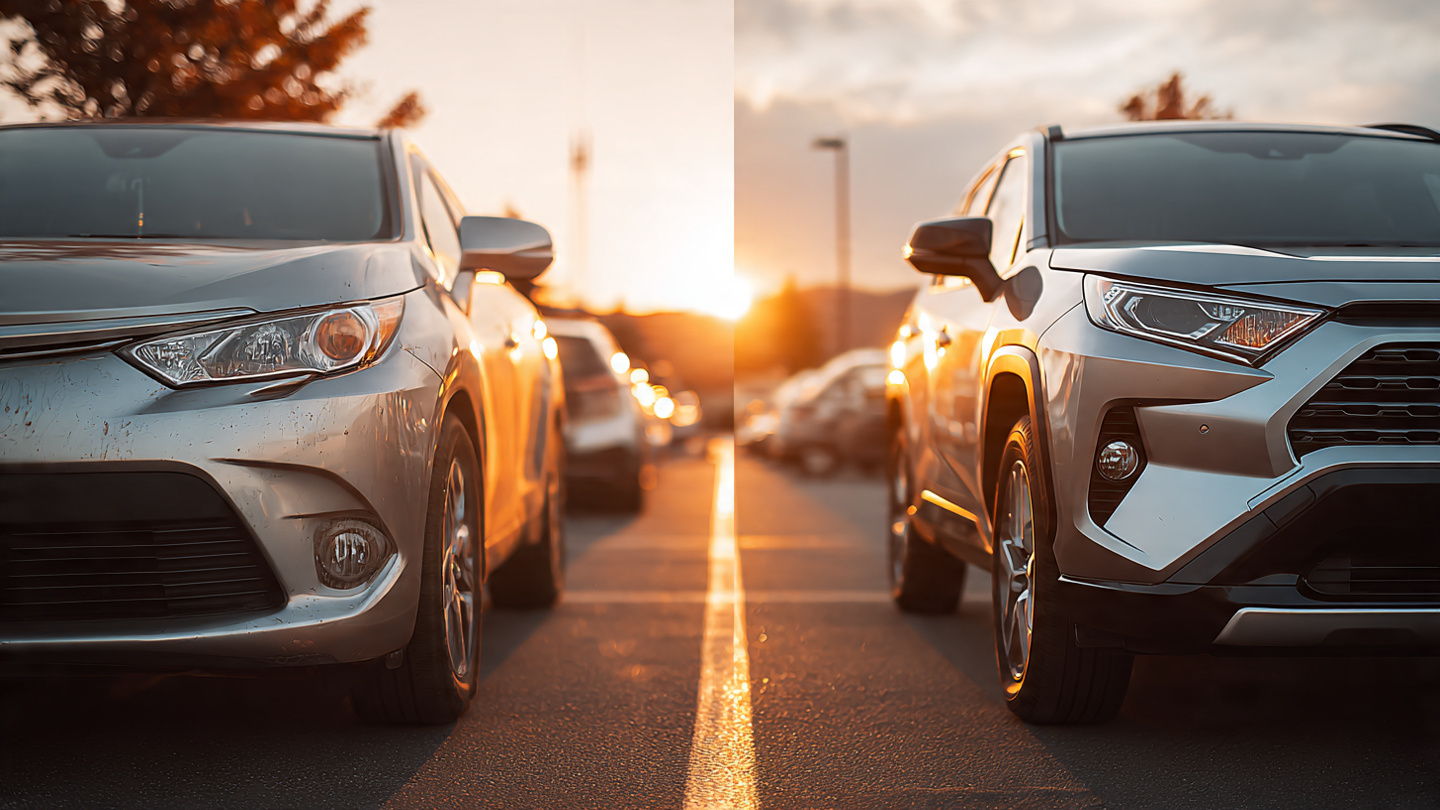
Now look at what happens when one person walks into a Toyota dealership and trades a Camry for a RAV4.
Same brand, same dealer, comparable sticker price. The Camry carries a FARS fatality rate of 2.03 deaths per 100 million VMT across a fleet of 5.68 million vehicles.[2] The RAV4 sits at 0.19 across 3.76 million. That is a 90.6% reduction in fatal crash exposure, not over a decade of incremental regulatory progress and infrastructure investment and public awareness campaigns, but in a single afternoon at a dealership.
We ran the same calculation across four high-volume same-brand swaps using our FARS 2014–2023 dataset.
Toyota Camry to RAV4: 10.7 times safer, a 90.6% improvement. Nissan Altima to Rogue: 8.2 times safer, an 87.8% improvement. Honda Accord to CR-V: 5.8 times, 82.7%. Honda Civic to CR-V: 4.2 times, 76.4%.[2]
Every single swap delivered between four and eleven times the improvement that the entire United States transportation system achieved in a calendar year.
The compounding math that should make you angry
At the national rate of 7.6% annual improvement in fatality rate per VMT, how many years would it take for background progress alone to match what a Camry-to-RAV4 swap delivers instantly? Compound 7.6% year over year until you reach 90.6% cumulative reduction. The answer: approximately 30 years, assuming the 2025 decline rate sustains indefinitely, which it will not, because traffic safety gains are cyclical and the 2020–2021 spike already proved how fast progress reverses.[3]
For the Honda Accord to CR-V swap (82.7% improvement), you need roughly 22 years of compounding at 7.6%. The Civic to CR-V swap (76.4%) takes about 18 years.
Thirty years. That is how long America needs to match what one consumer can do in an afternoon at a Toyota dealership by pointing at a different vehicle on the lot.
Why the gap is this large
Three forces converge. Weight: the RAV4 at 3,615 pounds outweighs the Camry by roughly 300 pounds, and IIHS research shows that every additional 1,000 pounds of vehicle mass reduces the driver's fatality risk by approximately 47%.[4] Ride height: SUVs position occupants higher, which means frontal collisions tend to engage the vehicle's full structural protection rather than submarining under a truck's bumper. And fleet age: the Camry's 5.68 million registered vehicles include millions of pre-2012 models that lack electronic stability control, automatic emergency braking, and modern side-curtain airbags, all of which the RAV4's newer and smaller fleet is more likely to have.
Within-class spread tells the rest of the story
If the sedan-to-SUV gap seems dramatic, the within-class variation is worse. Among sedans in our dataset, the fatality rate spread runs from 0.02 (Toyota Matrix) to 5.11 (Nissan Maxima), a 255-fold range.[2] Among SUVs: 0.03 (Tesla Model Y) to 7.83 (Chevrolet Tracker), a 261-fold range. Even if you refuse to switch vehicle classes, picking the right model within your preferred segment delivers enormous returns.
Limitations
Our FARS data spans 2014–2023 and reflects a fleet mix that includes many older vehicles. A brand-new 2026 Camry equipped with Toyota Safety Sense 3.0 almost certainly has a lower fatality rate than the fleet-wide 2.03 average. We cannot isolate model year within our rate calculations because VMT estimates from the National Household Travel Survey are not broken down by model year, introducing approximately ±15% uncertainty on low-volume models.[5] FARS captures only fatal crashes, so a vehicle with a low death rate might still produce high rates of serious injury. And the demographic profiles of sedan buyers and SUV buyers differ in ways (age, income, driving patterns, impairment rates) that FARS cannot fully disentangle from vehicle design effects.
The strongest case against this framing
A critic would argue, correctly, that the high sedan fatality rates reflect fleet age more than inherent design inferiority, that a 2025 Honda Accord with AEB and lane-keeping assist is a fundamentally different machine from a 2008 Accord without electronic stability control, and that telling consumers to abandon sedans based on fleet-average data that includes fifteen-year-old cars is misleading. This critique has merit, and newer sedans are dramatically safer than their predecessors. But the fleet-average data represents what is actually killing people on American roads right now, not what might happen in a controlled test environment, and for the 180 million Americans currently driving vehicles already on the road, the swap math applies to the cars they actually own.
What you should do with this
If you are shopping for your next vehicle and safety is a priority, check our FARS dataset before you sign. The five safest large-fleet compact SUVs by fatality rate: Toyota RAV4 (0.19), Chevrolet Traverse (0.20), Subaru Forester (0.26), Honda Pilot (0.29), Kia Sorento (0.29).[2] If you currently drive a sedan from any of these brands, your same-brand crossover or SUV alternative likely carries a fatality rate 4 to 11 times lower. That is not a rounding error; it is the difference between the safety improvement Washington has delivered in a year and the one your dealership can deliver before lunch.
Sources & References
- NHTSA, 2025 Preliminary Traffic Fatality Data. 39,254 fatalities in 2024, 36,640 in 2025 (6.7% decline). Fatality rate: 1.19 → 1.10 per 100M VMT (7.6% decline). nhtsa.gov
- NHTSA, Fatality Analysis Reporting System (FARS), 2014–2023. Model-specific fatality rates, fleet sizes, and within-class spread calculated from FARS microdata cross-referenced with registration and VMT estimates. nhtsa.gov
- National Safety Council, Preliminary Motor Vehicle Deaths, 2025. Context on cyclical nature of traffic fatality trends and the 2020–2021 spike. nsc.org
- IIHS, Vehicle Size and Weight. Research on the relationship between vehicle mass and occupant fatality risk. iihs.org
- National Household Travel Survey (NHTS). VMT estimation methodology and limitations. nhts.ornl.gov
Source: NHTSA FARS 2014–2023. Fatality rates are deaths per 100M VMT using estimated fleet VMT. Sedan fleet averages include older vehicles without modern safety features. See methodology for caveats.