New York Cut Traffic Deaths 78% While California Added 243. One Built Speed Cameras.
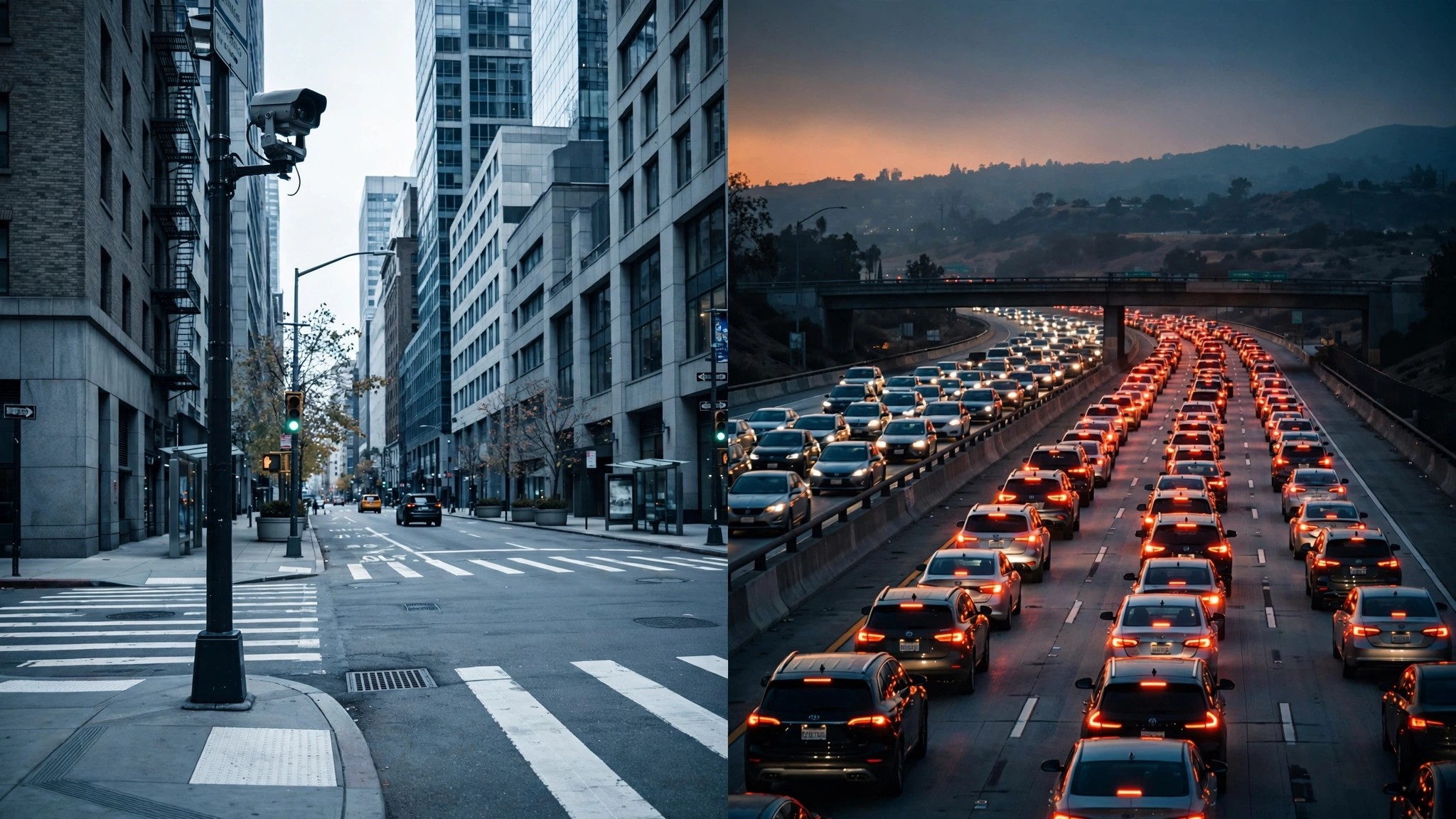
The National Safety Council's preliminary estimates for January through April 2026 contain a divergence so extreme it reads like a data error. New York reported 150 fewer traffic deaths than the same period last year, a 78% decline, while California reported 243 more. Same country, same four months, opposite trajectories separated by roughly 400 corpses.
A caveat upfront, because data integrity matters more than headlines: New York's number carries an asterisk in the NSC report, almost certainly flagging incomplete state-level reporting, which means the actual decline is probably smaller, maybe 30%, maybe 40%, though the exact figure matters less than the direction. What isn't a reporting artifact is the divergence itself, because New York is saving people while California is losing them, and the mechanisms driving that split are identifiable.
Start with what New York built. Congestion pricing went live January 5, 2025, pulling 87,000 vehicles per day out of lower Manhattan, and crashes in the tolled zone dropped 14% while motor vehicle occupant injuries fell 34%.[1] Then there are the speed cameras, now operating 24 hours a day, seven days a week across the largest automated enforcement network in the country, where speeding at monitored locations dropped 30% on average and on Houston Street in the East Village it dropped 96%.[2] During the newly enforced nighttime and weekend hours, traffic fatalities in camera zones fell 25%. Add Sammy's Law, which lowered default speed limits to 20 mph citywide by end of 2025, and Mayor Mamdani's subsequent reduction to 15 mph in 700 school zones, and you have a jurisdiction that decided speeding kills and then actually did something about it.[3]
Now look at California, which has no statewide speed camera program, no congestion pricing anywhere in the state, and climbing VMT. AB 645 authorized a pilot in six cities starting July 2024, and early results won't be meaningful for years. Meanwhile the preliminary mileage death rate nationally dropped to 1.06 per 100 million vehicle miles driven, down from 1.36 just three years ago.[4] California is swimming against that current with 243 additional deaths through four months, which annualizes to roughly 700 extra fatalities per year if the rate holds, and seven hundred people is not a rounding error; it is a policy failure measured in body bags.
Structural objections exist, and the strongest is geographic: New York's density makes automated enforcement and transit alternatives feasible in ways that don't translate to California's freeway-centric sprawl. Fair enough, but density didn't build the cameras; a political decision did. And the speed camera data from NYC shows something the FARS database has been whispering for decades: speed is the single most modifiable risk factor in fatal crashes, and enforcement works when it actually exists. Drivers with 20 or more speed camera violations are five times as likely to cause a severe crash, and those with thirty or more violations are fifty times as likely.[3] New York identified these serial offenders and proposed legislation requiring intelligent speed assistance devices on their vehicles, while California hasn't gotten that far because California doesn't have the camera network to identify them in the first place.
What to do with this
If you live in California, your state legislator has a phone number. AB 645 covers six cities out of 482 statewide. Speed cameras are not a New York invention, and they are not particularly expensive relative to the cost of a single fatal crash, which NHTSA estimates at $12.9 million in comprehensive societal costs.[5] If New York's network prevents even 50 deaths a year, that is $645 million in avoided costs against an annual operating budget measured in tens of millions, which is the kind of math that shouldn't require a campaign contribution to notice. If you live in New York, the data says your commute just got measurably safer, though the full picture won't crystallize until final FARS numbers land in late 2027. Either way, the preliminary signal is unmistakable: one state decided that saving lives required spending money and tolerating cameras, and the other decided it didn't.
Sources & References
- NYC.gov, “Vision Zero: Traffic Deaths Are Near Lowest Levels in Recorded History After First Three Months of 2026,” 2026. nyc.gov
- NYC DOT, “Speeding, Injuries, and Traffic Fatalities Declined in Areas With Speed Cameras During First Year of 24/7 Enforcement.” nyc.gov
- Vital City NYC, “A Road Safety Blueprint for the Mamdani Administration,” 2026. vitalcitynyc.org
- National Safety Council, “Monthly Preliminary Motor-Vehicle Fatality Estimates, April 2026.” injuryfacts.nsc.org
- NHTSA, “The Economic and Societal Impact of Motor Vehicle Crashes, 2019 (Revised).” nhtsa.gov
Source: National Safety Council preliminary estimates, January–April 2026. New York's figure carries an asterisk in the NSC report, indicating potential incomplete state-level reporting; actual decline likely lower than 78%. California figure is also preliminary, and final FARS data is expected late 2027. See methodology for caveats.