NHTSA Closed Two Probes Covering 817,000 Vehicles in One Weekend. Nobody Checked If the Fixes Work.
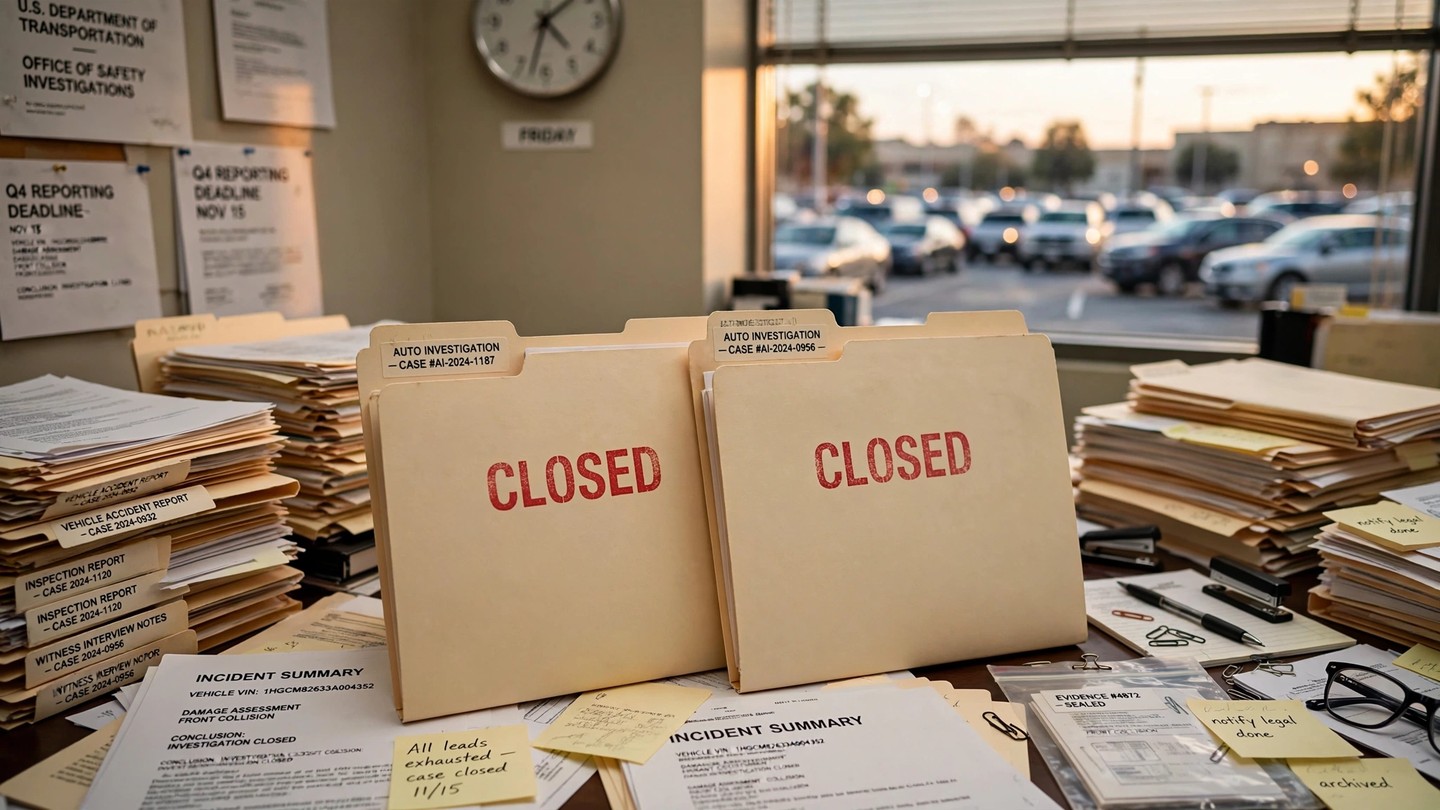
Between Friday evening and Saturday morning, NHTSA quietly closed investigations into two separate defects affecting 817,243 vehicles. One involved Honda minivans whose side curtain airbags fire when you hit a pothole. Another involved Teslas that could lose power steering at any speed without warning. Both probes ended identically: manufacturer filed a recall, agency stamped the file closed, nobody scheduled a follow-up to see if the fixes actually landed.
Honda's Odyssey problem is instructive because of how long it festered. Owners reported airbags detonating over speed bumps as early as January 2017. Honda accumulated 130 warranty claims and 25 injury reports before NHTSA opened a preliminary evaluation in October 2025, eight years and nine months after the first documented complaint.[1] A recall followed in April 2026. Two months later, NHTSA closed the probe. Paperwork cleared. Miscalibrated deployment thresholds in the SRS control unit meant every pothole in America was an unintended trigger for a pyrotechnic device bolted six inches from a child's head in the second row. For almost a decade.
Tesla's case moved faster on the front end and slower on the back. NHTSA opened its preliminary evaluation in July 2023 after drivers of 2023 Model 3 and Model Y vehicles reported sudden inability to turn the steering wheel.[2] By early 2024, the agency escalated to an Engineering Analysis, its final administrative step before compelling a recall. Tesla issued a voluntary recall of 376,241 vehicles in February 2025, pushing an over-the-air software update that prevented overvoltage breakdown on the power steering's circuit board. Naturally, Tesla claimed the recall was "not in response to" NHTSA's investigation. Sixteen more months passed before the agency closed the engineering analysis this weekend, presumably to monitor whether the software patch held, though NHTSA never explained what required sixteen months between fix and file closure.
What makes these closures worth examining together is a time asymmetry. It borders on structural comedy. A 2023 DOT Office of Inspector General audit found that NHTSA's preliminary evaluations averaged 617 days open against a 120-day target.[3] Engineering analyses averaged 1,001 days against a one-year target. Twenty-six of 27 sampled investigations blew their deadlines. An agency that needs five times its own deadline to decide whether a problem exists can apparently close the file in a weekend when a manufacturer submits the right form.
Here is a question nobody at NHTSA is required to answer: what percentage of those 817,243 vehicles have actually been fixed? Industry-wide, recall completion rates average roughly 70%, meaning on any given recall, three out of ten affected vehicles never see a wrench or a software update.[4] For Honda Odyssey owners, notification letters were mailed in late May 2026, barely a month before the probe closed. Dealers need to physically update or replace each SRS ECU, and while Tesla's OTA delivery is faster, not every owner accepts updates promptly, and Tesla does not publish per-recall completion data with the same granularity other manufacturers provide to NHTSA's publicly searchable database.
And it gets busier. That same NHTSA office is managing an expanding portfolio of active Tesla investigations. EA26002 covers 3.2 million vehicles over Full Self-Driving's failure to detect low-visibility conditions; PE25012 covers another 2.88 million for FSD-related traffic violations. Last week, a special crash investigation opened into a June 20 incident in Katy, Texas, where a Model 3 drove through a home's wall and killed 76-year-old Martha Avila.[5] NTSB opened its own parallel probe. Four active investigations across more than six million Tesla vehicles, handled by an office that its own inspector general says cannot reliably hit deadlines on a single probe.
Structural incentives here are clear enough to diagram: NHTSA opens an investigation, public pressure builds, a manufacturer files a voluntary recall while sometimes explicitly denying the investigation prompted it, and the agency closes the file. Recall completion settles around 70% over the next few years, the agency moves on, and vehicles that never get fixed become a rounding error in a system that measures success by investigations closed, not defects eliminated. If NHTSA tracked a "residual risk" metric counting estimated unfixed vehicles still on the road after every closure, this weekend's scorecard would read less like progress and more like accounting.
Limitations: Those 617-day and 1,001-day averages derive from a 27-investigation OIG sample covering 2018 and 2019 cases, though NHTSA has since upgraded its case management system and claims process improvements. Industry-wide recall completion of ~70% is an approximation; actual rates vary by manufacturer, defect severity, and fix type (OTA versus dealer visit). Tesla's OTA mechanism likely achieves higher completion than average, though Tesla does not publish granular data, and closure after a recall is standard administrative procedure. What is novel here is narrower: measuring the time asymmetry between opening and closing, combined with no public residual-risk metric, reveals a structural incentive to count investigative throughput rather than defect elimination.
Strongest counterargument: NHTSA's Deputy Administrator has stated that the agency does not wait until an investigation closes to hold manufacturers accountable, and that keeping investigations open serves as ongoing oversight. Several long-term investigations involve consent orders, standing general orders, and active auditors even while technically open, and an OIG finding that investigations exceeded internal timelines does not, by itself, prove that NHTSA's safety interventions were insufficient or that effective work was not being done. Weekend closure of these two probes may reflect genuine confidence that both recalls adequately address each defect.
What you should do: If you own a 2018-2022 Honda Odyssey, check your VIN at nhtsa.gov/recalls and schedule the ECU update with your dealer immediately. Do not assume a notification letter reached you. If you own a 2023 Tesla Model 3 or Model Y, verify your software version includes the steering fix (release 2023.38.4 or later). For any vehicle at all: NHTSA's recall lookup tool is free, takes ninety seconds, and is more reliable than waiting for the agency to close a file on your behalf.
Sources & References
- Reuters, “US auto safety regulator closes evaluation of 441,002 Honda Odyssey vehicles after recall,” June 27, 2026. reuters.com
- Reuters, “US safety agency ends power steering probe into 376,000 Tesla EVs,” June 28, 2026. reuters.com
- DOT Office of Inspector General, “NHTSA Has Not Fully Established and Applied Its Risk-Based Process for Safety Defect Analysis,” June 2023. oig.dot.gov
- NHTSA, “Recall Completion Rates Report,” annual data. Industry-wide average recall completion rate is approximately 70-75% within 18 months of notification. nhtsa.gov/recalls
- Memeburn, “Tesla Faces Federal Probe After Fatal Texas Crash,” June 2026; NHTSA special crash investigation and NTSB safety probe opened June 23-25, 2026. memeburn.com