The Dodge Neon Was America’s Disposable First Car. It Killed 602 People.
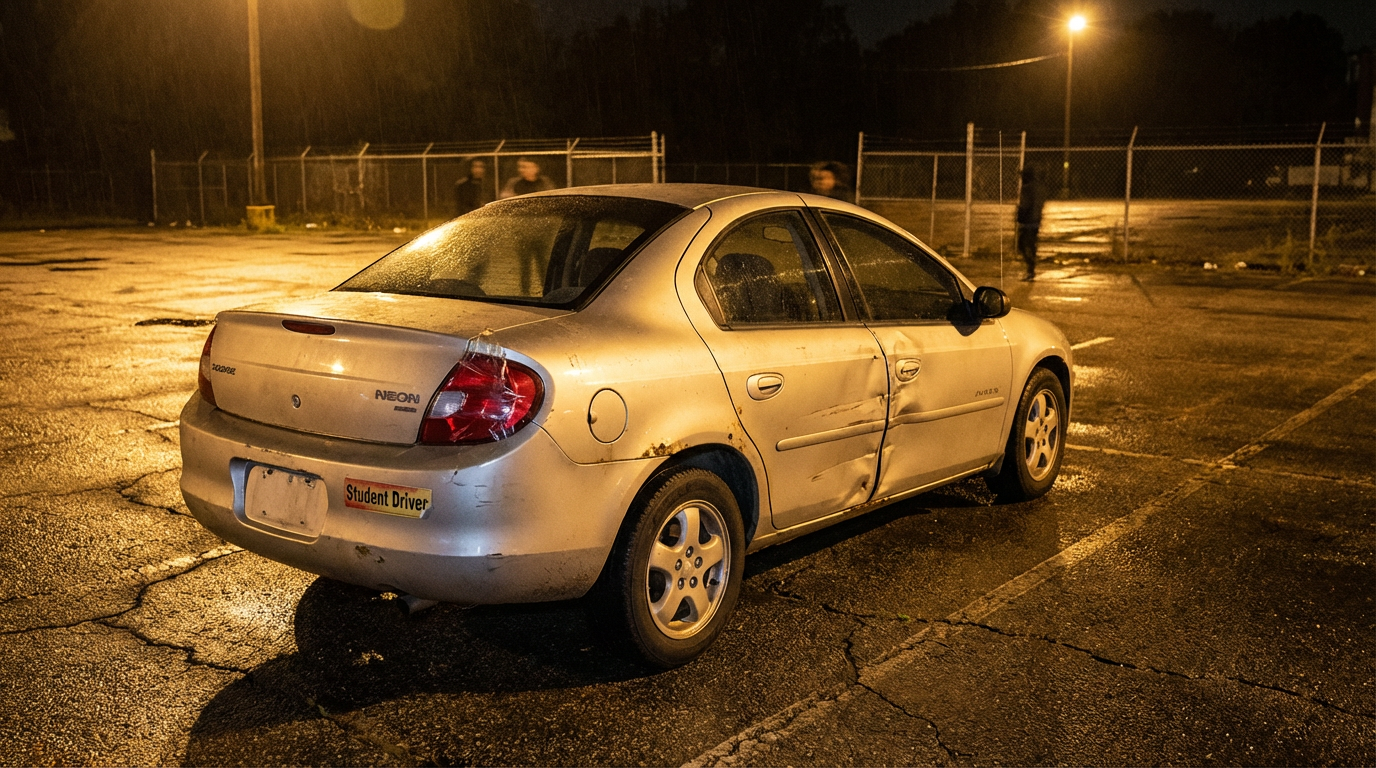
According to the toxicology reports — and there are a lot of them — the Dodge Neon has a drug problem. Not a drinking problem. A drug problem. Of the 340 Neon drivers in fatal crashes who were tested, 11.8% came back drug-positive. That’s nearly double the national average for sedans. Combine that with the 16.5% alcohol-positive rate, and 23.2% of fatal Neon crashes involved an impaired driver — putting it in the top tier of any vehicle in the FARS database.
The Neon’s overall fatality rate is 1.50 deaths per 100 million vehicle miles traveled — 602 total deaths from a fleet of roughly 350,000 vehicles between 2014 and 2023. That rate actually isn’t the worst in its class. The Ford Focus comes in at 2.52. The Chevrolet Cavalier hits 2.43. The Cobalt reaches a staggering 5.10. By the numbers, the Neon was merely bad — not catastrophic.
But those cars didn’t have the Neon’s toxicology profile.
The First-Car Death Pipeline
| Vehicle | Rate | Deaths | Impairment | Drug % |
|---|---|---|---|---|
| Chevrolet Cobalt | 5.10 | 1,540 | 22.4% | — |
| Ford Focus | 2.52 | 3,046 | 19.4% | — |
| Chevrolet Cavalier | 2.43 | 1,225 | 22.4% | — |
| Honda Civic | 2.25 | 6,553 | 20.4% | — |
| Nissan Sentra | 2.13 | 2,571 | 20.0% | — |
| Dodge Neon | 1.50 | 602 | 23.2% | 11.8% |
| Hyundai Elantra | 1.50 | 2,407 | 18.6% | — |
| Toyota Corolla | 1.85 | 4,945 | 19.2% | — |
Look at the Neon’s column. Its death rate is mid-pack, even slightly better than the Corolla. But its impairment rate is the highest in the segment by a comfortable margin. The sober Neon was actually a reasonably safe cheap car. The impaired Neon was something else entirely.
Model Year 2005: The Final, Deadliest Year
Chrysler killed the Neon nameplate after 2005 (replacing it with the Caliber, which was worse in every way except survival odds). That final model year accounts for 159 of the Neon’s 602 deaths — 26% of all fatalities from a single model year. The year 2004 added another 108. Together, the last two years of production account for nearly half the total body count.
The pattern isn’t hard to decode. The Neon was a $13,000 car when it was new. By the time these model years hit the FARS window (2014–2023), they were $2,000 Craigslist specials being driven by the people who couldn’t afford anything better. The Neon wasn’t chosen. It was all that was left.
The Hi Line
The “Hi Line” was what Chrysler called its marketing plan — the Neon was supposed to be the entry point that graduated buyers into Sebrings, 300s, and eventually a Jeep. Instead, it became the car you drove until you could afford not to. The marketing slogan was literally “Hi.” — the most aggressively nonthreatening word in the English language, paired with a car that was quietly accumulating one of the highest drug-impairment rates in the database.
There’s a direct line between a car’s resale value and who ends up driving it ten years later. A $2,000 car selects for desperation, not driving skill. The Neon’s toxicology isn’t evidence that Chrysler built a car for drug users. It’s evidence that cheap used cars end up in the hands of people whose lives are already going wrong.
Every car is an autobiography. The Neon’s final chapter was written in toxicology reports.