For 48 Years, NHTSA Rated Cars on How Well They Crumpled. One Car Finally Passed the Other Test.
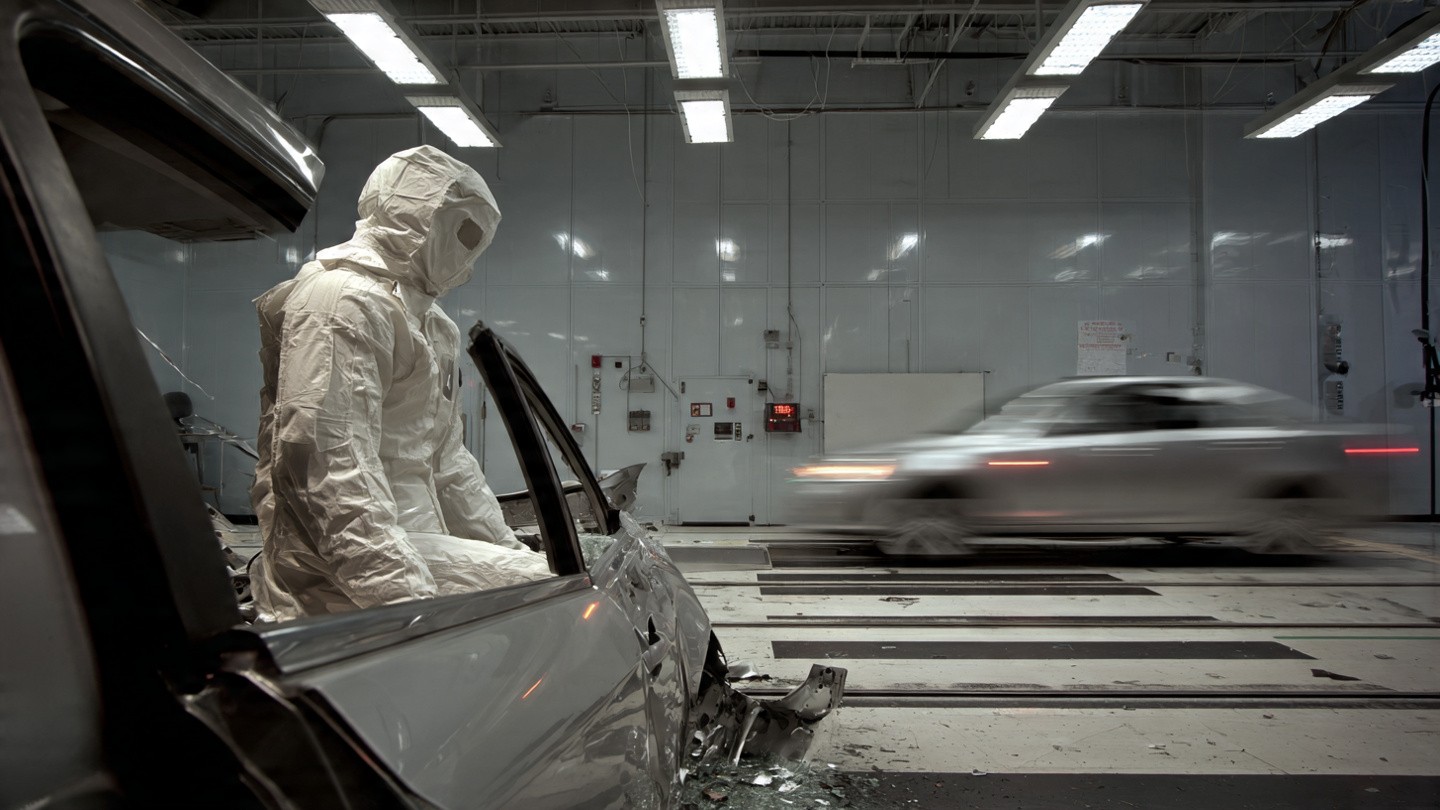
In 1978, the National Highway Traffic Safety Administration launched NCAP, the New Car Assessment Program, by driving a Chevrolet Impala into a concrete barrier at 35 miles per hour and measuring what happened to the dummy inside. That was the question: after your car hits something, how dead are you? For the next 48 years, that remained the only question NHTSA's star ratings attempted to answer.
Not whether the car saw the pedestrian in the crosswalk. Not whether it nudged you back into your lane when you drifted at 2 a.m. Not whether it noticed the Suburban parked in your blind spot while you signaled left on El Camino Real. The star rating on the window sticker, the one most car buyers say influences their purchase decision, measured one thing and one thing only: structural integrity upon impact. How well does this two-ton steel cage absorb kinetic energy and redirect it away from your femurs?
Last week, NHTSA announced the 2026 Tesla Model Y had become the first vehicle in history to pass the agency's new ADAS crash-prevention criteria.[1] Four tests, all pass/fail: pedestrian automatic emergency braking, lane-keeping assistance, blind-spot warning, blind-spot intervention. One car. Out of roughly 400 models sold in America.
You could frame that as a Tesla achievement story if you wanted to miss the point entirely.
The point is not Tesla's engineering; it is the timeline. IIHS started rating front crash prevention systems in 2013.[2] Euro NCAP required automatic emergency braking for its top safety rating in 2014.[3] The technology that brakes for pedestrians, warns about blind spots, corrects lane departures has been commercially available, independently rated, and factored into safety awards in every other developed nation for more than a decade. NHTSA's consumer-facing star rating ignored all of it until this year. That is a fourteen-year gap between the rest of the world telling consumers "this car tries not to crash" and NHTSA adding that information to the sticker on the window.
During those fourteen years, approximately 97,000 pedestrians were killed by vehicles on American roads.[4] The US is the only high-income country where pedestrian fatalities rose during that period: up 50% from 2013 to 2022, according to a CDC analysis of 28 nations.[5] Every other country in the comparison group saw pedestrian deaths decline by a median of 24.7%. The American trajectory diverged upward while the rest of the developed world bent the curve down.
AEB alone would not have reversed that divergence. Pedestrian deaths are driven by vehicle mass creep, SUV front-end geometry, road design that prioritizes throughput over survival, and the phone in every driver's hand. But the Partnership for Analytics Research in Traffic Safety found in 2024 that AEB-equipped vehicles had 52% fewer rear-end crashes and significantly reduced pedestrian-strike incidents compared to identical models without the technology.[6] A system that exists, works, and was already being rated by other agencies. The federal government's own consumer information program just never mentioned it.
Your 2020 Toyota Camry has five NHTSA stars. A 2026 Tesla Model Y also has five stars. One of them can detect a child stepping off a curb and apply full braking force in under 300 milliseconds. The other cannot. The star ratings are identical. The stars never told you the difference because for 48 years, the stars were not designed to.
Consumer Federation of America flagged this problem in 2020, calling it "starflation": so many vehicles earn 4 or 5 stars that the ratings have lost their ability to differentiate.[7] That was six years ago; the fix arrived this month. NHTSA's new ADAS criteria are pass/fail, not star-weighted, and results in 2026 are self-reported by manufacturers with independent lab verification starting in 2027.[8] One car has passed, and others will follow. But for at least one more year, you cannot look at a window sticker and know whether the five-star car on the lot will brake for the jogger you did not see.
What This Means for You
Do not trust NHTSA stars alone when shopping for a car. They still primarily measure crash survival, not crash prevention. Go to iihs.org/ratings and check whether your model has a Top Safety Pick+ designation, which requires superior or advanced front crash prevention. Verify your current vehicle has working AEB: check your owner's manual for "automatic emergency braking" or "pre-collision system." If your car is a 2017 or older model, it probably does not have AEB. If it does, make sure the system is enabled in your settings. A disturbing number of drivers unknowingly disable it.
Sources & References
- NHTSA, 2026 Tesla Model Y NCAP ADAS Test Results, May 2026. nhtsa.gov
- IIHS, Front Crash Prevention Ratings Program. iihs.org
- Euro NCAP, 2014 Rating Protocol Updates. euroncap.com
- GHSA, Pedestrian Traffic Fatalities by State, 2013–2025 preliminary reports. ghsa.org
- CDC MMWR, Pedestrian and Overall Road Traffic Crash Deaths — United States and 27 Other High-Income Countries, 2013–2022, Vol. 74 No. 8, 2025. cdc.gov
- Partnership for Analytics Research in Traffic Safety, AEB Effectiveness Study, 2024. Via codot.gov
- Consumer Federation of America, Celebrating the 40th Anniversary of NHTSA’s NCAP Uncovers the Need for a Total Overhaul, 2020. consumerfed.org
- Sidley Austin LLP, NHTSA Delays Implementing Updates to the Five-Star Safety Ratings Program, Sept. 2025. sidley.com
Source: NHTSA NCAP program data, GHSA pedestrian fatality reports 2013–2025, IIHS front crash prevention ratings, CDC MMWR Vol. 74 No. 8, PARTS AEB effectiveness study 2024. Pedestrian death totals are approximated from annual GHSA preliminary reports; final FARS counts may differ. See methodology for caveats.