72% of America's Road Deaths Happen in Vehicles That Pre-Date Stability Control
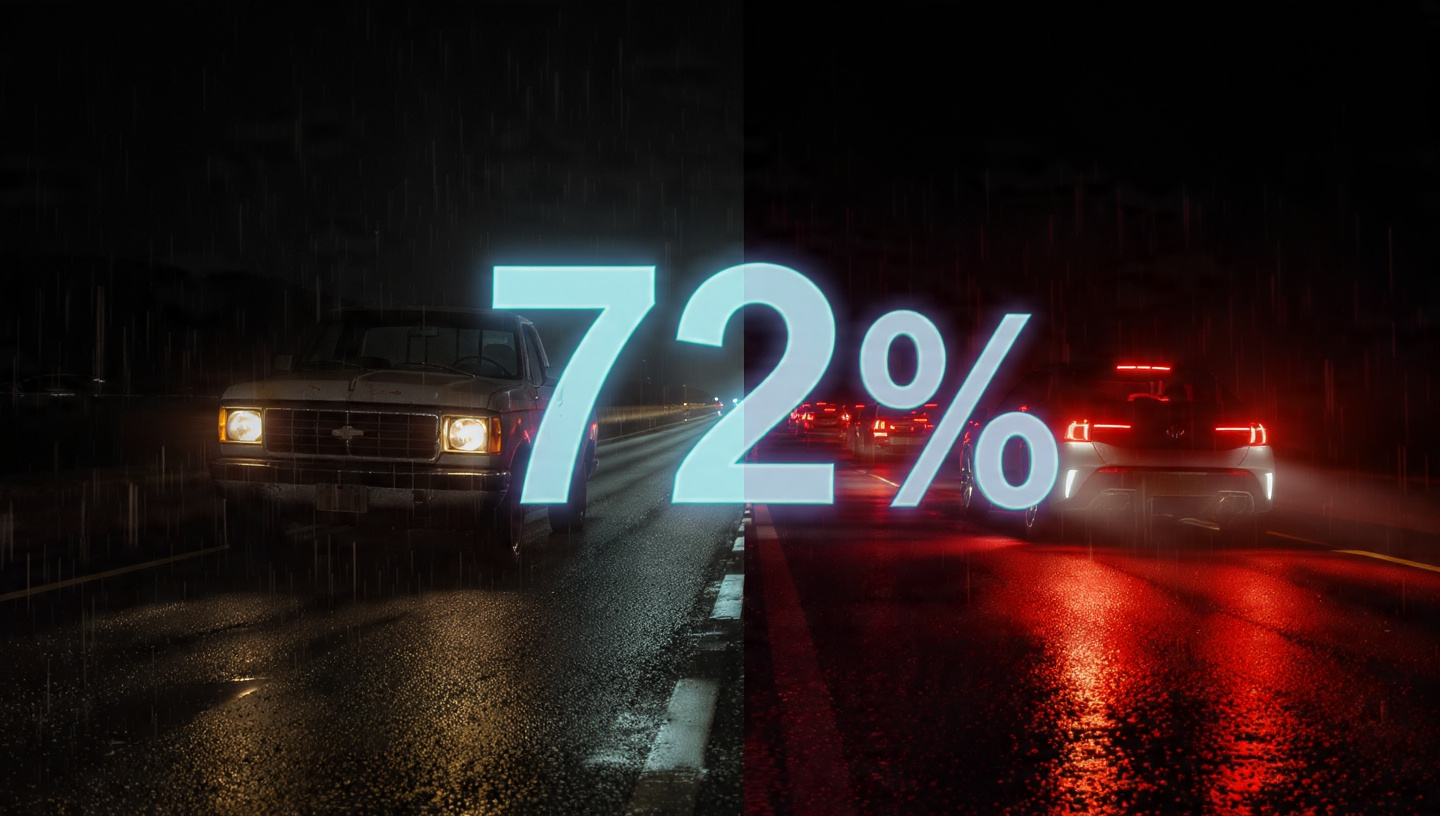
Federal rule FMVSS 126 required every new light vehicle sold in America to have electronic stability control by model year 2012. That was fourteen years ago. In the time since, 134,491 people recorded in FARS died in vehicles built before the mandate took effect, accounting for 71.9% of the 187,058 occupant fatalities in the database.[1]
That number demands context. FARS records all fatal motor vehicle crashes on public roads. When you cross-reference each fatality vehicle's model year against the federal mandate timeline, you get a technology generation map of American road death. Three mandates mark the major generational boundaries: ESC in 2012, rearview cameras in 2018, and the forthcoming AEB rule phasing in through 2029. Results are blunt. Only 28.1% of fatalities involve vehicles from the ESC-equipped generation. Just 7.6% involve vehicles built after backup cameras became standard. And a vanishing 0.6% involve vehicles young enough to carry voluntary-agreement AEB systems.[2]
Pickups sit at the ugly end of this distribution. Of the 41,167 pickup truck occupant deaths in the dataset, 33,630 occurred in trucks built before MY2012: 82%.[1] That's 18 percentage points worse than sports cars (64%), the class with the lowest pre-ESC share. Mechanics explain this gap, and the data is well-documented. IIHS found ESC reduces fatal single-vehicle rollover risk by 75% for SUVs and 72% for passenger cars.[3] Pickups, with their high center of gravity and body-on-frame construction, are the vehicles ESC was practically invented to save. They are also the vehicles Americans keep the longest. On average, a light truck on the road today is 11.9 years old; the average passenger car is 14.5.[4] A 12-year-old pickup bought new in 2014 would be MY2014 and equipped with ESC. But the median fatal pickup in FARS is older than that, often much older.
Class by class, the breakdown tells a consistent story. Sedans: 69% of 87,406 deaths from pre-ESC model years. SUVs: 68% of 45,242. Vans: 76% of 7,464. In every class, the majority of people who die on American roads die in vehicles that lack a technology proven to cut fatal crashes by roughly a third.[3] NHTSA itself estimated ESC saved 4,100 lives between 2010 and 2014 alone, when the mandate was still phasing in and only a fraction of the fleet was equipped.[5]
The honest caveat is that model year is a proxy, not a scalpel. A MY2008 Honda Accord lacks ESC, but it also lacks side curtain airbags as standard, a modern crumple zone geometry, and the structural rigidity of a 2015 Accord. Attributing the entire 72% gap to ESC would be dishonest. What's defensible is this: the ESC mandate model year is the clearest bright line in modern vehicle safety regulation, and everything on the wrong side of that line is measurably more dangerous for reasons that compound. ESC alone reduces fatal crash risk by 38% for cars and 56% for SUVs, per IIHS.[3] But ESC-era vehicles also arrived with better structures, better airbag coverage, and better restraint systems. The mandate marks a generation, not just a feature.
The strongest counterargument: FARS 2014-2023 data inherently oversamples older model years because a MY2000 vehicle had all ten years of crash exposure while a MY2022 vehicle had at most one. If you normalized by vehicle-years-of-exposure rather than raw counts, the pre-ESC share would shrink, possibly substantially. The 72% figure measures the population that died, not the risk per vehicle. It's a snapshot of fleet composition at the moment of fatal impact, and America's fleet is old. The number indicts the fleet's age at least as much as any single technology.
What FARS cannot measure: how many crashes ESC prevented entirely (FARS only records fatal crashes, not crashes that didn't happen), driver income, maintenance history, or tire condition. The pre-ESC fleet correlates with lower household income, rural routes, deferred maintenance, and bald tires. Separating the technology gap from the economic gap is impossible with this data. Both are probably lethal.
What to do with this: If you're buying a used car, treat MY2012 as a hard safety floor. Every vehicle from that year forward carries stability control. If you're buying for a teenager, move the floor to MY2018 for backup cameras and better structural standards. If you drive a pre-2012 pickup truck, you occupy the single most dangerous cell in this analysis: 82% of all pickup deaths, in a vehicle class where ESC's rollover prevention delivers its largest benefit. Check your VIN at nhtsa.gov/recalls, and if the budget exists, consider that trading into a 2013 pickup with 150,000 miles may be safer than keeping a 2005 with 90,000.
Sources & References
- NHTSA, Fatality Analysis Reporting System (FARS), 2014–2023. Cross-tabulation of fatalities by vehicle model year and vehicle class. nhtsa.gov
- NHTSA, FMVSS 126: Electronic Stability Control Systems, Final Rule, June 2007; FMVSS 111: Rear Visibility, Final Rule, 2014; FMVSS 127: AEB, Final Rule, 2024. govinfo.gov
- IIHS, “Life-saving benefits of ESC continue to accrue,” 2016. ESC reduces fatal crash risk 38% for cars, 56% for SUVs; single-vehicle rollovers reduced 75% (SUVs), 72% (cars). iihs.org
- S&P Global Mobility, “Average Age of Light Vehicles in U.S.,” 2025. Average 12.8 years overall; passenger cars 14.5 years, light trucks 11.9 years. aapexshow.com
- NHTSA, Estimating Lives Saved by Electronic Stability Control, 2008–2012, DOT HS 812 042. 4,100 lives saved 2010–2014. trb.org