The Cheapest Car to Earn IIHS's Highest Safety Award Has Been Recalled Three Times This Year
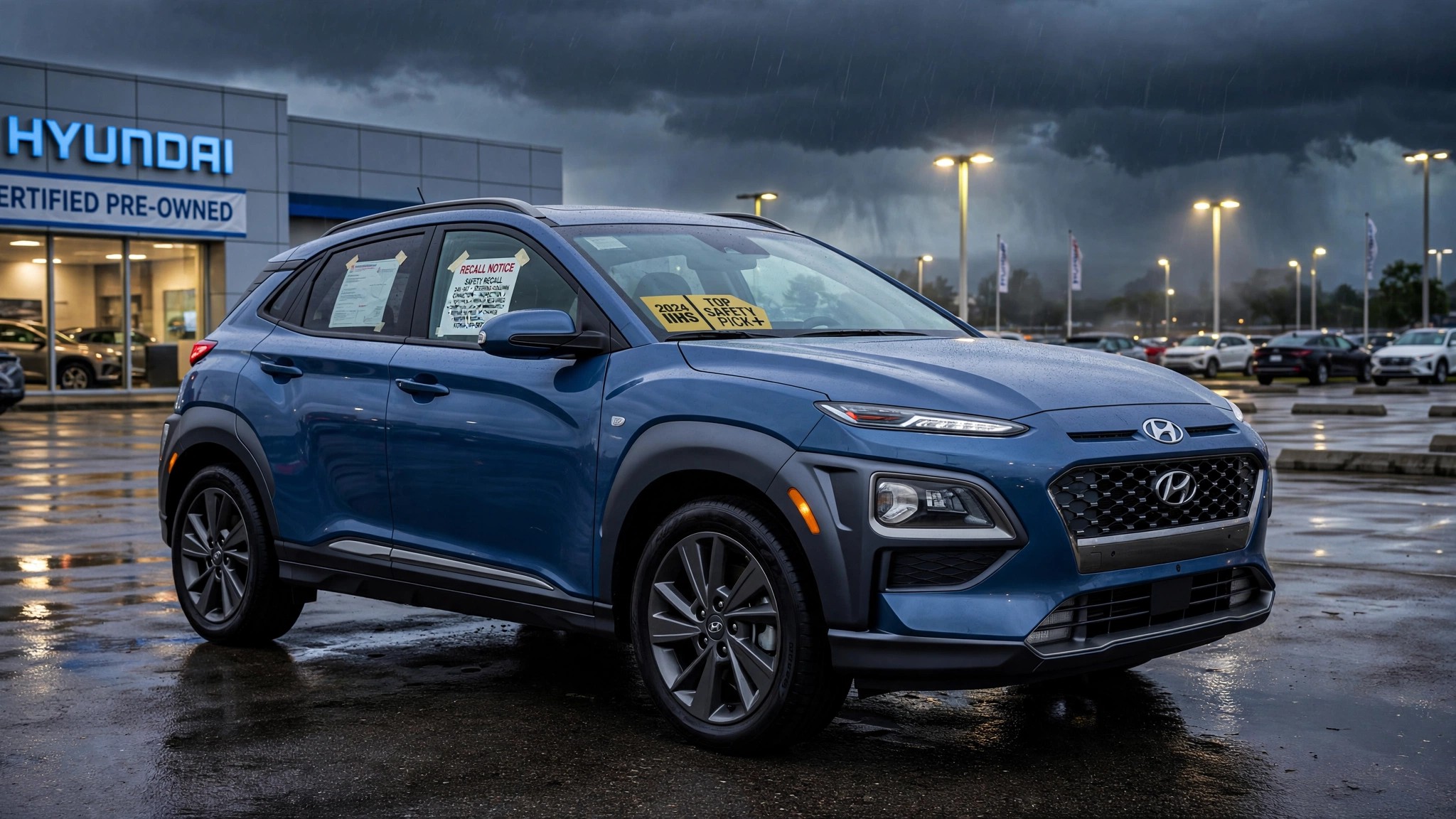
Before you congratulate yourself for buying the budget-friendly crossover with the gold-star safety rating, you might want to check the mail. The 2026 Hyundai Kona earned IIHS Top Safety Pick+ in March, making it the cheapest vehicle in America to carry the institute's highest honor at $25,500 MSRP. Seven months later, it has been recalled three separate times. The latest one tells owners not to let anyone sit in one of the five seats.
The timeline reads like a stress test for the phrase "award-winning." In January, Hyundai recalled the Kona (and several other models) for an instrument panel display that could go dark mid-drive, violating FMVSS 101.[1] In February, 4,555 Konas were pulled for steering knuckles that could crack and break due to mold contamination at supplier Myunghwa, potentially causing total loss of steering control.[2] And now, in July, 47,749 units are recalled because the rear center seatbelt buckle may not restrain an occupant in a crash. Root cause: a supplier's stamping die wore out from overuse and nobody caught it.[3]
Hyundai's interim advice to owners? Don't put anyone in that seat, and notification letters won't arrive until September 11 — remedy comes "sometime after that."
Look at what those three recalls cover: steering, visibility, and restraint. That is not a single bad batch but three independent failure modes across three different suppliers, hitting three of the most fundamental safety systems a vehicle has. IIHS tested a Kona in a controlled moderate-overlap frontal crash and pronounced it excellent. These recalls describe what happens in the months after that test, when 47,749 vehicles scatter across American roads and the stamping die nobody maintained starts producing buckles that don't hold.
None of this appears in the FARS data yet. The Kona's fatality rate across 2014-2023 is 0.12 deaths per 100 million vehicle miles traveled, built on 73 fatalities and a fleet of roughly 481,000.[4] That rate places it in the top tier of safety alongside the Honda HR-V (0.13) and Subaru Crosstrek (0.08), but most of the Kona's FARS window predates the 2024 redesign that earned the TSP+ award, and the recalled 2026 models haven't accumulated meaningful crash data. That rate tells you what happened to first-generation Konas — it says nothing about whether a 2026 buckle will hold in September.
Now the counterargument, stated at full strength: three recalls with zero injuries might be the system working exactly as designed. Hyundai identified the steering defect before a single crash, caught the seatbelt buckle issue through quality control, and even addressed the display recall via OTA update. A manufacturer that recalls proactively is objectively better than one that fights NHTSA for years. And IIHS test results and recall frequency measure different things: crash tests evaluate structural design while recalls flag manufacturing execution, and both matter because they're complementary.
That's fair. But consider what the consumer actually experiences: you see "Top Safety Pick+" and a $25,500 sticker and you think you found the sweet spot, maximum safety per dollar. You drive it off the lot feeling vindicated. In January your dashboard goes dark, and in February your steering knuckle is under investigation. In July you're told to leave a seat empty because the seatbelt might not hold your passenger. That badge meant one car, on one day, passed one test. Your car is a different object entirely.
For context: of the 16 vehicles IIHS tested in its May 2026 batch, only two earned TSP+.[5] The award is hard to get, and it means something about the design. But a design that earns a perfect crash-test score can ship with a seatbelt buckle stamped by a worn die, steering knuckles cast in a contaminated mold, and display software that fails to render your speedometer. Crash tests measure the blueprint; recalls measure the factory.
Sources & References
- NHTSA Recall #293, January 25, 2026. Instrument panel display failure on 2025-2026 Kona and other Hyundai models. FMVSS 101 noncompliance. nhtsa.gov/recalls
- NHTSA Recall #295, February 4, 2026. 4,555 units, 2026 Kona. Steering knuckle casting defect from mold contamination at supplier Myunghwa. nhtsa.gov/recalls
- NHTSA Recall #306, July 2026. 47,749 units, 2025-2026 Kona/Kona Electric. Rear center seatbelt buckle manufactured outside specification due to supplier die wear. nhtsa.gov/recalls
- NHTSA, Fatality Analysis Reporting System (FARS), 2014–2023. Hyundai Kona: 73 deaths, 136 fatal crashes, est. 481,250 fleet. nhtsa.gov
- IIHS, “Two additional models earn awards in latest IIHS ratings,” May 14, 2026. Only Palisade and Prius earned TSP+ in the May batch. iihs.org
What to Do
If you own a 2026 Kona: check your VIN at nhtsa.gov/recalls immediately — you may have open campaigns on all three recalls. Do not seat anyone in the rear center position until the buckle is inspected. If you're shopping for a subcompact crossover, the Kona's crash-test performance is real, and so are its three recalls. Check the recall history of any vehicle you're considering alongside its IIHS rating, because the design passed the test but whether your unit was built correctly is a different question entirely.
Limitations
FARS data covers 2014-2023 and includes both first-generation (2018-2023) and second-generation (2024+) Konas without distinguishing between them. The 73 recorded fatalities are weighted toward earlier, lower-volume years. The 2026 model that earned TSP+ has not accumulated meaningful FARS crash data. The display recall (#293) affected many Hyundai models beyond the Kona, so attributing it solely to Kona quality is imprecise. Zero injuries across all three recalls means the real-world impact of these defects remains unmeasured.