Kia Recalled 463,000 Tellurides for Fire Risk. The Fix Caught Fire.
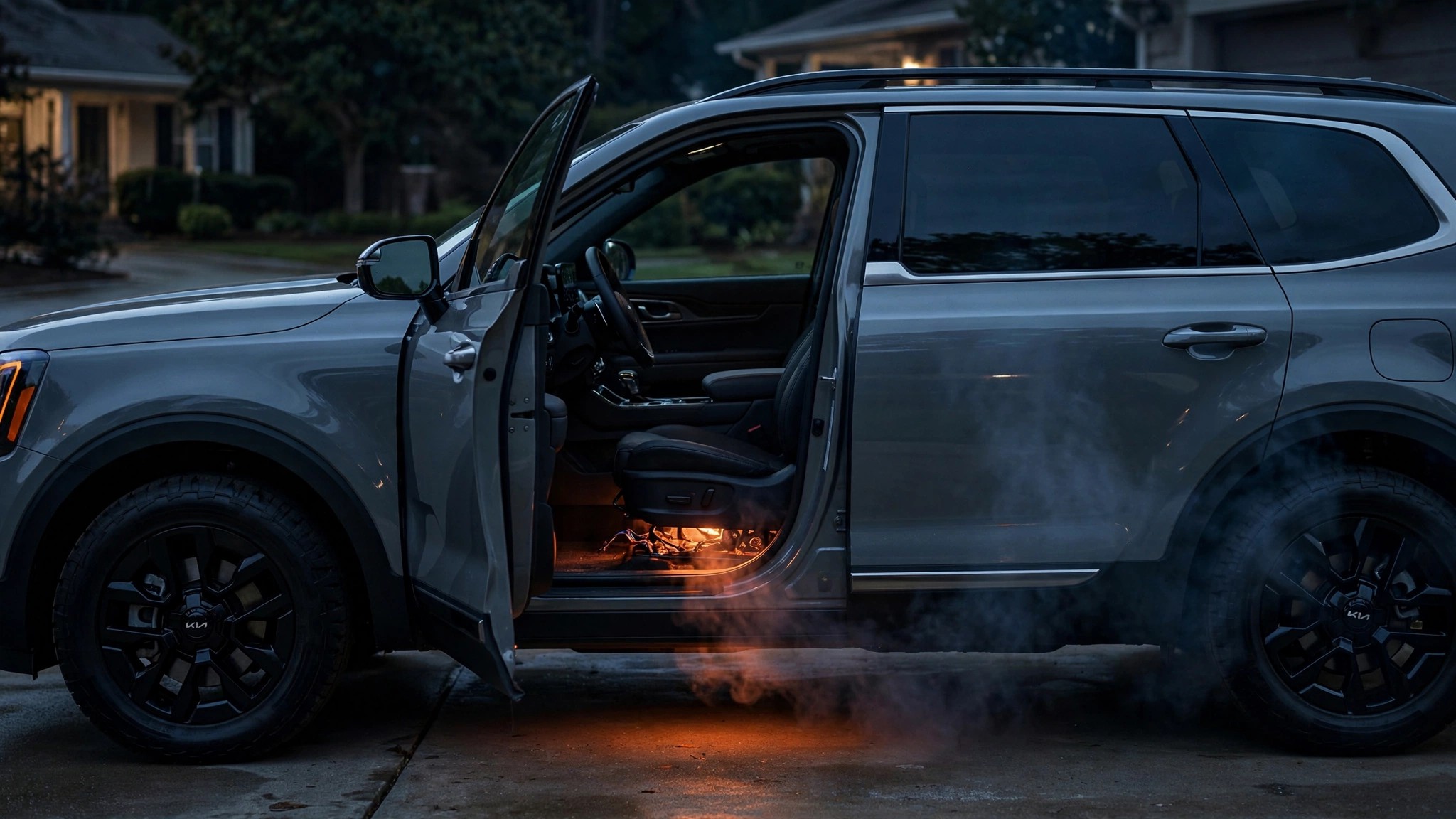
In June 2024, Kia told 462,869 Telluride owners their front seats might catch fire. Park outside, they said; bring it to a dealer, we'll install a bracket and swap out the knobs, problem solved.
Two years later, the problem is not solved. Kia filed a second recall this week for the same vehicles, the same defect, the same fire risk. Seven underseat fires, eleven melted seat motors. Some of those fires happened in Tellurides that had already received the first recall repair.
Owners brought their SUVs in, dealers performed the recall service, Kia closed the paperwork — and the seats kept catching fire.
Kia's own investigation into the re-failures turned up two problems. First: "sporadic dealer workmanship issues." Some technicians reinforced the seat switch cover but apparently forgot to replace the switch itself. Second, and worse: the physical design flaw survived the fix. Kia's filing with NHTSA acknowledges that "if occupant strikes the seat slide knob when entering vehicle, twisting forces may also result in a dislodged or misaligned seat switch." Translation: bumping the knob with your knee while climbing in can undo what the recall was supposed to prevent, and the motor runs unchecked until it overheats and the seat begins to smolder.
Kia's new remedy isn't a redesigned switch: it's an electronic fuse spliced into the seat motor circuit. If the motor runs continuously because the switch is jammed, the fuse pops before the motor can overheat. It's a circuit breaker on a problem Kia couldn't engineer away in two years and two tries.
The Compounding Exposure Problem
NHTSA's own data shows that roughly 39% of recalled vehicles never get repaired.[1] For the Telluride, that means approximately 180,000 of the original 462,869 may have never seen a dealer at all, still carrying the original defective switch, the original knobs, no bracket, and no fuse to interrupt a motor that Kia itself admits will overheat.
Of the roughly 283,000 that did get the first fix, an unknown fraction are still vulnerable because the fix didn't work. Kia's own words: fires in repaired vehicles, "sporadic dealer workmanship," design flaws the remedy didn't address.
So what's the real number of Tellurides at risk right now? Not 39%, and not 61%; somewhere between most and all of 462,869 vehicles remain exposed to the original fire defect. Remedies won't begin until August 13. VINs won't even be searchable until July 17.
A Fuse Is Not a Fix
There's a meaningful engineering distinction between fixing a defect and limiting its consequences. Kia did not redesign the seat switch or change the mechanism that allows the knob to dislodge it when struck; they added a fuse. If the motor runs when it shouldn't, the fuse blows, and the motor stops before it generates enough heat to ignite. Vehicles built after May 30, 2024 already have a reinforced switch, but the 462,869 recalled units get the fuse.
It'll probably work: fuses are simple, reliable, well-understood. But the philosophy matters. In the first recall, Kia said: we'll make the switch harder to dislodge, and that failed. The second recall says: we accept the switch will dislodge, so we'll cut the power before it burns — a concession, not a correction.
The Broader Pattern
This isn't happening in isolation. In March, a two-year-old named Lucia Ayala suffocated when a power-folding third-row seatback trapped her in a 2026 Hyundai Palisade.[2] Hyundai recalled more than 60,000 Palisades. Cadillac discovered the same defect in 14,540 of its Vistiq EVs and issued its own recall.[3] Kia pulled 568 Telluride Hybrids for the same third-row issue. All separate from the front seat fire recall.
Different mechanisms and different brands, but the same gap: powered seat systems are failing in ways nobody tested for, and the industry response has been reactive, serial, and in Kia's case, inadequate on the first attempt.
The Strongest Case for Kia
Fairness demands noting that across all seven fires in 462,869 vehicles, there have been zero injuries and zero deaths, a rate of 0.0015%. Mechanically, the fuse is sound, and Kia discovered the remedy failure itself rather than after a crash or a federal investigation, which is better than the alternative. But "nobody burned alive yet" is a low bar for a vehicle marketed to families, and the fact that a recall remedy needed its own recall raises questions about whether the initial investigation was thorough enough.
What To Do
If you own a 2020–2024 Kia Telluride: park it outside, away from your house and other cars. Not in the garage, not next to the neighbor's Honda; this is not overcaution, and NHTSA has issued the same advisory twice.
Starting July 17, check your VIN at nhtsa.gov/recalls. Notification letters will be mailed August 13. When the fix is available, get it done. Yes, even if you already got the first one done, especially if you already got the first one done.
And check your VIN even if you've "completed" the original recall. A completed recall on a Kia Telluride currently means you received a repair that Kia itself says didn't work.
Sources & References
- NHTSA, recall completion rate data via Annual Recall Reports. Approximately 39% of recalled vehicles remain unrepaired. nhtsa.gov/recalls
- NHTSA Recall 26V173000, 2026 Hyundai Palisade power-folding third-row seatback defect. Lucia Ayala, age 2, suffocated March 7, 2026, Akron, Ohio. nhtsa.gov/recalls
- NHTSA Recall, 2026–2027 Cadillac Vistiq third-row powered seatback defect, 14,540 vehicles. nhtsa.gov/recalls
- NHTSA Recall 24V407000, 2020–2024 Kia Telluride front power seat motor overheating (first recall, June 2024). nhtsa.gov/recalls
- Fox Business, “Kia issues new recall of 460,000 vehicles after previous fix to fire risk failed,” July 10, 2026. foxbusiness.com
- CarBuzz, “Kia Has Another Possible Fire Risk With Nearly Half A Million SUVs,” July 9, 2026. carbuzz.com
Source: NHTSA recall filings 24V407000 (June 2024) and second recall (July 2026). The 39% non-completion figure is a national average across all makes and recalls; actual completion rates for the Telluride may differ. Incident counts (7 fires, 11 meltings) are self-reported by Kia to NHTSA and may undercount unreported events. The Crash Report has no affiliation with Kia, Hyundai, or GM. See methodology for caveats.